NOAA Ocean Service describes hydrothermal vents as places where seawater enters cracks in the ocean crust, heats underground and rises back to the seafloor. The process can create hot, mineral-rich plumes in a world without sunlight. Around some vents, microbes make food from chemical energy and support dense communities of animals. That discovery changed how scientists think about where life can thrive.
These vents occur where Earth’s ocean crust is active, especially along underwater mountain chains where tectonic plates pull apart. They also form near some volcanic arcs and seamounts. The dramatic chimneys have made hydrothermal vents a lasting symbol of the deep sea. Their story begins below the seafloor, inside a moving system of water, heat and rock. The vents also reveal processes that steadily shape ocean chemistry far from the coast.
How seawater becomes a vent plume
Seawater can slip downward through fractures in ocean crust. As it travels deeper, heat from nearby magma or hot rock warms it. The water reacts with the surrounding rock and collects dissolved chemicals. Buoyancy then drives the altered fluid upward through other openings in the seafloor. Along the way, the fluid loses some seawater ingredients and gains material from rock.
At depth, enormous pressure keeps this water from behaving like water in a kitchen pot. Some fluids can reach extremely high temperatures before they emerge. When hot fluid meets the cold ocean, its dissolved materials can quickly form solid particles. NOAA Ocean Exploration’s overview of vents and volcanoes traces this circulation to seawater moving through fissures near spreading centers and subduction zones.
The word hydrothermal joins water and heat. The system carries heat out of the crust and shifts chemicals between rock and seawater. Each vent field has its own mix of temperature, acidity, gases and minerals. Those differences help determine which organisms settle nearby.
Why black smokers build chimneys
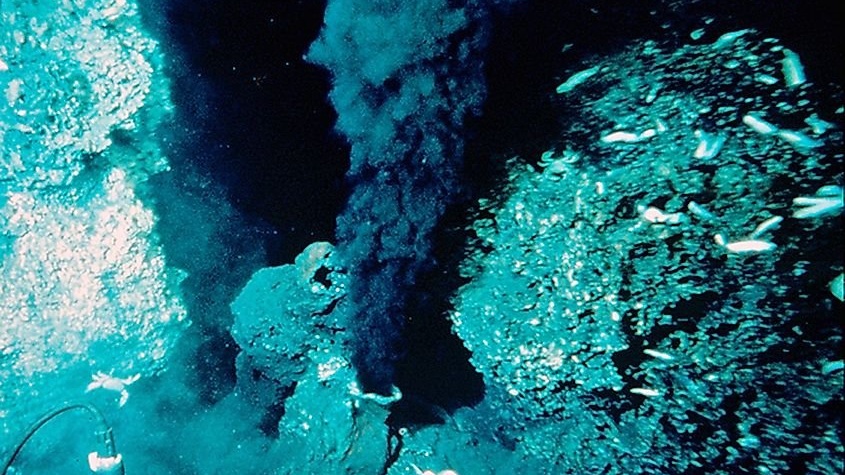
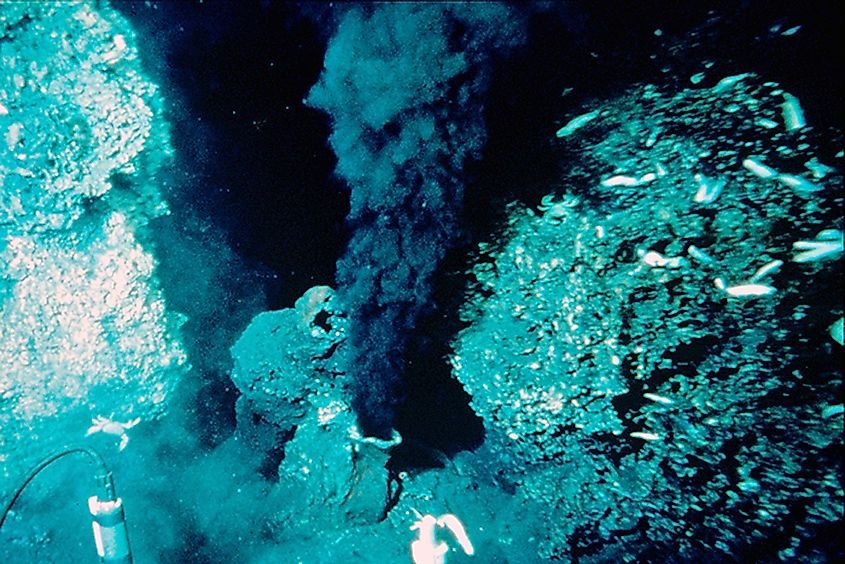
Black smokers are the most familiar kind of hydrothermal vent. Their dark clouds consist of tiny mineral particles rich in sulfides. Iron sulfides and other compounds can precipitate as the hot fluid cools in seawater. Over time, those deposits may stack into spires and chimney-like structures around the outlet. The minerals leave each structure with a record of fluid that once passed through it.
Other vents release cooler fluid and can form pale deposits. They are often called white smokers because minerals such as barium, calcium and silica can give the plume or chimney a lighter look. The distinction offers a useful visual shortcut, while real vent fields include a wider range of flow styles. Focused outlets, diffuse seepage, fresh lava and inactive chimneys can all exist close together.
That variety matters because a chimney is temporary geology. A small shift in underground plumbing can change the amount of fluid reaching the seafloor. Mineral growth can block an opening. Volcanic activity can create new cracks. The habitats around vents must keep pace with a landscape that can change far faster than the broad deep-ocean plain around it.
Food webs fueled by chemistry
Sunlight never reaches most deep hydrothermal vents. The food web begins with chemosynthesis, a process in which microbes use energy from chemical reactions to build organic material. In many vent settings, sulfur compounds in the fluid are central to that work. NOAA’s Pacific Marine Environmental Laboratory explains how chemosynthesis supplies an energy pathway for life in this dark environment.
Bacteria and archaea can live as free cells, form mats, or live in close partnerships with animals. Some giant tube worms, clams and mussels house microbes in their bodies. The animals provide a protected place and access to chemicals. The microbes turn chemical energy into food. Shrimp, crabs, snails, fish and octopuses may feed within this web or on its edges. That partnership works where the right blend of vent fluid and seawater meets.
Vent animals face a sharp chemical boundary. Water that leaves an outlet may be hot and rich in compounds that harm many organisms. Just a short distance away, deep seawater is cold and oxygenated. Species often occupy narrow zones where the mixture suits them. NOAA Ocean Exploration notes that vent ecosystems are driven largely by chemosynthesis, even though the organisms and fluids differ from those at cold seeps.
Discovery changed deep-sea science
Scientists first found hydrothermal vents near the Galapagos Islands in 1977 while exploring an ocean spreading ridge. The sight of large animal communities around the vents was startling because the deep ocean there receives no sunlight. A U.S. Geological Survey record for the Galapagos Rift paper describes thermal springs, chemical exchange with seawater and animal communities associated with the site.
Two years later, researchers using the submersible Alvin observed high-temperature black smokers on the East Pacific Rise. Together, the expeditions showed that a rich ecosystem could be built on chemical energy. The finding also gave researchers a new setting for studying life in extreme conditions, from high pressure and heat to rapidly changing chemistry. Scientists could finally see the chemistry and biology operating together on the seafloor.
That history still shapes exploration. Finding vents is difficult because they may lie thousands of meters below the surface. Scientists look for clues in water chemistry, temperature and particles in the water column. Detailed maps and remotely operated vehicles can then help locate the source and document its geology and wildlife.
Vents face a growing mining question
Hydrothermal vent deposits can contain metals that interest mining companies. The same mineral-rich processes that form black smoker chimneys can leave deposits on the seafloor. Any effort to disturb these places raises difficult questions because vent communities are specialized, patchy and linked to a particular flow of fluid. A decision made at the surface can affect organisms adapted to conditions at one small vent.
Some animals can spread to new sites as larvae in the water, but that does not guarantee a damaged habitat will recover quickly. A vent can stop flowing, restart elsewhere, or vanish after geological change. Researchers need to understand the connections among vent fields before judging how a disruption at one site could affect a larger region.
Deep-sea mining is therefore an ecological issue as well as a resource question. Careful surveys can identify active vents, inactive structures, nearby communities and the currents that may move sediment or dissolved material. The strongest choices will depend on sound evidence from each site. Hydrothermal vents remain natural laboratories where geology, chemistry and living systems meet in a remarkably small area.