NOAA’s National Ocean Service explains in its tides overview how gravity turns entire oceans into slow-moving waves. This regular rise and fall shapes coastal ecosystems, changes water depths and controls currents through harbors and narrow channels. Accurate tide predictions help ships navigate safely and allow coastal communities to prepare for unusually high water.
The familiar explanation begins with the Moon pulling on Earth’s oceans. The complete mechanism involves differences in gravitational strength across the planet. Earth and the Moon also move together through space, while the Sun adds another gravitational influence. Continents and seafloor topography then reshape the resulting motion into the complex tidal patterns observed along real coastlines.
Seen from a beach, the process can appear local. Water climbs the shore, pauses and then retreats. Yet each coastal tide belongs to a planetary system driven by celestial motion and modified by the shape of every ocean basin.
Gravity sets the oceans in motion
“Gravity is one major force that creates tides,” according to the NOAA National Ocean Service. Every object with mass exerts a gravitational pull. The Moon pulls on Earth, Earth pulls on the Moon and the Sun pulls on both.
Tides arise because the Moon’s gravitational influence varies across Earth. The side facing the Moon lies closer to it and feels a slightly stronger pull. Earth’s center feels a little less, while the far side experiences an even weaker pull. This variation is called a tidal force.
The distinction matters because gravity acting equally on every part of Earth would accelerate the planet as a whole. Tides emerge from differential gravity, which stretches Earth along the line connecting its center with the Moon. The effect acts on rock as well as water. Solid ground rises and falls slightly under tidal forces, although moving seawater makes the phenomenon far easier to see.
Distance plays a decisive role. The Sun is vastly more massive than the Moon, yet it is also much farther away. Tidal strength depends strongly on how quickly gravity changes across Earth. The nearby Moon therefore has the larger influence on ocean tides.
Why Earth develops two tidal bulges
A simplified model of Earth’s oceans produces two tidal bulges. One forms on the side facing the Moon. The other develops on the opposite side. These bulges represent regions where the ocean surface is displaced relative to Earth’s center.
The near-side bulge is the easier one to picture. The Moon pulls the nearby ocean more strongly than it pulls Earth’s center. Water shifts toward the Moon, raising the ocean surface along that side of the planet.
The far-side bulge comes from the same gravitational gradient. Earth’s center is pulled toward the Moon more strongly than the ocean on the far side. Relative to the planet beneath it, that distant water is left outward. In a reference frame moving with the Earth-Moon system, this behavior is often described through inertia and the motion of both bodies around their shared center of mass.
Low-tide regions appear between the two bulges in the idealized model. Water is redistributed toward the areas aligned with the Moon, lowering the sea surface in regions roughly a quarter-turn away. The total amount of ocean water remains essentially the same as its distribution changes across the globe.
How rotation carries coastlines through the tides
Earth rotates beneath the broad tidal pattern. A coastline moves into a region of higher water and later passes into a region of lower water. This geometry helps explain why many locations experience two high tides and two low tides during each lunar day.
A lunar day lasts about 24 hours and 50 minutes. During each Earth day, the Moon advances along its orbit. Earth must rotate a little farther for the same location to face the Moon again. As a result, corresponding tides often arrive roughly 50 minutes later from one day to the next.
Real oceans give this basic rhythm a far more intricate form. Continents interrupt the movement of tidal waves. Seafloor ridges, shallow shelves, islands and narrow passages alter their speed and direction. Water also takes time to respond, so local high tide rarely occurs at the moment the Moon passes directly overhead.
Some coasts experience two similar high tides each lunar day, a pattern called semidiurnal. Other places have one high and one low tide, known as a diurnal pattern. Mixed tides produce two daily highs and lows of unequal height. Each pattern reflects how a particular ocean basin responds to repeated gravitational forcing.
When the Sun strengthens the Moon’s pull
The Sun contributes its own tidal force. NOAA summarizes the relationship clearly: “The sun’s tide-generating force is about half that of the moon.” Its influence can reinforce part of the lunar tide or reduce the overall tidal range, depending on the positions of the Sun and Moon.
During a new moon, the Moon lies approximately between Earth and the Sun. Their tide-generating effects act along nearly the same line. During a full moon, Earth lies between the Sun and Moon, which again places all three bodies along a similar axis.
These alignments create spring tides. High tides tend to rise higher, while low tides tend to fall lower. The word “spring” refers to the water springing upward and producing a larger range. Spring tides occur throughout the year near every new and full moon.
The Moon’s elliptical orbit adds further variation. When the Moon approaches perigee, its closest point to Earth, the lunar tidal force becomes stronger. A new or full moon near perigee can produce especially large astronomical tides. Local winds and atmospheric pressure can raise or lower the water beyond the predicted level.
Why spring and neap tides alternate
About a week after a new or full moon, the Sun and Moon appear roughly at right angles as viewed from Earth. This geometry occurs near the first-quarter and third-quarter lunar phases. Their tidal influences then emphasize different directions.
The resulting neap tides have a smaller difference between high and low water. High tides usually reach lower levels than they do during spring tides. Low tides also remain higher. The ocean’s daily vertical movement becomes less pronounced along many coastlines.
Spring and neap tides alternate through the lunar month. The cycle takes about two weeks from one spring tide period to the next. The exact heights vary because the distances among Earth, the Moon and the Sun keep changing.
A location’s tidal range measures the vertical difference between high and low tide. Astronomical alignment helps set that range, while local geography determines how strongly it appears. Two coastlines under the same Moon can experience dramatically different changes in water level.
How coastlines reshape the tidal cycle
Ocean basins behave like enormous containers with irregular boundaries. A tidal wave entering shallow water slows down and grows steeper. Bays can channel the moving water into a narrowing space, while broad continental shelves can amplify its vertical motion.
The natural response time of a basin also matters. Repeated tidal forcing can synchronize with the motion of water in a bay. This process, called resonance, allows each incoming cycle to reinforce motion already underway. Funnel-shaped geography can add another layer of amplification.
Narrow straits and harbor entrances often convert the changing water level into fast tidal currents. Water flowing toward shore or into an estuary produces a flood current. The returning flow creates an ebb current. Between them comes a period of weaker movement called slack water.
Weather can temporarily shift observed water levels away from astronomical predictions. Strong onshore winds push water toward the coast. Offshore winds drive surface water away. Low atmospheric pressure allows the sea surface to rise slightly, while high pressure presses it downward.
River flow adds further complexity inside estuaries. Heavy rainfall or seasonal snowmelt can strengthen the seaward current and alter the arrival of an incoming tide. These interacting forces explain why tide tables rely on long records from local monitoring stations rather than celestial positions alone.
Tidal forces heat distant ocean worlds
The same physics extends far beyond Earth. A large planet can pull unevenly on a nearby moon, stretching its surface and interior. If that moon follows an elliptical orbit, its distance from the planet changes. The strength and direction of the distortion vary throughout each orbit.
This repeated flexing generates friction inside the moon. Mechanical energy becomes heat through a process known as tidal heating. The effect can warm worlds that receive little sunlight and help maintain liquid water beneath an icy exterior.
Jupiter’s moon Europa provides one of the best-known examples. Jupiter’s gravity flexes Europa as the moon travels around its slightly eccentric orbit. Interactions with other Jovian moons help maintain that orbital shape. The resulting tidal energy contributes to conditions that can support a global ocean beneath Europa’s ice.
Saturn’s moon Enceladus also experiences strong tidal flexing. Heat generated in its interior helps power geological activity near its south pole. Water-rich material escapes through fractures and forms towering plumes, offering spacecraft a way to sample material connected with the moon’s hidden ocean.
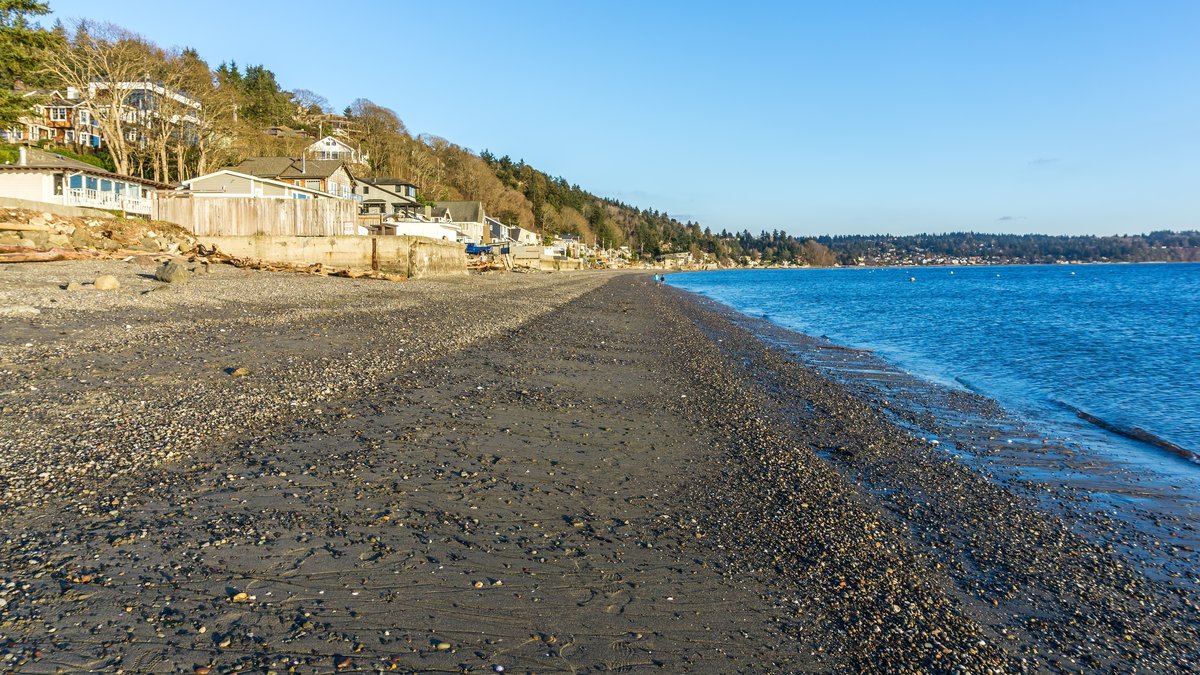
On Earth, tides are visible as water advancing and retreating along a beach. Across the outer solar system, the same gravitational principle can flex entire moons and sustain buried seas. From coastal currents to distant ocean worlds, tides reveal how gravity can move matter and generate heat across astonishing scales.