Calcareous ooze is deep-sea sediment dominated by calcium carbonate remains, chiefly from microscopic organisms such as foraminifera and coccolithophores. Siliceous ooze is dominated by silica remains from diatoms or radiolarians. Their distributions record plankton productivity, water chemistry, depth and the supply of sediment from land.
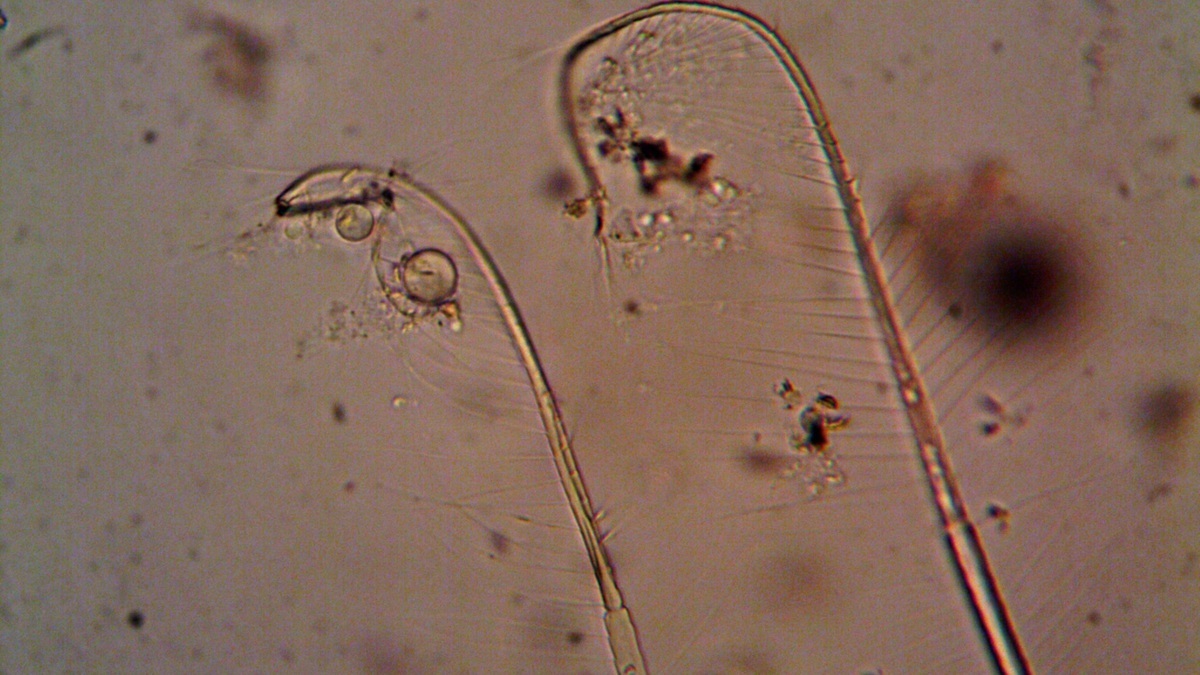
Marine geologists commonly apply the word ooze when biogenic remains make up at least about 30 percent of a sediment. The material is not sewage or a uniform paste. Under a microscope, it can contain exquisite shells, plates and skeletons mixed with clay, dust and volcanic particles.
A NOAA deep-sea sediment activity summarizes the biological sources and explains why carbonate becomes less abundant on the deepest floors. The contrast between the two oozes begins at the sunlit surface but is filtered during the long fall to the seabed.
Calcareous ooze begins with carbonate shells
Foraminifera are mostly single-celled protists that build chambered tests. Coccolithophores are phytoplankton covered by tiny carbonate plates. Pteropod shells can contribute aragonite, a carbonate mineral more soluble than the calcite common in many other remains.
When these organisms die, particles sink as individual grains or inside larger aggregates and fecal pellets. Some carbonate dissolves in the water column, while the remainder reaches the bottom. Accumulation depends on the rate of supply exceeding dissolution and dilution.
Calcareous ooze is widespread on elevated deep seafloor and across broad regions with abundant carbonate-producing plankton. It is generally scarce below the local carbonate compensation depth, where dissolution balances the downward carbonate supply.
After burial, chemical alteration continues. Silica can dissolve and reprecipitate as harder chert, while carbonate ooze compacts and cements into chalk or limestone. Pressure solution removes material at grain contacts. The resulting rock retains part of the original biological signal, though recrystallization can erase delicate microfossil detail.
Siliceous ooze comes from opal skeletons
Diatoms build intricate silica walls called frustules and thrive where light coincides with a strong nutrient supply. Radiolarians form silica skeletons and live as zooplankton, especially in productive open-ocean waters.
Biogenic silica is an amorphous form of hydrated opal rather than crystalline quartz. It starts dissolving in seawater as soon as an organism dies. Siliceous ooze therefore accumulates where production and export are high enough to overwhelm dissolution.
Large deposits occur beneath productive polar waters and major equatorial upwelling regions. Argo’s article on ocean upwelling explains how rising water supplies nutrients that can support intense plankton growth.
Carbonate microfossils are particularly useful for isotope measurements and siliceous microfossils often provide age and productivity evidence where carbonate has dissolved. A core with both groups gives overlapping lines of evidence. Where one is absent, researchers first ask whether the organisms were scarce or their remains failed to survive.
Depth favors preservation of different minerals
Cold, high-pressure deep water contains more dissolved carbon dioxide and is more corrosive to calcium carbonate. Carbonate preservation declines sharply below the lysocline and becomes minimal beneath the compensation depth. The exact levels vary among basins and through time.
Silica behaves differently. Deep water is generally undersaturated with respect to biogenic opal too, so silica also dissolves. Its preservation depends less on a single depth boundary and more on rapid delivery, burial and the productivity of source organisms overhead.
A deep site can lack both types of ooze if biological supply is low. Windblown dust, red clay or sediment carried from continents may dominate instead. Strong bottom currents can also winnow fine particles or prevent steady deposition.
Modern sediment maps are snapshots of several interacting processes. Surface productivity can change seasonally, particles may take weeks to sink and bottom sediment integrates centuries. Ooze distribution therefore records a long average rather than the plankton community observed during one cruise.
Geography controls the final sediment
Near continents, rivers and winds deliver abundant mineral grains that dilute microscopic shells. Farther offshore, the slower rain of biological material can form a larger fraction of the sediment. Distance from land therefore works alongside depth and productivity.
Ocean circulation sets nutrient availability and the chemistry of deep water. Diatom-rich sediment is especially common around Antarctica, while radiolarian ooze occurs in productive equatorial belts. Carbonate ooze covers many shallower abyssal areas outside strong silica-production zones.
Topography creates local exceptions. A seamount summit may preserve carbonate above the compensation depth even when the surrounding abyssal plain does not. Two cores only a short horizontal distance apart can therefore contain strikingly different sediment.
Biogenic sediment connects microscopic life with ocean-basin geology. Carbonate and silica follow distinct chemical pathways, so their survival cannot be inferred from productivity alone. Pelagic clay supplies the background material against which ooze is defined and its changing flux can raise or lower a biological percentage without changing plankton production.
Ooze becomes a record of past oceans
Shell chemistry and species composition preserve clues about past temperature, ice volume and water masses. Researchers identify microfossils in dated core layers and measure stable isotopes or trace elements. The result is a timeline assembled from countless individual plankton remains.
Changes between carbonate-rich and silica-rich layers can reflect shifts in productivity, depth or ocean chemistry. The USGS account of limestone and chert shows how ancient oozes can harden into rocks and later appear on land through plate tectonics.
Dissolution can remove part of the original signal. Researchers compare multiple species and chemical markers, inspect preservation under microscopes and use sedimentation rates to avoid treating every change in shell abundance as a surface-ocean event.
The names describe composition, not appearance
Both sediments can look pale, brown or gray depending on clay, iron oxides and organic matter. Classification requires microscopic identification or chemical analysis because color alone cannot reliably separate carbonate from silica.
Calcareous and siliceous remains often occur together in the same sample. The dominant biogenic component determines the name once the sediment qualifies as ooze, while mixed names describe important secondary material. Pelagic clay can remain substantial in either case.
The practical difference lies in mineral source and preservation: carbonate ooze reflects abundant calcifying plankton above a bottom where carbonate survives, while siliceous ooze marks high production and burial of opal skeletons. Both link surface ecology to deep-sea geology.
Researchers identify ooze in cores
A core arrives as a sequence of sediment, not a ready-made climate graph. Technicians describe color and texture, photograph the split surface and measure physical properties. Smear slides reveal the relative abundance of microfossils, clay and mineral grains. Carbonate content can be measured chemically, while biogenic silica requires methods that separate it from ordinary silicate minerals.
Foraminiferal tests and coccolith plates identify calcareous material. Diatom frustules and radiolarian skeletons identify siliceous material. Preservation varies even within a sample: delicate structures dissolve first, leaving resistant fragments that can bias a simple count toward hardier species.
Age models combine microfossil appearances, magnetic reversals, isotope signals and other dated markers. Accumulation rate follows from layer thickness divided by elapsed time. A high percentage of ooze does not automatically mean a high flux, because slow input of clay can make biological remains dominate a very slowly accumulating sediment.
Mass accumulation rate provides a better test of how much carbonate or silica reached the bottom. Researchers multiply sedimentation rate by dry density and component fraction. Compaction and gaps must be considered, especially where bottom currents eroded layers or organisms mixed younger particles downward.
The final interpretation joins surface ecology, dissolution and burial. A diatom-rich layer may indicate productive water, improved silica preservation or reduced dilution. Multiple chemical and biological indicators help distinguish those possibilities and keep the core record tied to a physical mechanism.
Calcareous ooze becomes scarce below the carbonate compensation depth. Both ooze types contribute to the sediment that blankets an abyssal plain.