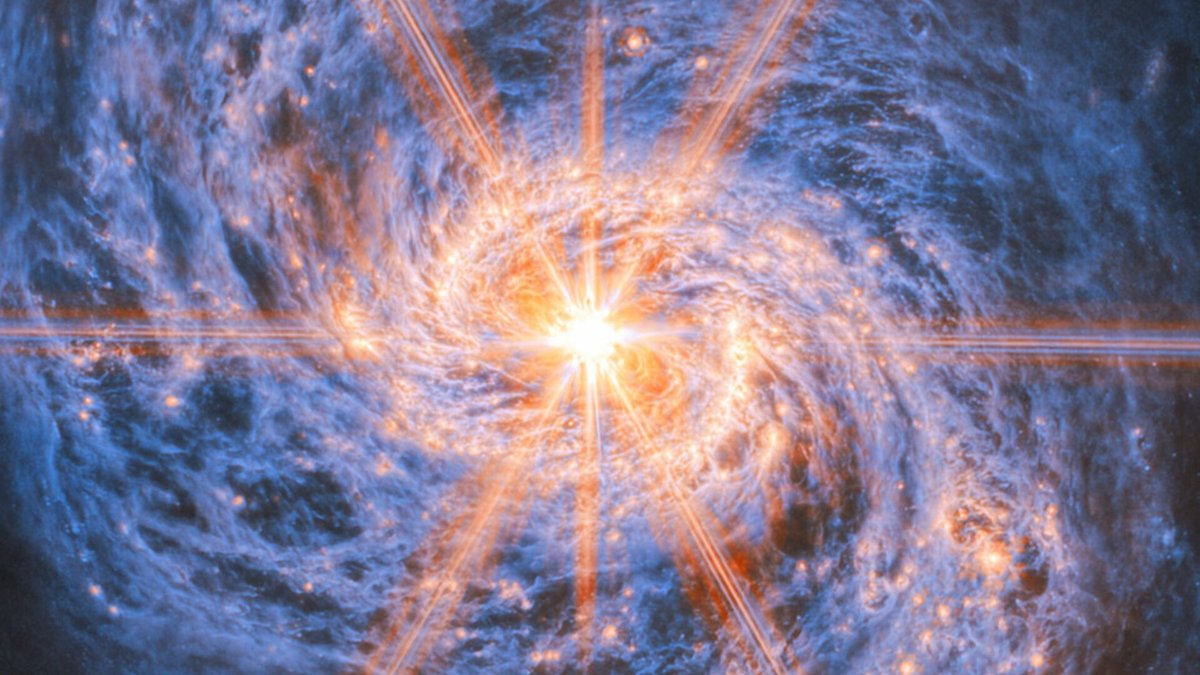
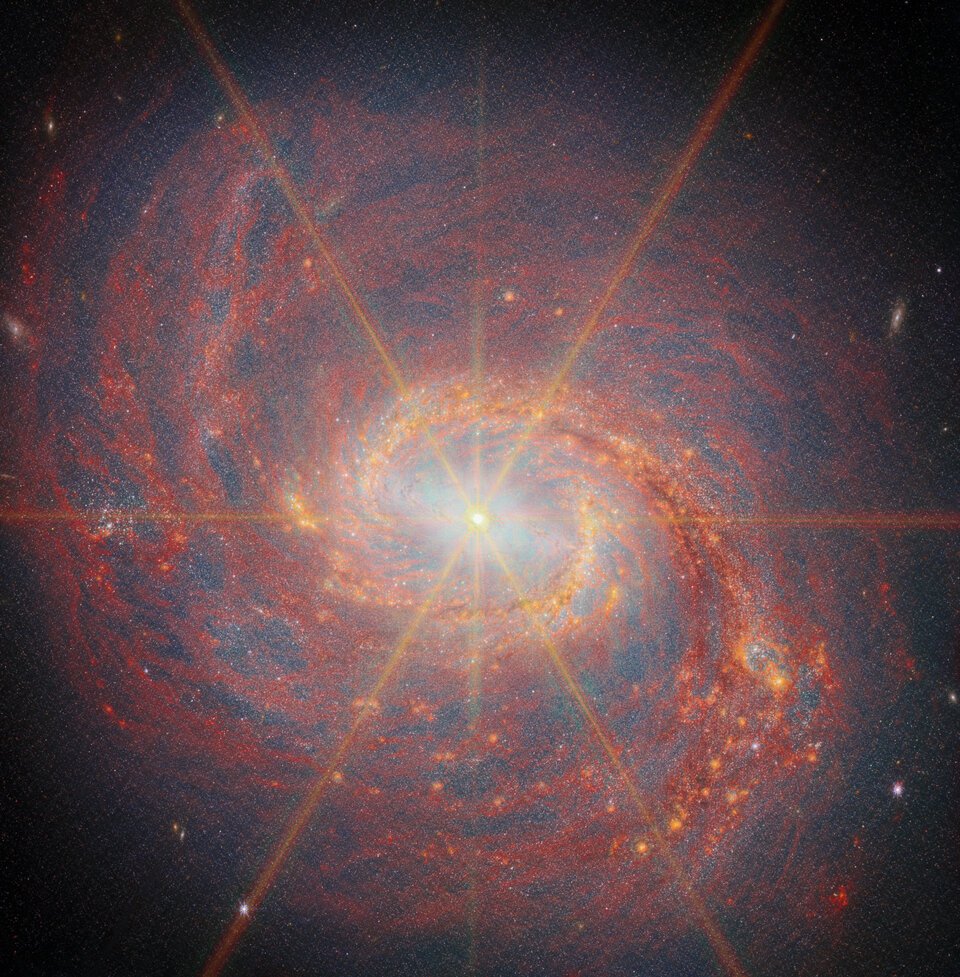
The NASA/ESA/CSA James Webb Space Telescope has released a new ESA/Webb Picture of the Month showing Messier 77, a nearby barred spiral galaxy with a dazzling center powered by a supermassive black hole. The image reveals the galaxy’s glowing dust, star-forming structures and brilliant core in infrared light.
Messier 77, also known as M77 and the Squid Galaxy, sits about 45 million light-years away in the constellation Cetus. That makes it relatively close by galactic standards. Webb can therefore resolve details in its central regions, spiral arms and dusty disk with extraordinary clarity.
The new view comes from Webb’s Mid-Infrared Instrument, or MIRI. Mid-infrared light is especially useful for tracing warm dust and gas in galaxies. In M77, that dust forms a smoky vortex around one of the most energetic galactic centers in the nearby universe.
A Galaxy Core Bright Enough To Dazzle Webb
Webb’s image centers on a piercingly bright galactic nucleus that floods the surrounding spiral structure with light. At the heart of M77 is a compact region of hot gas that outshines the rest of the galaxy. The core is so intense that it creates a dramatic visual pattern in Webb’s image.
This central engine is an active galactic nucleus, often shortened to AGN. An AGN forms when material falls toward a galaxy’s central black hole. The gas does much more than drift inward. It gathers speed, heats up and releases enormous amounts of radiation.
In visible-light views, dust can hide parts of a galaxy’s interior. Webb’s infrared instruments cut through much of that obscuring material. The result is a more complete look at where dust gathers, where stars are forming and where the central black hole dominates the scene.
M77 is especially valuable because it combines several important galaxy features in one nearby target. It has a bright AGN, active star formation, spiral arms, a central bar and extended gas structures. For astronomers, that mix turns one galaxy into a natural laboratory.
The Black Hole Powering Messier 77
The black hole at the center of M77 has about eight million times the mass of the Sun. Its gravity pulls nearby gas into tight orbits around the galactic core. As that material crowds inward, collisions and friction heat it to extreme temperatures.
That process produces the radiation that makes the core shine so strongly. A supermassive black hole itself is invisible when viewed directly. The surrounding gas announces its presence by glowing as it is compressed and heated near the center.
M77’s AGN is compact enough to act almost like a point source for Webb. That concentrated brightness helps explain why the image has such a striking central appearance. The galaxy’s nucleus is small on cosmic scales, yet it dominates the view.
Active galactic nuclei also influence their host galaxies. Their radiation can heat nearby gas, shape the surrounding environment and change how material moves through the central regions. In M77, Webb’s view shows that powerful black hole activity shares the stage with vigorous star formation.
Dust Spirals Seen in Infrared Light
Mid-infrared light gives M77 a ghostly, sculpted look. Webb’s MIRI data show interstellar dust grains glowing at long wavelengths. In the image, this dusty material appears as blue filaments curling through the disk.
Dust in galaxies is both a product and a raw ingredient. It forms from earlier generations of stars and helps build future ones. Clouds of gas and dust can collapse into dense knots, where new stars begin to ignite.
Across M77’s disk, Webb captures cavities and filaments in the dusty gas. These shapes hint at a restless environment. Young stars, stellar winds, radiation and gravity all help carve the galaxy’s interior into bubbles and strands.
The orange bubbles in the spiral arms mark regions shaped by newly formed star clusters. These clusters heat and sculpt nearby gas. Their presence shows that M77’s spiral arms are active birthplaces rather than quiet lanes of starlight.
Webb’s infrared view matters because dust is central to the life cycle of galaxies. By tracing where dust glows, astronomers can follow how star-forming material is gathered, disturbed and recycled over time.
A Hidden Bar and a Starburst Ring
Near-infrared imaging from Webb’s Near-Infrared Camera, or NIRCam, reveals a bar spanning the central region of M77. Visible-light images can miss this structure because dust and bright central emission complicate the view. Infrared light brings the bar into clearer focus.
Bars are important in spiral galaxies because they can guide gas toward the center. As material moves inward, it can pile up and trigger star formation. In M77, that central structure is tied to one of the galaxy’s most impressive features.
The bar is enclosed by a bright starburst ring. This ring is formed by the inner ends of M77’s two spiral arms. It stretches more than 6,000 light-years across and contains intense, widespread star-forming activity.
Starburst regions form stars at unusually high rates. In Webb’s view, the ring appears packed with concentrated orange bubbles. Those bubbles trace stellar nurseries where young star clusters are shaping the gas around them.
M77’s relative closeness makes this ring a well-studied example of starburst activity. Astronomers can use it to examine how spiral structure, bars, gas flows and stellar birth interact inside an active galaxy.
Why the Orange Rays Appear
The bright orange rays stretching from M77’s center come from Webb’s optics. They are diffraction spikes, a familiar signature of the telescope’s design. Their shape is tied to Webb’s segmented hexagonal mirror and the supports that hold its secondary mirror.
Diffraction happens when light bends very slightly around edges. Webb’s mirror segments and support structures produce a distinctive pattern with six main spikes and two smaller ones. The same basic pattern appears in Webb images when a source is bright and compact enough.
Stars often show diffraction spikes because they appear as concentrated points of light from Webb’s distant viewpoint. M77’s active nucleus is compact and brilliant enough to create a similar effect. That makes the galaxy’s center look like a beacon embedded in dust.
The spikes also show just how intense the AGN is. A whole galaxy surrounds the nucleus, yet the central source still overwhelms the image enough to create optical artifacts. That visual clue helps communicate the scale of the energy pouring from the core.
For readers, the spikes are a reminder that astronomical images combine real cosmic structures with the behavior of the telescope. Webb records infrared light from space and its optical design gives the brightest compact sources a recognizable shape.
Webb’s Nearby Galaxy Survey
The data behind this image came from observing program 3707. That program surveyed massive, nearby, star-forming galaxies. Its goal was to build a rich dataset that can support many scientific investigations.
Programs like this are powerful because they create more than a single beautiful image. They give researchers consistent observations of galaxies where stars are actively forming. That allows teams to compare dust, gas, star clusters and galactic structure across different environments.
In M77, Webb reveals star clusters and reservoirs of gas with fine detail. These features are central to the cycle of star formation, stellar evolution and stellar death. Massive stars can reshape their surroundings, then return material to space when they die.
M77 also has structures beyond Webb’s focused view. Its arms connect to a faint extended ring of hydrogen gas thousands of light-years wide. Vast filaments stretch outward into intergalactic space, giving the Squid Galaxy its tentacle-like nickname.
The new image shows how one nearby galaxy can connect black hole growth, star formation, dust physics and galactic structure. Webb’s infrared instruments turn M77 into a layered portrait of cosmic activity, with a blazing core at the center and star-forming material spiraling around it.