Using the James Webb Space Telescope to probe one of the Solar System’s strangest moons, Caltech researchers have found that Neptune’s moon Nereid may be an original survivor from the planet’s early satellite system. The work, reported in Science Advances, points to a dramatic history in which Triton’s arrival reshaped Neptune’s family of moons.
The finding gives scientists a new way to read Neptune’s past. Nereid has long stood out because its orbit stretches far from Neptune and swings through space in a steep, elongated path. That strange route once made it look like a captured object from the outer Solar System. Webb’s infrared view now suggests a different origin, one tied more closely to Neptune itself.
The study combines two lines of evidence. First, Webb examined the moon’s surface chemistry. Then, computer simulations tested whether a native moon could survive the violent capture of Triton, Neptune’s largest moon. Together, the results suggest that Nereid may be the rare intact remnant of a moon system that was mostly destroyed billions of years ago.
Webb Reveals Nereid’s Icy Signature
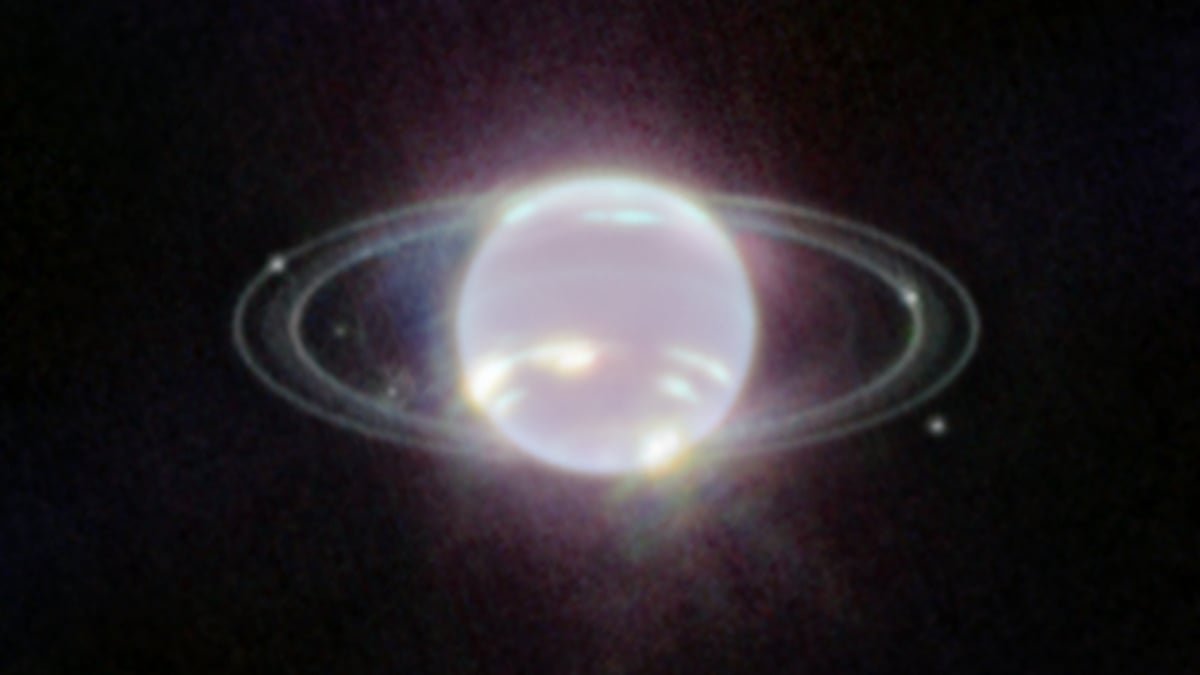
The James Webb Space Telescope gave researchers a fresh look at Nereid in infrared light. This matters because infrared observations can reveal surface materials that ordinary images cannot separate as clearly. For a distant and dim moon like Nereid, that extra sensitivity is especially valuable.
Webb’s observations showed that Nereid has a surface rich in water ice. Its spectral fingerprint resembles icy moons that formed around giant planets more than it resembles darker, dustier bodies from the Kuiper Belt. That detail is central to the new interpretation.
James Webb Space Telescope data also allowed the team to compare Nereid with objects that have different suspected histories. One important comparison is Phoebe, Saturn’s irregular moon. Phoebe is widely treated as a captured outer Solar System body and its infrared signature differs from Nereid’s water-rich surface.
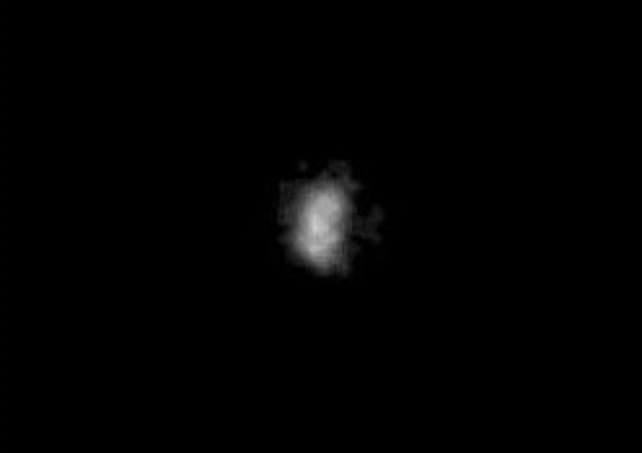
That contrast changes how scientists read Nereid’s orbit. An odd orbit can make a moon look like a captured object. A water-rich surface can preserve clues from where the moon formed. In this case, the surface clues point toward an origin within Neptune’s own early satellite system.
A Moon That Looks Native to Neptune
Nereid has been puzzling astronomers for decades. Gerard Kuiper discovered it in 1949, more than a century after Triton was found. Until Voyager 2 flew past Neptune in 1989, Nereid was the only other known moon around the planet.
Its path around Neptune is extreme. Nereid follows a highly elliptical orbit that takes roughly 360 days to complete. That kind of orbit often raises a simple question. Did the moon form with the planet, or did Neptune capture it later?
The new study favors a native origin. In that scenario, Neptune’s moon system once looked more orderly. Nereid would have formed closer to Neptune with other regular moons. Later, a massive disruption pushed it onto its current tilted and stretched orbit.
This idea depends on both chemistry and motion. Surface composition says Nereid looks more like an icy moon born near a giant planet. Orbital modeling shows that a native moon could be tossed outward and still survive. Each part supports the same basic story.
That story also explains why Nereid is so scientifically valuable. If it began as a regular moon, it may preserve material from Neptune’s early days. Its distant orbit may have helped shield it from some of the later recycling and collisions that affected moons closer to the planet.
Triton’s Capture May Have Shattered an Earlier Moon System
Triton dominates Neptune’s moons today. It contains almost all the mass in the planet’s satellite system. It also moves around Neptune in a backward direction compared with the planet’s rotation, a strong clue that it came from elsewhere.
Scientists have long suspected that Triton began as part of the Kuiper Belt. One leading idea is that Triton once belonged to a binary object, similar in broad concept to Pluto and Charon. During a close encounter with Neptune, one object escaped while Triton became trapped by the planet’s gravity.
That capture would have been violent for any moons already orbiting Neptune. A large incoming body on a wide and eccentric path would repeatedly disturb the older satellites. Some moons could have collided. Others could have been flung away from Neptune entirely.
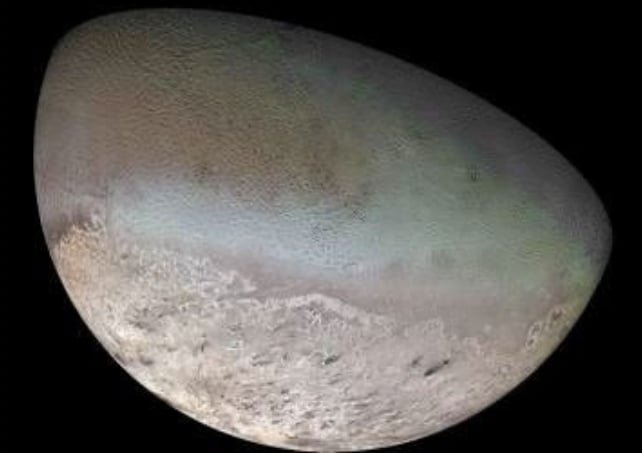
The debris from this disruption may help explain Neptune’s present system. Material from destroyed moons could have contributed to the planet’s rings and smaller inner moons. Bodies such as Proteus may represent later accumulations of material after the worst of the chaos had passed.
In this framework, Triton’s capture becomes the central event. It reshaped the architecture of the whole system. Nereid’s strange orbit becomes a fossil record of that upheaval, rather than a sign that Nereid arrived from the same distant source as Triton.
Simulations Show How Nereid Escaped
To test the idea, the researchers used computer simulations to recreate Neptune’s early moon system. They started with a more regular set of moons moving on cleaner paths around the planet. Then they introduced a captured Triton and watched how the system evolved.
The simulations used REBOUND, a dynamical modeling tool used to follow the gravitational interactions of planets, moons and smaller bodies. These models let scientists run many versions of the same cosmic event. Small changes in starting conditions can lead to very different outcomes.
Most outcomes were destructive. That result fits the basic expectation for a large captured moon entering an existing satellite system. Triton’s gravity would have stirred the older moons until many were broken apart, ejected, or driven into unstable paths.
Yet the simulations also found a path for survival. In about 20 percent of the modeled runs, one native inner moon was kicked into a stable orbit that resembled Nereid’s current path. It became distant, elongated and tilted, while still remaining bound to Neptune.
This result gives the chemistry a physical explanation. orbital simulations show how a moon born around Neptune could reach an orbit that looks irregular today. Webb’s data then show why that moon’s surface seems more native than captured.
Why Nereid Could Preserve Neptune’s Lost History
Nereid may be one of the best remaining witnesses to Neptune’s early moon system. The planet’s current moons give a scrambled view of that history because Triton’s arrival likely reset much of the system. A surviving original moon would be a rare archive.
Its distance from Neptune helps make that archive interesting. A moon that spends much of its orbit far from the planet may experience different heating, collision and resurfacing conditions than inner moons. That can help preserve old surface material for billions of years.
The study also underscores why Neptune remains such a compelling target for future exploration. Voyager 2 provided humanity’s only close spacecraft encounter with the planet in 1989. Since then, scientists have relied on telescopes and modeling to investigate its moons.
A future spacecraft could test the Nereid story more directly. Close-up imaging, detailed spectroscopy and measurements of shape and geology could reveal whether the moon’s surface matches an ancient native origin. Such observations could also show how strongly Triton’s capture altered the rest of the system.
For now, Webb has given researchers a powerful clue. water ice on Nereid, combined with simulations of a violent ancient encounter, points to a moon that survived a catastrophic reshuffling. If that picture holds, Nereid may be the last intact piece of Neptune’s first family of moons.