Twenty-one young adults who said they were under psychological stress put on a headset and entered a digital beach for 15 minutes. Eighteen completed both the session and usable before-and-after heart-rate testing and that analyzable group ended with lower average heart rates. The study paired that physiological change with interviews and the same pattern appeared in the participants’ own words: many described feeling calmer, more focused and briefly removed from the pressures that had followed them into the session.
Researchers from Curtin University reported the work in the British Journal of Occupational Therapy. Their mixed-method study followed 21 volunteers in Perth, Western Australia, ages 18 to 25 and looked at both physiology and experience instead of relying on a single stress score.
Stress relief studies often rise or fall on a practical question: can a short intervention help people who are busy, distracted and not especially interested in formal relaxation routines? The paper suggests that immersive virtual reality may have a place there, at least as a brief tool for young adults, because the session was short, the technology was easy for most participants to use and the effect looked meaningful enough for the authors to recommend further study. Just as important, the paper reads as an early uncontrolled pilot rather than a decisive trial, so any practical takeaway has to stay modest.
The test used one headset, one beach scene and one short session
The basic design was straightforward. Each participant completed a pre-session heart rate reading, spent 15 minutes in a virtual reality environment and then had heart rate measured again at the end. Eighteen participants also completed a semi-structured interview, which gave the researchers a way to compare body signals with personal descriptions of what the session felt like.
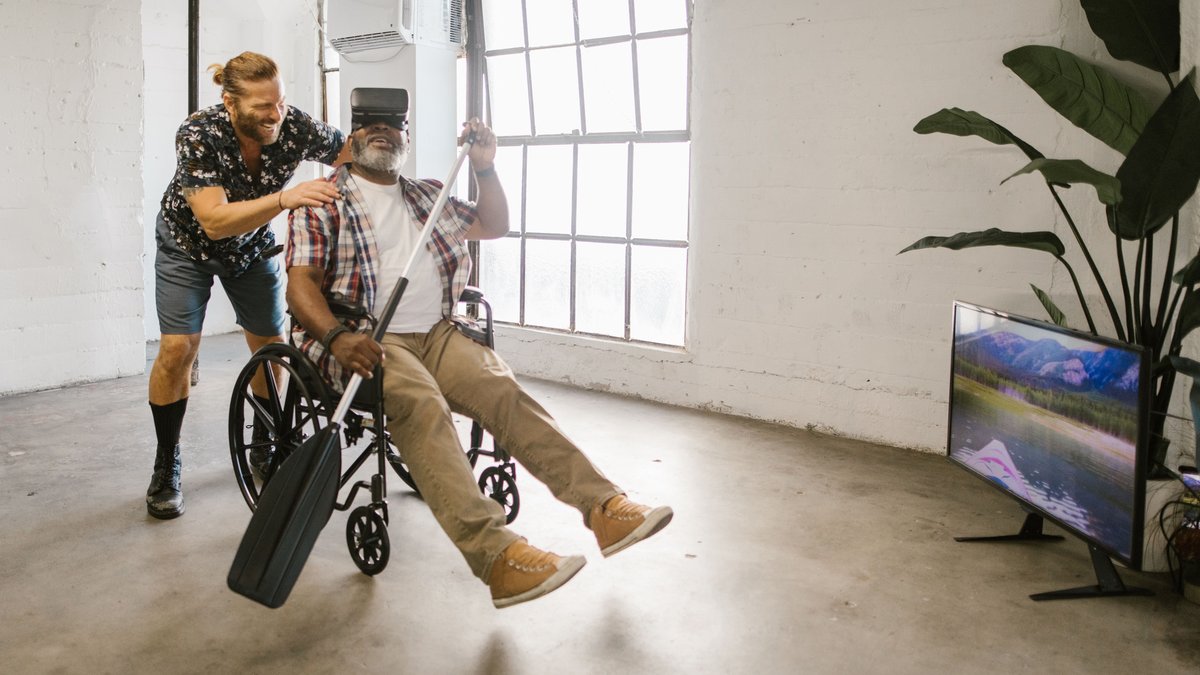
The virtual setting was a beach scene inside Nature Treks VR on an Oculus Go headset. Participants could move around, change direction and add items to the environment with a hand controller. That freedom mattered because the paper argues that personal control inside the scene helped some people settle in more quickly and feel that the environment belonged to them rather than to the software.
Most volunteers were already familiar with digital tools, which may explain why the learning curve was short. One participant stopped because of visual disturbance while wearing the goggles and two others completed the session but could not contribute usable heart-rate data because the chest strap malfunctioned. Those details do not erase the main result, yet they do show that even a simple VR session still depends on comfort and working equipment. They also narrow the quantitative claim: the strongest physiological result belongs to the 18 full completers, not to every person who was initially enrolled.
Heart rate gave the study one concrete sign of reduced stress
Physiological measures matter in stress research because a person can say they feel calmer while their body shows little change, or the reverse. In this study, the measurable result moved in the same direction as the interviews. Mean heart rate dropped from 83.6 beats per minute before the session to 72.7 beats per minute afterward, a statistically significant shift in the paired test the authors reported.
The paper does not claim that heart rate alone proves a full treatment effect and that caution is sensible. People were seated, resting and taking a break from ordinary tasks, so more than one factor could have contributed to the decline. Even so, the result gives the study something stronger than mood language alone. A fall in heart rate during a short, guided experience fits the broader interpretation that the session helped participants move into a calmer state.
The researchers used a chest-worn heart rate monitor and recorded the readings through the Polar Beat mobile application. That setup is more credible than relying on rough self-estimates, but it still leaves room for future studies to add stronger physiological tracking, repeated measurements or a comparison group. The article therefore stays on the careful side: the headset session was associated with reduced heart rate in this small sample and the design supports interest rather than sweeping clinical claims.
The interviews show why the beach felt bigger than 15 minutes
The qualitative part of the study produced four recurring themes. Participants said they felt relaxed and calm, found the experience time-efficient and easy to use, felt transported to another place and often came away surprised by how effective the session felt. Those themes help explain why a brief intervention could leave a stronger impression than its clock time would suggest.
Several volunteers said the virtual environment seemed longer than 15 minutes, which points to one of VR’s special advantages in stress work. A headset can fill the visual field, bring in sound and reduce everyday distractions at the same time. The paper also notes that some people compared the experience to a holiday, while others said the session let them focus on one thing instead of drifting in and out of attention the way meditation sometimes does for them.
Audio and visuals were central to that effect. Participants described the scene as immersive enough to interrupt thoughts about work, study and other stressors. The environment did not cure the sources of stress and the authors do not present it as a substitute for broader care when someone needs clinical support. What they do show is a plausible short-term mechanism: a convincing digital setting can absorb attention long enough for arousal to ease and for mental focus to narrow around a calmer experience.
Ease of use may matter as much as the graphics
Stress-management tools often fail in everyday life because they ask too much at the wrong moment. A long routine, a steep learning curve or a method that feels awkward can be enough to keep people from using it consistently. The young adults in this study repeatedly described VR relaxation as fast and intuitive, which may be one reason the session scored well with them.
That point matters because the authors were not studying a group with a formal mental health diagnosis. They wanted to know whether VR could still be useful for people carrying common, self-reported stress in ordinary life. According to the interviews, many participants felt that a brief headset session could fit into a busy day and help them reset before returning to work or study, which is a practical benefit rather than an abstract one.
The comparison with meditation is also worth noting. Some participants said they found virtual reality easier to stay with because the scene held their attention. That does not make VR better for every person or every setting. It suggests that young adults who struggle to engage with quieter strategies may respond well to a more guided sensory environment, especially when the goal is a short break rather than a long reflective practice.
The promise is real, but the study is still small and early
The paper offers encouraging evidence, yet it also has clear limits. The sample was small, the participants came from one metropolitan area and the study focused on healthy young adults who reported stress rather than on a clinical population. There was no randomized control group sitting quietly without VR, so the results cannot isolate every reason the participants relaxed.
That missing comparison group matters because this was effectively a single-arm pilot with a before-and-after structure. A quiet room, a seated rest break, expectancy effects and the novelty of the headset could all plausibly move heart rate or self-report in the same direction. The authors themselves acknowledge that point and recommend a future randomized controlled design with an active comparison such as mindfulness or meditation delivered for the same amount of time.
Future work could test whether the same effect appears with larger groups, different ages and repeated sessions over time. Researchers could also compare a beach scene with other kinds of natural or urban environments, track how long the calm feeling lasts and examine whether the same approach helps performance under pressure instead of short-term stress alone. Those next steps would help determine whether psychological stress is eased mainly by immersion, by the natural setting, by the forced pause in a busy day or by some mix of all three.
For now, the study supports a modest but useful conclusion. A short virtual reality stress session gave many of these participants a feeling of being elsewhere, lowered average heart rate and seemed easy enough to imagine using again. That combination makes VR more than a novelty in this context. It looks like a practical relaxation tool worth testing with stronger methods and in broader groups.