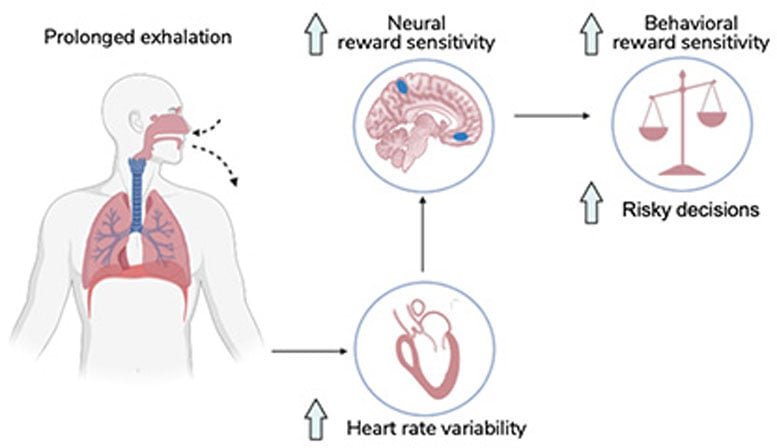
A study in Neuron involving 41 healthy volunteers found that slow breathing with a longer exhale can shift heart activity, change reward processing in the brain and make people more likely to choose riskier options.
Researchers from the German Institute of Human Nutrition Potsdam-Rehbruecke, known as DIfE and Charité – Universitätsmedizin Berlin showed that a simple breathing rhythm can influence decision behavior through measurable changes in the body. The work was led by Prof. Soyoung Q Park in collaboration with partners at Freie Universität Berlin and the German Naval Institute of Maritime Medicine.
The finding adds a surprising twist to how scientists think about choice. Decisions often feel like mental calculations. This study shows that the body’s rhythm can help shape those calculations before a person acts.
“Our decisions are rarely determined solely by external information,” said Soyoung Q Park, head of the Department of Decision Neuroscience and Nutrition at DIfE. Her team wanted to test whether deliberate breathing could create a physiological state that changes the way people weigh rewards and risks.
A longer exhale changed risk decisions
The experiment asked participants to make choices involving risk while following two breathing conditions. In one condition, they breathed at their normal pace. In the other, they followed a slower rhythm with a prolonged exhalation.
The slow-breathing pattern used a 2:8 inhale-exhale ratio. That means the exhale lasted much longer than the inhale. This kind of rhythm is known to influence the autonomic nervous system, which helps regulate heart rate and other automatic body functions.
During the task, participants evaluated options with possible gains and losses. The researchers then compared how choices changed under normal breathing and under prolonged exhalation. The key result was clear. Prolonged exhalation increased the likelihood of riskier choices.
That shift appeared to come from stronger sensitivity to potential rewards. Participants became more responsive to possible gains. Their sensitivity to possible losses remained similar across the breathing conditions.
Park described the study’s goal in practical terms. “We wanted to create a physiological shift using a slow breathing pattern to change the quality of our decisions,” she said.
Brain scans tracked the shift in real time
To follow the process inside the body and brain, the researchers used functional magnetic resonance imaging, or fMRI, while participants made decisions. The team also recorded breathing, heart function, skin conductance and pupil responses.
This combination gave the researchers a richer picture than behavior alone could provide. A riskier choice on a screen was only one part of the story. The team could also see how the breathing pattern altered physiology and how those changes lined up with activity in reward-related brain regions.
The brain scans pointed to increased activity in the ventromedial prefrontal cortex and the precuneus. These areas are involved in valuation, internal state monitoring and the way the brain integrates information during decisions.
In everyday terms, the brain appeared to place more weight on potential rewards when the body entered the slow-breathing state. The effect was measurable and it emerged while participants were actively making choices.
The study’s design also matters because it examined deliberate regulation. Participants were instructed to breathe in a specific way. That allowed the researchers to test whether a conscious change in breathing could influence decision-making through heart-brain pathways.
The heart helped tune reward sensitivity
At the center of the finding is heart rate variability, a measure of changing intervals between heartbeats. Higher variability is often linked to stronger parasympathetic activity, the branch of the autonomic nervous system associated with recovery, regulation and calmer bodily states.
Prolonged exhalation increased cardiac parasympathetic activity in the study. Participants who showed greater parasympathetic upregulation also showed stronger reward-related responses in the ventromedial prefrontal cortex and precuneus.
This means the heart did more than respond passively to breathing. The researchers found a pathway in which breathing changed cardiac dynamics and those changes were tied to the brain’s sensitivity to reward.
“The interplay between breathing and cardiac dynamics makes the brain more receptive to rewards,” said Wenhao Huang, the study’s lead author.
The result supports a body-brain view of decision-making. In this view, the brain evaluates the outside world while also reading signals from the body. Breathing can adjust those signals and the adjustment can tilt how rewards are processed.

Why breathing may become a decision tool
Breathing exercises are simple to learn, inexpensive and easy to repeat. That makes the findings especially interesting for daily self-regulation, although the study was performed in healthy volunteers under controlled research conditions.
The researchers suggest that breath-based interventions could have clinical relevance in the future. Conditions such as anxiety and depression are often linked with disrupted autonomic regulation and altered reward processing. Studies in patient groups will be needed before the approach can be translated into treatment.
“Breathing techniques have accompanied humanity for millennia across various religions and cultures,” Park said. The new work gives scientists a measurable route for studying how those techniques may affect choices through the heart and brain.
One future direction involves eating behavior. Park noted that dietary decisions are strongly influenced by reward assessment and bodily state. Targeted breath regulation could eventually help researchers explore ways to support more conscious food choices, including in people who are overweight.
For now, the study offers a tightly controlled glimpse into body-brain interaction. A longer exhale changed cardiac dynamics. Those changes aligned with reward activity in the brain. The result was a measurable shift toward bolder choices.