A study in Science has revealed that NASA’s Lucy spacecraft found a far stranger asteroid than telescopes on Earth could see. During its April 20, 2025 flyby, Lucy showed that asteroid Donaldjohanson is a wobbling, peanut-shaped body with a complicated spin and minerals that point to a brief ancient encounter with liquid water.
The asteroid sits in the main asteroid belt between Mars and Jupiter. Lucy visited it while traveling toward the Jupiter Trojan asteroids, the mission’s main scientific targets. The encounter was planned as a rehearsal for the spacecraft and mission team. It also became a rare close-up look at a small world shaped by impacts, gravity, sunlight and chemistry.
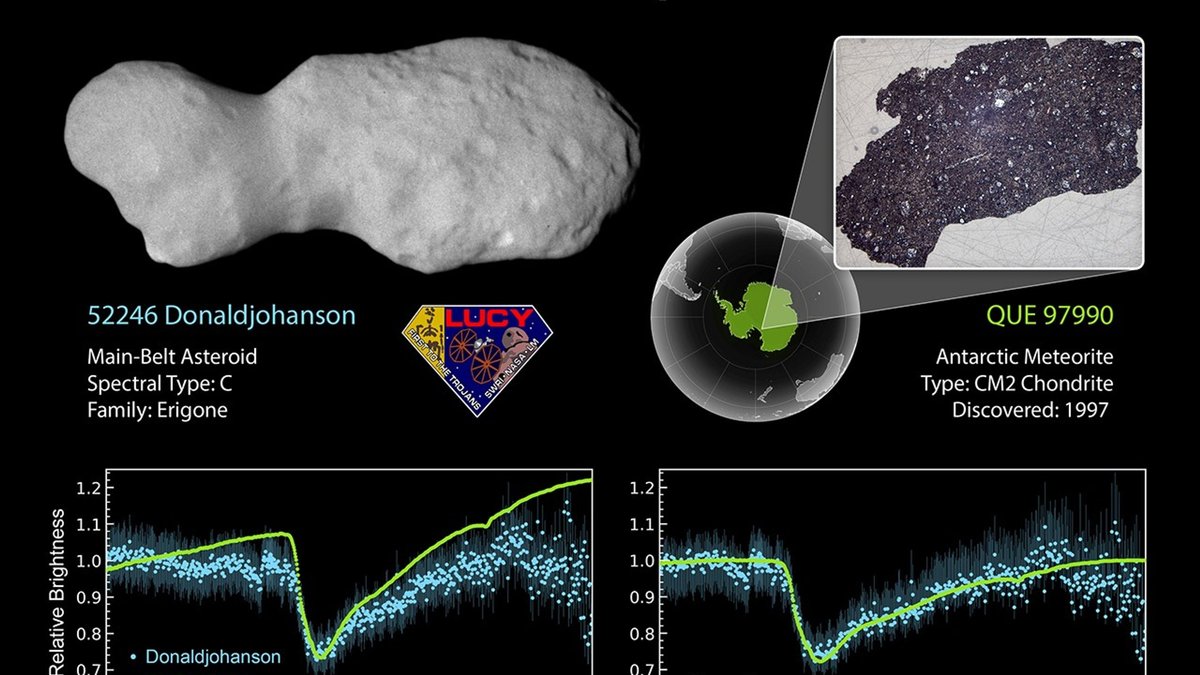
From Earth, Donaldjohanson had looked elongated. Up close, NASA’s Lucy spacecraft saw something more dramatic. The asteroid appears to have two lobes joined by a narrow neck, like a peanut drifting through space. Its surface carries craters and ridges, while its motion suggests a body that rolls and wobbles through a slow, complex dance.
Lucy’s Close Flyby of Donaldjohanson
Lucy flew past asteroid Donaldjohanson on April 20, 2025, at a distance of about 650 miles. The spacecraft was moving at roughly 30,000 miles per hour. In that brief pass, its instruments gathered close-up images and other data that scientists are now using to reconstruct the asteroid’s shape, spin, surface history and composition.
The flyby came before Lucy’s primary asteroid encounters. Its first main Trojan flyby is scheduled for August 12, 2027, when the spacecraft will visit Eurybates. Donaldjohanson gave the mission team a chance to test the spacecraft’s targeting, imaging and science operations before that higher-priority stage of the mission begins.
For planetary scientists, the rehearsal delivered its own scientific prize. Small asteroids can preserve clues about collisions and chemical alteration from deep in solar system history. Donaldjohanson is especially useful because it can be compared with other carbon-rich asteroids that spacecraft have already studied, including Bennu and Ryugu.
The mission itself is led by the Southwest Research Institute, with NASA Goddard Space Flight Center managing the mission for the agency. Lockheed Martin Space built the spacecraft. Lucy is part of NASA’s Discovery Program, which supports focused planetary science missions designed to answer specific questions about the solar system.
A Peanut Shape Born From a Collision
Donaldjohanson’s most obvious surprise is its bilobate structure. The asteroid has two lobes connected by a neck, which gives it a peanut-like shape. This form suggests that two fragments came together gently after a violent breakup event.
The asteroid likely formed about 155 million years ago, when a larger carbon- and water-rich parent body was shattered in the main asteroid belt. After that collision, debris gathered again under weak gravity. Two pieces appear to have settled together instead of merging into a simple rounded body.
That kind of gentle assembly can leave a fragile-looking world behind. On Donaldjohanson, the neck between the lobes may record how the fragments made contact. The surface also shows craters and ridges that hint at later movement of loose material across slopes.
Although 155 million years sounds ancient by human standards, it is young for an asteroid. Bennu and Ryugu are thought to have formed about 1 to 2 billion years ago. Donaldjohanson therefore gives scientists a younger example of a carbon-rich asteroid fragment with a different path through solar system history.
The comparison matters because similar-looking asteroids can carry different records. Simone Marchi, Lucy deputy principal investigator and lead author of the study at Southwest Research Institute, said that “every subtle difference is another clue to our origin story.”
The Asteroid Spins Like a Wobbly Top
Before Lucy arrived, Earth-based telescopes had detected repeating changes in Donaldjohanson’s brightness. Those light patterns suggested an elongated object rotating once every 10.5 Earth days. Lucy’s close-up data revealed a more unusual motion.
The asteroid has a tumbling rotation. According to the mission team’s analysis, Donaldjohanson rotates end-over-end once every 10.5 Earth days. It also wobbles back and forth around its long axis once every 26.5 days.
That means Donaldjohanson moves more like a lopsided top than a planet spinning cleanly around one axis. Its shape helps explain why. A peanut-shaped object has an uneven mass distribution and that can make its rotation more complicated than the spin of a nearly spherical body.
Small bodies often have complicated lives because they are so easy to disturb. Collisions can change their shape. Sunlight can gradually alter their spin. Loose gravel and dust can slide across their surfaces when rotation changes. On Donaldjohanson, Lucy saw signs that several of those processes may have acted together.
The asteroid’s craters also look worn down in places. The team interprets this as evidence that loose rocky material moved across the surface as the asteroid’s spin changed. Even weak gravity can shape a small world when the same small forces keep acting over millions of years.
Sunlight May Have Slowed Its Rotation
Donaldjohanson probably spun much faster when it first formed. The study team estimates that it may have rotated at least 10 times faster than it does today. Over the last 20 million to 60 million years, it appears to have slowed to its current rotation state.
The likely driver is the YORP effect, a subtle force caused by sunlight and heat. When sunlight warms an asteroid’s surface, that surface later radiates energy away as infrared light. The escaping radiation gives the surface a tiny push.
For a perfectly balanced object, those pushes can largely cancel out. Donaldjohanson has an irregular shape, so the tiny forces can add up to a twist. Over long periods, that twist can change how fast an asteroid spins.
This process can slow some asteroids and speed up others. Bennu and Ryugu are useful comparisons because both rotate much faster than Donaldjohanson. Bennu spins once every four hours, while Ryugu spins about once every seven hours. Scientists think both may once have rotated more slowly.
As Donaldjohanson slowed, the balance between gravity and centrifugal force changed. Material that once sat in one place could become unstable and move downslope. This offers a way to explain the asteroid’s softened craters and altered surface texture without needing a major recent collision.
Ancient Water Left a Chemical Clue
Lucy’s instruments also found evidence for iron-rich clay minerals on Donaldjohanson’s surface. Those minerals are important because clays form with the help of liquid water. The finding suggests that the material making up Donaldjohanson once interacted with water in the distant past.
The water exposure appears to have been brief. In clays, iron can be replaced by elements such as magnesium when water remains present for longer periods. Donaldjohanson’s iron-rich clays therefore suggest a short episode of alteration rather than a long-lived watery environment.
That history differs from the story told by Bennu and Ryugu. Those asteroids contain magnesium-rich clays, which point to more prolonged water exposure. In their parent bodies, liquid water may have lasted for millions of years before the bodies were broken apart.
These differences may reflect where and when the parent bodies formed. One parent asteroid could have formed in a region with more ice. Another could have warmed differently. Some bodies may have held water longer because of their size, composition, or internal heat.
Donaldjohanson’s chemistry therefore adds a new piece to the puzzle of how water-bearing materials moved through the early solar system. Carbon-rich asteroids are often studied because they may have helped deliver water and organic compounds to young planets. Donaldjohanson shows that even related asteroids can preserve distinct records of water exposure.
Why Donaldjohanson Matters for Lucy’s Trojan Mission
Lucy is on its way to the Jupiter Trojan asteroids, a population of objects that share Jupiter’s orbit around the Sun. These asteroids are thought to preserve material from the early solar system. Studying them may help scientists understand how the planets formed and migrated into their current arrangement.
Donaldjohanson was a main-belt stop on the way to that main mission. Its value comes from the detail it adds before Lucy reaches the Trojans. The asteroid gives researchers a known comparison point with a measured shape, spin, surface and composition.
Eurybates, Lucy’s first Trojan target, is especially interesting because its spectrum appears more similar to Donaldjohanson than Lucy’s other Trojan targets. Their histories may still be different. The comparison could reveal how small bodies were scattered, captured, or preserved as the giant planets shifted long ago.
Marchi said that once scientists begin learning more about the Trojans, “our understanding of solar system formation is destined to be challenged.” The statement captures why Lucy’s route matters. Each flyby adds another case study from a different region and a different history.
Donaldjohanson’s name also fits the mission’s larger theme. The asteroid is named after Donald Johanson, who discovered the fossilized human ancestor known as Lucy in Ethiopia in 1974. NASA’s Lucy mission carries that idea into space, searching for ancient remnants that can help reconstruct our origins on a planetary scale.
The next major step comes in 2027, when Lucy begins its planned Trojan encounters. Donaldjohanson has already shown that small asteroids can be geologically active in subtle ways. A wobbling peanut-shaped body in the main belt now offers a preview of the surprises waiting near Jupiter.