NASA’s Fly Foundational Robots mission is giving scientists a rare chance to test a hard-to-measure form of cosmic light in orbit. According to a NASA announcement, a prototype detector called AstroPix will fly on the agency’s upcoming robotic arm demonstration, which is expected to launch in late 2027.
The small payload could help advance future observatories that study the most energetic light in the universe. Gamma rays can come from lightning in Earth’s atmosphere, solar flares from the Sun and violent events in distant galaxies. They can also reveal some of the universe’s most extreme engines, including exploding stars and black holes.
AstroPix is designed to measure gamma rays with energies between 20,000 and 700,000 electron volts. Visible light carries only about 2 to 3 electron volts. That huge difference shows why gamma-ray astronomy requires specialized detectors, careful testing and a view from above Earth’s atmosphere.
A New Ride for AstroPix
NASA Goddard Space Flight Center is developing AstroPix as a new kind of gamma-ray sensor for future space science missions. The technology will ride aboard Fly Foundational Robots, a NASA mission built to demonstrate robotic operations in low Earth orbit.
The AstroPix demonstration is formally called the AstroPix Satellite Technology dEmonstration Payload. NASA also refers to it as A-STEP. The payload will be placed inside a movable cube on the spacecraft. During the mission, a robotic arm will pick up and reposition that module in orbit.
This gives AstroPix a useful path into space. Technology demonstrations often use balloons or sounding rockets to reach high altitudes for short tests. Orbit offers a more demanding environment and a more valuable proving ground for hardware that could later support full science missions.
“We need to thoroughly test AstroPix’s performance before we can use the sensors in future science missions,” said Dan Violette, an AstroPix team member and post-doctoral fellow at NASA Goddard in Greenbelt, Maryland.
The flight also shows how a mission designed for one purpose can carry another useful experiment. Fly Foundational Robots is focused on in-space robotic manipulation. AstroPix adds an astrophysics technology test to the same spacecraft.
The Gamma-Ray Gap Scientists Want To Close
Gamma rays sit at the high-energy end of the electromagnetic spectrum. They come from environments where matter is accelerated, compressed, heated, or disrupted on enormous scales. For astronomers, each detected gamma ray can carry clues about the physical forces behind cosmic explosions.
NASA already studies gamma rays with missions such as the Fermi Gamma-ray Space Telescope and the Neil Gehrels Swift Observatory. These missions have helped scientists track high-energy events across the sky, including gamma-ray bursts and other explosive sources.
One energy range remains especially important for future improvements. NASA notes that existing detectors are less sensitive between 500,000 and 1 million electron volts. This range is where many gamma-ray bursts shine brightest.
That same window is also expected to contain strong emission from the most massive and distant active galaxies. These galaxies are powered by black holes that feed on surrounding material. As gas and dust fall inward, their energy can emerge across the electromagnetic spectrum.
AstroPix is being developed to help bridge that sensitivity gap in future missions. NASA says stacked AstroPix detectors could improve observations of these objects. Better measurements would help scientists probe the processes that create and drive some of the universe’s most powerful outbursts.
How the Pixel Detectors Work
Gamma-ray sensors have to record light that carries far more energy than the light human eyes can see. AstroPix approaches that challenge with silicon pixel detectors. NASA compares the basic idea to the image sensors found in cellphone cameras.
Each AstroPix chip contains four silicon pixel gamma-ray detectors. Each detector incorporates 1,225 pixels. Instead of capturing an everyday photo, these pixels are designed to register gamma-ray light.
The approach could make future detectors easier to build into layered instruments. When gamma rays interact with detector material, a layered design can help scientists reconstruct where the incoming radiation came from and how much energy it carried. NASA says stacking AstroPix detectors could support future missions that target the medium-energy gamma-ray range.
The prototype’s measurement range extends from 20,000 to 700,000 electron volts. That covers a region far above visible light and reaches into a scientifically rich part of the gamma-ray spectrum. The technology is still being tested, so the orbital flight is a step toward future mission use.
NASA’s announcement also places AstroPix within a broader development path. Comparable technologies have already flown on a scientific balloon mission. The current prototype is also expected to become part of a sounding rocket payload. The Fly Foundational Robots flight would add a valuable orbital test.
A Robotic Arm Will Move the Payload in Space
The AstroPix payload will sit inside the mission’s Orbital Replacement Unit. This movable module is an 11.8-inch cube, about 30 centimeters wide. It will hold the chips and the electronics needed to provide power, collect data and transmit that data during flight.
During the mission, the robotic arm will pick up and reposition the unit. After that movement, the A-STEP payload will collect its data. That sequence links the gamma-ray sensor test to the mission’s larger goal of demonstrating robotic handling of spacecraft components in orbit.
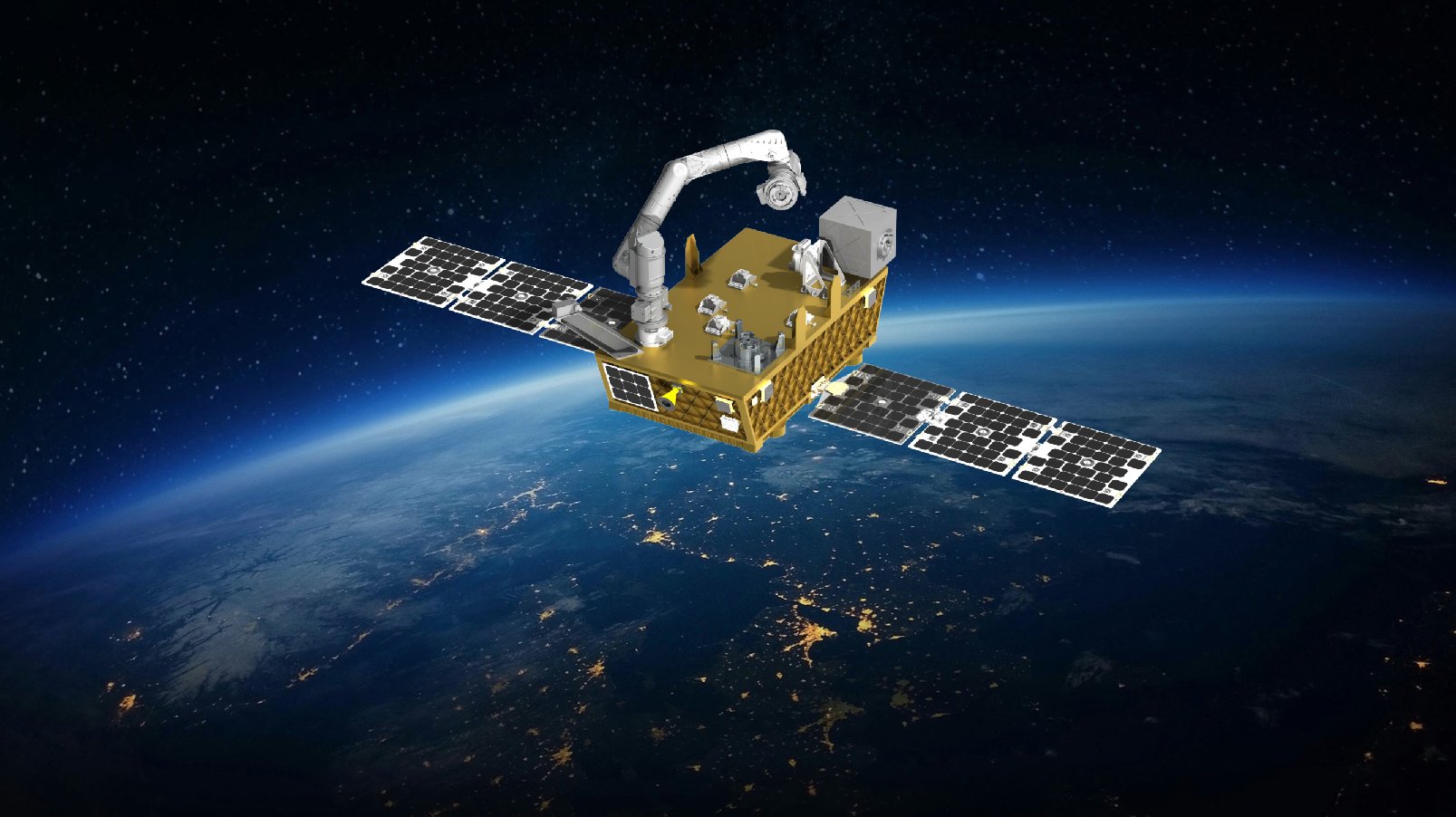
The unit was already designed with interfaces that could support a payload. As mission development moved forward, the team identified a chance to place an additional technology demonstration inside the cube. That decision gave AstroPix a practical way to fly.
“The unit already had the volume, power and data needed to support the AstroPix team’s design,” said Bo Naasz, senior technical lead for In-space Servicing, Assembly and Manufacturing in NASA’s Space Technology Mission Directorate at NASA Headquarters in Washington.
Naasz said the mission also supports a larger vision for spacecraft operations. “One of our major goals with Fly Foundational Robots is to demonstrate robotic changeout of payloads in orbit,” he said.
Why This Test Could Matter for Future Telescopes
A successful AstroPix test would give engineers and scientists a clearer picture of how the prototype performs in a real orbital environment. Space exposes hardware to radiation, temperature swings and operational constraints that ground tests can only approximate.
For astronomy, the payoff could come later. Future gamma-ray telescopes may need detectors that are sensitive, compact, power-efficient and practical to assemble in layers. AstroPix is being explored as one possible path toward those instruments.
The science target is compelling because gamma-ray bursts rank among the brightest explosions in the universe. These flashes can occur when massive stars collapse or when compact objects merge. Observing them across the right energy range helps scientists understand how energy is released so quickly.
Active galaxies add another reason to improve medium-energy gamma-ray observations. Their central black holes can shape their surroundings over vast distances. Better gamma-ray sensitivity could help researchers study how those black holes accelerate particles and influence their host galaxies.
The orbital test will still be an early technology demonstration. AstroPix will need careful evaluation before it can be used in future science missions. That measured approach is part of how space instruments mature, one test at a time.
The Partners Behind the Mission
Fly Foundational Robots is funded through NASA’s Space Technology Mission Directorate. The mission belongs to the agency’s In-space Servicing, Assembly and Manufacturing portfolio, known as ISAM. NASA Goddard manages that portfolio.
Rocket Lab Robotics will supply the robotic arm system through a NASA Small Business Innovation Research Phase III award. The arm will perform the in-orbit operations needed for the robotic servicing demonstration. Those operations include picking up and repositioning the module that carries A-STEP.
Astro Digital, based in Littleton, Colorado, will provide the spacecraft for the hosted orbital flight test. NASA’s Flight Opportunities program will support that hosted test. The program is managed at NASA’s Armstrong Flight Research Center in Edwards, California.
The development of AstroPix is supported by NASA’s Astrophysics Division in the Science Mission Directorate at NASA Headquarters. NASA says that support comes through the agency’s Astrophysics Research and Analysis Program. Funding also came through the Nancy Grace Roman Technology Fellowship.
The AstroPix team is working to deliver its hardware in September. After delivery, the hardware will be integrated into the Fly Foundational Robots payload before final integration onto the spacecraft. If the mission proceeds as planned, a small cube moved by a robotic arm could help shape the next generation of gamma-ray astronomy.