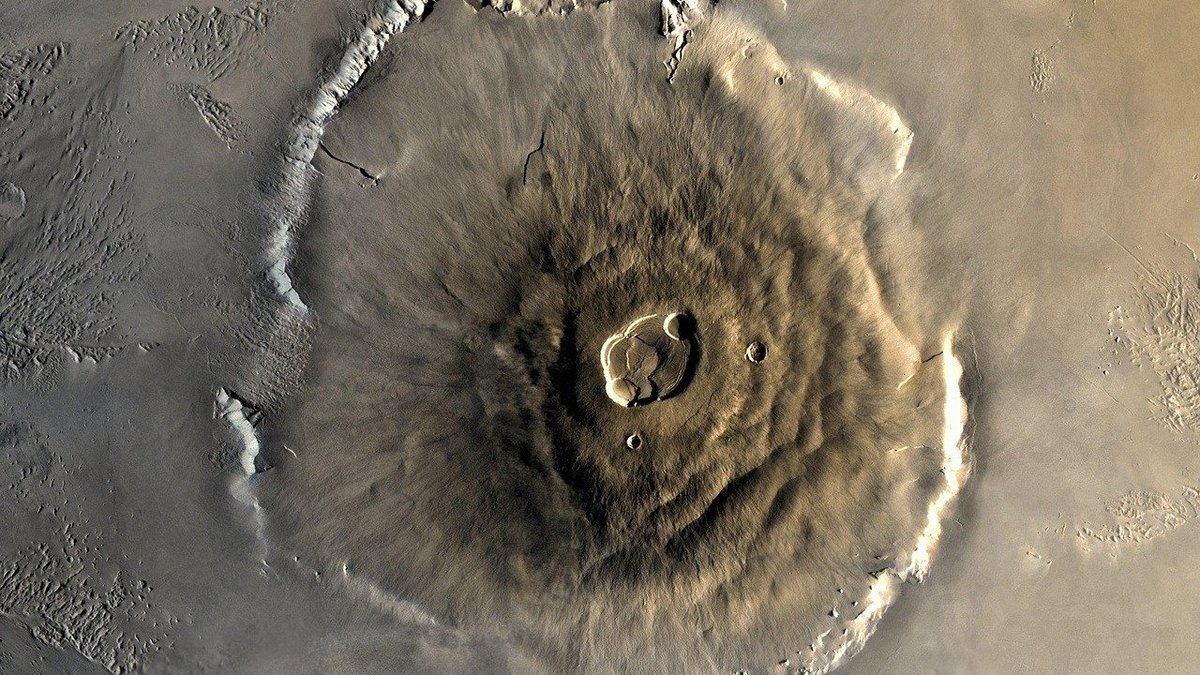
NASA Science’s Olympus Mons image record reveals one of Mars’ strangest landmarks, a volcano so enormous and so gently sloped that its scale almost disappears from the ground. NASA describes it as “the largest known volcano in the Solar System,” a Martian giant whose shape rewrites the usual picture of what a mountain should look like.
Olympus Mons rises from the Tharsis volcanic province on Mars, where ancient eruptions built some of the largest volcanoes ever observed. From orbit, its scale is unmistakable. From the surface, the experience would be much harder to read. The volcano spreads so far in every direction that its base would sit beyond the horizon.
The result is a paradox of perception. A visitor near the summit could be standing on the tallest planetary volcano known to science and still see a landscape that feels broad, muted and gently tilted. The mountain’s size becomes most obvious from orbit, where spacecraft can capture the full outline of its immense shield.
NASA’s giant volcano on Mars
NASA Science identifies Olympus Mons as a vast shield volcano, the same broad volcanic type that built Hawaii’s islands on Earth. Its Martian version grew to an extreme scale. NASA’s image description gives a height of about 27 kilometers and a base more than 600 kilometers wide.
That combination makes Olympus Mons one of the most dramatic examples of how different planets build landscapes. Earth has tall volcanoes and huge volcanic provinces. Mars produced a single volcano that sprawls across a region comparable to a large U.S. state.
The volcano’s broad outline comes from repeated eruptions of fluid lava. Over time, those flows spread outward and stacked up in layers. The shape that emerged is wide and low in profile, even though the total height is extraordinary.
Orbital images from missions such as Viking helped turn Olympus Mons into one of Mars’ most recognizable features. The view from space shows the circular summit region, the sweeping flanks and the raised margins that mark the volcano’s edge.
A mountain the size of a state
The most important number is width. NASA describes Olympus Mons as “over 600 kilometers at the base,” which is roughly 370 miles across. A feature that wide would cover much of New Mexico or Arizona if placed over the southwestern United States.
The area of the volcano’s base is often estimated at roughly 300,000 square kilometers. That places it in the range of large countries and states. At that scale, calling it a mountain can feel almost too small. It is a volcanic landscape in its own right.
Its height is just as striking. Olympus Mons stands far above the surrounding plains and towers over Earth’s most famous peaks. Mount Everest reaches about 8.8 kilometers above sea level. Olympus Mons rises more than twice that height above nearby Martian terrain.
Earth’s Mauna Loa offers a useful comparison because it is also a shield volcano. Measured from the ocean floor, Mauna Loa rises about 9 kilometers and spans about 120 kilometers across. Olympus Mons is several times wider and far taller, giving Mars the dominant volcanic monument in the solar system.
Why the slope feels flat
A number explains the odd ground-level experience. Olympus Mons has flanks that average only a few degrees in slope. Across everyday distances, that kind of grade would feel like a gradual rise rather than a climb up a dramatic peak.
The Martian horizon adds to the effect. Mars is smaller than Earth, so the horizon sits closer to an observer. On Olympus Mons, the base lies hundreds of kilometers away. The full volcanic outline would be hidden by the planet’s curve long before a person could take it in.
That matters because humans recognize mountains through edges, skylines and steep drop-offs. Olympus Mons gives few of those clues near the summit. The ground would appear to lean gently away, with no visible base to frame the view.
Seen from orbit, the same landscape becomes obvious. Spacecraft can trace the shield’s enormous footprint and show how lava flows radiate from the summit region. Surface perspective shrinks the scene. Orbital perspective restores its true scale.
The cliff around the base
The volcano becomes more dramatic near its outer margin. NASA notes that Olympus Mons is “surrounded by a well-defined scarp,” a steep boundary that rises several kilometers in places. This ringlike cliff gives the volcano a sharper edge than its gentle flanks suggest.
The scarp is one of the most striking parts of the structure. Instead of fading evenly into the surrounding plains, much of Olympus Mons ends at a raised wall. That wall can reach heights comparable to some of Earth’s largest mountain reliefs.
Scientists have studied several possible explanations for the escarpment. The volcano’s immense weight may have deformed the crust beneath it. Landslides, lava loading and interactions with the surrounding terrain may also have shaped the boundary.
For a traveler approaching from the surrounding plains, this outer cliff could be the place where Olympus Mons finally feels immense. The summit might feel broad and subtle. The volcano’s edge would present a wall of volcanic rock rising from the Martian surface.
Collapsed calderas at the summit
The summit of Olympus Mons carries another clue to its volcanic past. It is marked by a complex of nested summit calderas, broad collapse pits formed as magma moved away from chambers beneath the volcano.
Calderas form when the ground above a magma reservoir loses support and sinks. On Olympus Mons, multiple collapse events produced overlapping depressions. Together they create a summit feature roughly tens of kilometers across.
These calderas tell a story of repeated activity. Lava did flow from the volcano for long periods, then subsurface magma chambers drained or shifted. The surface responded by breaking and dropping into the space left behind.
In orbital imagery, the caldera complex gives the volcano a recognizable crown. It also helps researchers reconstruct how eruptions changed over time. Each collapse surface preserves part of the volcano’s long internal history.
How Mars let it grow
The reason Olympus Mons became so large begins with planetary architecture. Earth’s outer shell is broken into moving plates. Mars appears to have had a more fixed crust for much of its history.
On Earth, a volcanic hotspot can build an island or mountain for a time. Then plate tectonics carries the crust away from the heat source. The hotspot begins building a new volcano nearby, forming chains such as Hawaii.
On Mars, the crust could remain over a volcanic source for far longer. Lava kept arriving in roughly the same region. Flow after flow spread across the surface, slowly building one giant shield instead of a moving chain of smaller volcanoes.
Lower gravity also helped. Mars has weaker gravity than Earth, so a taller volcanic pile can stand with less internal stress. That does not make unlimited growth possible, but it gives Martian volcanoes a structural advantage.
The Tharsis region shows the result on a planetary scale. Olympus Mons sits near other enormous Martian volcanoes, evidence that Mars once released vast amounts of internal heat through volcanic activity. The planet’s surface still carries those scars.
What Olympus Mons records
Olympus Mons is more than a record-setting landform. It is a preserved archive of volcanic history on a planet that evolved differently from Earth. Its size, shape and summit collapse features all point to long-lived eruptions and a crust that stayed relatively still.
Some lava flows on and around large Martian volcanoes appear young in geological terms. That keeps researchers cautious when discussing whether Mars is fully inactive inside. The planet has cooled over time, yet its volcanic story may have lasted far longer than once assumed.
Olympus Mons also helps scientists compare worlds. Earth’s moving plates recycle crust and spread volcanism into chains. Mars preserved a giant volcanic construction in one place. The difference shows how geology changes when the same basic ingredients operate under different planetary conditions.
For readers, the most memorable lesson may be the simplest one. A larger mountain does not always look more dramatic from its summit. On Mars, the solar system’s greatest volcano could feel like a quiet rise in the ground, while its true form waits for an orbital view.