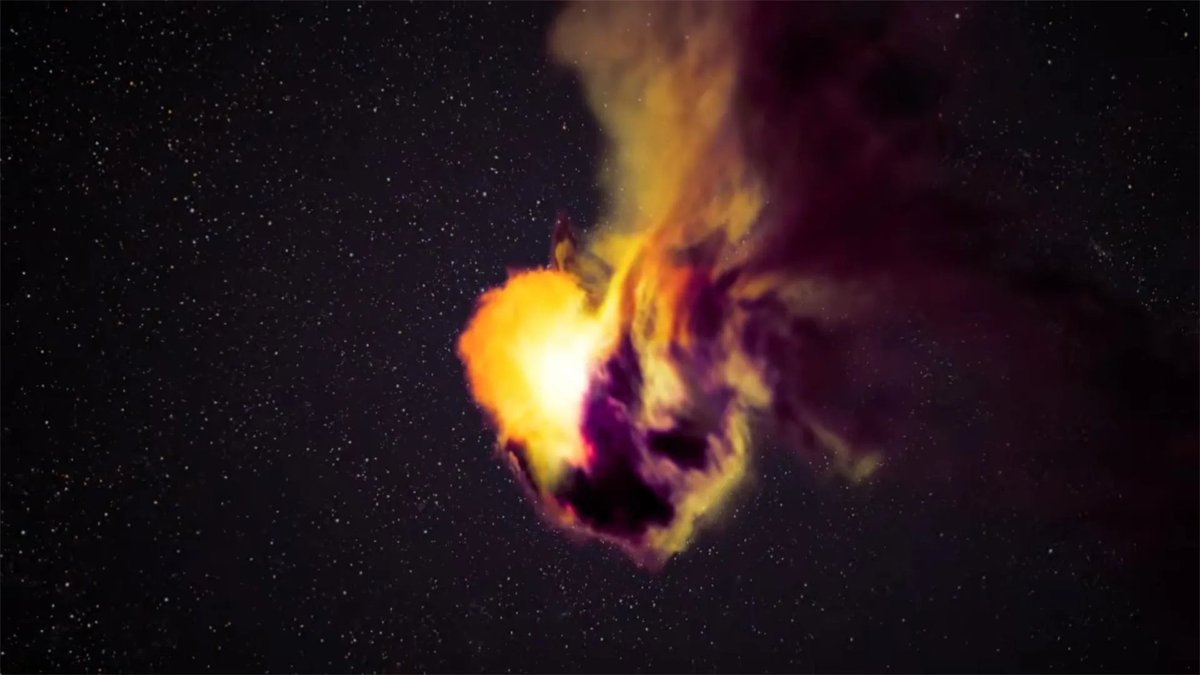
A study in Nature reports a rare stellar explosion, SN 2021yfj, that gave astronomers an unusually direct view into the inner layers of a massive dying star. The event appears to have come from a star stripped down to an oxygen, silicon and sulfur-rich region, exposing material that usually stays buried until the final collapse.
One supernova has now turned a long-standing picture of stellar death into something astronomers could observe. In SN 2021yfj, researchers led by Steve Schulze of Northwestern University found evidence for a thick shell of gas around the exploding star. Its chemistry pointed to material forged deep inside the star during one of the final stages before death.
The finding matters because massive stars are cosmic factories. They build many of the elements that later become planets, atmospheres, rocks, oceans and living bodies. When such stars explode, they scatter those ingredients into space. SN 2021yfj appears to have revealed a layer that astronomers had expected from theory, yet had rarely been able to study so directly in an actual explosion.
A star stripped to its core
SN 2021yfj belongs to an unusual class of stellar explosions known as an extremely stripped supernova. In these events, the star has lost much of its outer material before it explodes. That stripping can expose layers that were formed in the star’s interior during earlier nuclear burning stages.
Schulze described the event in stark terms. “This is the first time we have seen a star that was essentially stripped to the bone,” he said. The phrase fits the science. The exploding star appears to have shed the usual outer layers and revealed material much closer to the core.
Massive stars usually have a layered structure near the end of life. Hydrogen sits farther out, helium follows and heavier elements appear deeper inside. A star that still carries its outer layers hides its inner chemistry from view. SN 2021yfj gave astronomers a glimpse of deeper material because so much of the star had already been removed.
The Nature paper states, “Here we report the discovery of the supernova (SN) 2021yfj resulting from a star stripped to its O/Si/S-rich layer.” That shorthand refers to oxygen, silicon and sulfur. These elements point to advanced burning inside a massive star, close to the final sequence before collapse.
The strange shell around SN 2021yfj
The key clue around SN 2021yfj was a thick shell of gas. When the supernova blast raced outward, it slammed into material that the star had already expelled. That collision helped light up the shell and gave astronomers a way to study its chemical makeup.
Supernovae can act like cosmic flashbulbs. Their explosions illuminate gas that was shed before death. By studying the light from that interaction, astronomers can identify which elements are present. In this case, the signal pointed to material associated with oxygen, silicon and sulfur.
Schulze explained the bright event through a collision between shells. “One of the most recent shell ejections collided with a pre-existing shell,” he said. That collision produced light that helped reveal the nature of the material surrounding the doomed star.
The strange part is the depth of the exposed layer. In many supernovae, astronomers see evidence of hydrogen, helium, or carbon-rich material around the star. Those layers form earlier and have more time to move outward. SN 2021yfj showed material from a much deeper zone, which suggests a dramatic episode of mass loss shortly before the final explosion.
How massive stars build heavier elements
Massive stars shine because their cores fuse lighter atoms into heavier ones. The process starts with hydrogen, the lightest element. Hydrogen fusion creates helium and releases energy, which helps the star resist gravity.
As a massive star ages, its core changes. After hydrogen is depleted in the center, helium burning can produce carbon and oxygen. Later stages can create heavier elements such as neon, magnesium, silicon and sulfur. Each stage takes less time than the one before it.
The timing becomes extreme near the end. Hydrogen burning can last millions of years. Silicon burning can last only days. The star becomes a layered furnace, with each shell linked to a different chapter of nuclear fusion.
This layered structure is central to the discovery. The silicon and sulfur signature around SN 2021yfj suggests that material from one of the star’s deepest active layers had escaped into surrounding space. That gave astronomers a rare way to test their models of how massive stars assemble elements before they die.
Once a massive star builds an iron core, the usual energy balance breaks down. Fusion of iron absorbs energy instead of supplying it. Gravity then wins. The core collapses and the outer star is launched outward in a core-collapse supernova.
Why silicon and sulfur stunned astronomers
The surprise in SN 2021yfj comes from where the silicon and sulfur-rich material should have been. In standard models, those elements form deep inside the star late in life. They should have little time to travel far before the star collapses.
The observed shell suggests that the star expelled deep material shortly before the explosion. That raises a difficult question. How did material from such an inner layer get out into space fast enough to be sitting around the star when the supernova blast arrived?
A normal stellar wind can carry gas away from a star. In many massive stars, such winds help remove outer layers over long periods. SN 2021yfj seems to require a much more extreme stripping event. The star appears to have lost layer after layer until a deep oxygen, silicon and sulfur-rich zone was exposed.
This chemistry gives the event its scientific power. It provides evidence that the shells predicted by stellar evolution theory can exist in the expected sequence. It also shows that stars can sometimes lose material in ways that current models struggle to explain fully.
The result gives astronomers both a confirmation and a puzzle. The inner chemistry fits what theory predicts for massive stars near death. The removal of so much overlying material calls for a powerful physical mechanism.
A possible companion star
A leading explanation involves a companion star. Many massive stars live in pairs. When two stars orbit close together, gravity can pull gas from one star onto the other. That interaction can strip away layers more efficiently than a wind from a lone star.
If SN 2021yfj had a companion, the partner’s gravity may have helped peel away the outer material. In an extreme case, it could have drawn out gas down to the deep oxygen, silicon and sulfur-rich region. That scenario would help explain why the surrounding shell contained such unexpected chemistry.
Binary interactions are already important in supernova research. They can change how massive stars evolve, how much mass they lose and what kind of compact object remains after collapse. SN 2021yfj adds a vivid example to that broader problem.
The companion-star idea remains a plausible scenario rather than a settled answer. The observations point to deep stripping, while the exact process that removed the layers is still under investigation. Future supernova discoveries with similar chemistry could help reveal whether SN 2021yfj was a rare outlier or part of a wider class.
What the explosion reveals about the universe
The importance of SN 2021yfj stretches beyond one dying star. Supernovae help set the chemical history of galaxies. They release oxygen, neon, magnesium, sulfur and other elements into space, where the material can later become part of new stars and planets.
Elements are made in different cosmic settings. Lower-mass stars help make carbon and nitrogen. Neutron star mergers can produce some of the heaviest elements, including gold. Core-collapse supernovae are major sources of oxygen and several other elements that shape rocky worlds.
That makes the inner layers of massive stars central to the story of matter itself. When astronomers study a supernova like SN 2021yfj, they are also studying how the universe became chemically rich enough to form complex worlds. The material in planets and bodies traces back to generations of stars that lived, fused elements and exploded.
The early universe contained mostly hydrogen and helium. Later stars enriched galaxies with heavier elements. Over time, that enrichment changed how stars formed, how planets assembled and what kinds of environments could exist around them.
SN 2021yfj offers a rare observational link between stellar theory and cosmic chemistry. It showed a hidden layer that astronomers had expected deep inside massive stars. It also revealed a violent stripping process that still needs explanation. For researchers studying how stars seed the universe with elements, that combination makes the explosion especially valuable.