Japan’s Ministry of Land, Infrastructure, Transport and Tourism has outlined an Autoflow Road concept that could move freight through dedicated automated corridors between Tokyo and Osaka. The plan envisions unmanned electric transport systems carrying goods through highway spaces, roadside areas, or underground tunnels across a corridor of roughly 500 kilometers.
The proposal arrives as Japan faces a growing freight problem shaped by an aging population, a shrinking pool of truck drivers and tighter working-hour rules in road transport. In the official final summary, the Study Group on Autoflow Road frames the effort as a way to “Turn ‘Crisis’ into ‘Opportunity’ through Autoflow Road.”
At its most ambitious scale, the system could shift part of Japan’s long-distance cargo flow away from human-driven trucks and into a continuously operating network of automated vehicles. The idea sounds futuristic, yet it grows from a practical question: how can a country keep food, parcels, parts and supplies moving when the workforce behind that movement keeps getting smaller?
Japan’s Trucking Crisis
Japan’s freight network depends heavily on roads. Trucks carry a large share of goods between factories, farms, ports, warehouses, shops and homes. That dependence has become a national concern as labor shortages deepen across logistics.
The pressure is often described in Japan as the 2024 problem. New limits on overtime in road transport were introduced to reduce overwork and improve safety. Those rules also reduced the number of hours available for long-haul freight operations, especially on routes that depend on extended driving shifts.
Demography adds another strain. Japan’s population is aging and fewer younger workers are entering some physically demanding transport jobs. The result is a freight system with rising demand in some sectors and fewer drivers available to serve it.
E-commerce has sharpened the challenge. More household deliveries mean more parcels, tighter schedules and greater demand for reliable sorting and transport. Perishable foods create a different kind of urgency, since delays can reduce freshness and value before goods reach markets.
The Ministry of Land, Infrastructure, Transport and Tourism is treating freight movement as a strategic infrastructure issue. The Autoflow Road concept targets the long-haul middle of the logistics chain, where repetitive routes and high cargo volumes make automation easier to imagine.
How the Autoflow Road Would Move Cargo
The Autoflow Road would create a dedicated space for freight within or near existing road corridors. The ministry’s concept includes three possible locations: the median of highways, shoulder areas and underground tunnels. Each option would separate cargo movement from ordinary traffic.
Inside that space, goods would travel on automated electric vehicles or wheeled cargo units. The system would use standardized pallets or containers, automated loading equipment and logistics terminals connected to the wider transport network.
The plan does resemble a giant conveyor in some ways. Cargo would move continuously and the system could operate around the clock. Yet the official concept focuses on vehicles, corridors, hubs, sorting systems and automated handling rather than a single moving belt stretching across Japan.
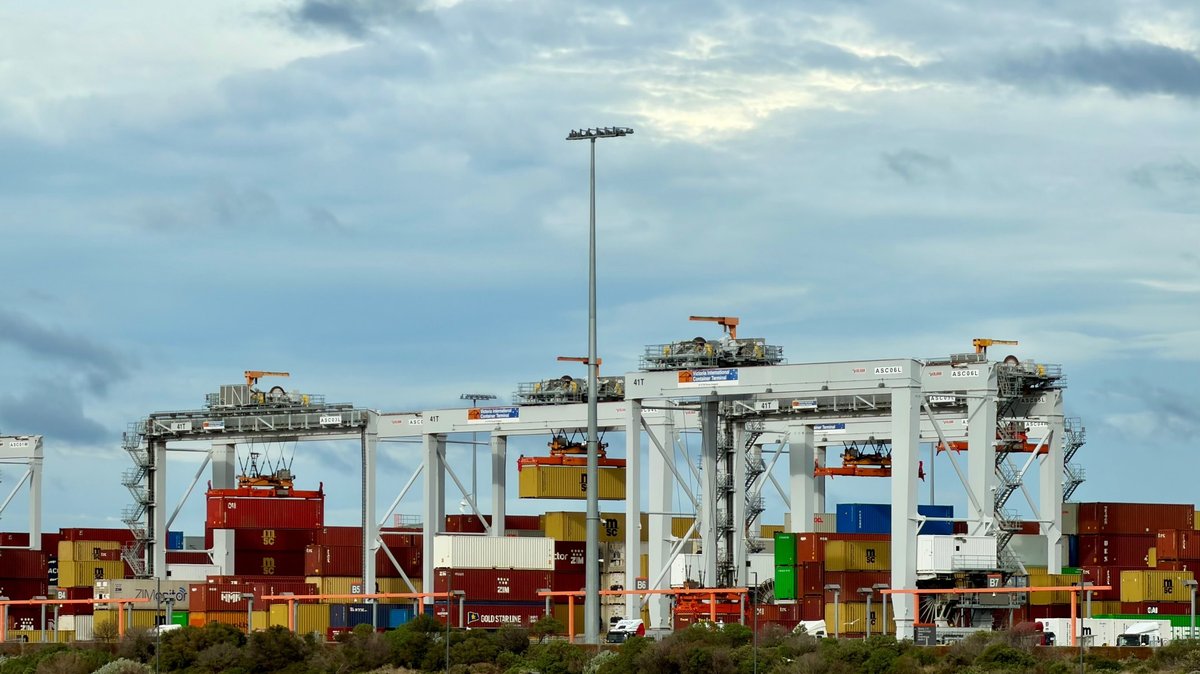
At logistics centers, freight would be transferred between trucks, railways, ports, airports and the automated corridor. That makes the terminals as important as the corridor itself. A fast automated line would lose much of its value if goods became stuck at loading docks.
Refrigeration is also part of the planning discussion. Cold-chain freight, such as vegetables, fruit, seafood and chilled foods, needs reliable temperature control. The final summary highlights the need to integrate transport equipment with sorting, storage and other logistics functions.
Why Tokyo to Osaka Matters
Roughly 500 kilometers separate the Tokyo and Osaka regions by road, making the corridor one of Japan’s most important freight arteries. It connects two major economic zones and passes near industrial, logistics and consumer markets that support daily life across the country.
The Tokyo to Osaka route also has a clear operational logic. A high-volume freight corridor can justify expensive automation more easily than a lightly used route. More cargo means more chances to spread infrastructure costs across many shipments.
Japan’s planners have discussed using existing highway space where possible. That could include central reservations or shoulders. In some places, underground sections may be considered when surface space is limited or when separation from traffic requires a different structure.
The corridor would support intercity movement. Local distribution would still rely on trucks and other vehicles for pickups, neighborhood delivery, store supply and service to places beyond the automated route. In that model, human drivers focus more on shorter and more flexible trips.
Tokyo and Osaka also give the concept international visibility. A functioning automated freight route between these regions would show how large economies might redesign logistics for aging societies, lower emissions and more resilient supply chains.
Automation Inside the Corridor
The core technology is driverless freight transport operating inside a controlled corridor. Physical separation would reduce conflicts with ordinary cars and trucks. That separation matters because freight units could move in close spacing and follow standardized operating rules.
The ministry’s planning materials describe continuous operation at speeds still under study. The range under consideration runs from 30 kilometers per hour to 80 kilometers per hour. The final capacity would depend on vehicle design, load size, spacing, safety rules, maintenance needs and hub performance.
One scenario uses 10-meter spacing between transport units and multiple lanes to increase throughput. Under certain assumptions, the Tokyo to Osaka corridor could move hundreds of thousands of tons per day. Those figures remain planning estimates until real-world testing confirms equipment performance and system reliability.
Automation also extends beyond motion. The plan includes automated loading and unloading, automatic sorting, monitoring and coordination with storage facilities. These functions are common in advanced warehouses and ports, but the proposed road corridor would stretch that logic across hundreds of kilometers.
Safety will shape every technical choice. A failed vehicle, dropped load, power interruption, or sensor error could disrupt the system. Planners will need rules for stopping, rerouting, maintenance access, emergency response and responsibility when equipment breaks down.
Carbon Cuts and 24-Hour Freight
The Autoflow Road is also tied to Japan’s climate goals. The official concept calls for clean energy, automation, standardization and carbon neutrality. Freight transport is a major source of emissions, especially when long-distance movement depends on diesel trucks.
An electric automated corridor could reduce emissions if the power supply is low-carbon and the system shifts enough freight away from conventional road haulage. The ministry’s estimates suggest the corridor could reduce millions of tons of carbon dioxide per year under favorable operating conditions.
The plan also highlights 24-hour cargo movement. Continuous operation could smooth freight flows across the day. If goods can enter the system during less crowded periods and move steadily to distant hubs, logistics companies may gain more predictable schedules.
That timing matters for congestion too. Nighttime truck concentration is common in some freight systems because businesses want goods ready for morning delivery. Automated buffering and storage lanes could help spread movement across more hours.
Energy use remains a key unknown. Tunnels, refrigeration, sensors, control systems and vehicles all require power. The climate benefit will depend on system efficiency, electricity sources, construction impacts and how much freight the corridor actually carries.
The Tests Planned Through 2027
Japan’s plan is moving through staged development rather than immediate full-scale construction. The final summary points to experiments in existing facilities and future trials on sections of the Shin-Tomei Expressway that are under construction.
The early tests are designed to examine specific use cases. These include unmanned cargo handling at hubs, automated vehicle movement on mainline sections, abnormality detection, avoidance behavior and other operating conditions needed for future deployment.
Through 2027, planners expect to collect data on equipment performance and operational requirements. They need to know how much space automated vehicles require, how loads behave during movement, how quickly goods can be transferred and how the system responds to disruptions.
After that, the schedule described in the available reports points toward a development phase from 2028 into the mid-2030s. Operation in viable sections is projected for the mid-2030s if the concept proves technically and economically workable.
The private sector is already part of the process. A consortium involving more than 100 companies was formed to discuss technologies, financing, business models and demonstrations. That cooperation will be important because logistics systems depend on carriers, shippers, warehouse operators, technology suppliers and road managers working together.
The Biggest Questions Still Ahead
The largest uncertainty is cost. Long underground sections would be expensive, especially across a 500-kilometer corridor. Surface or highway-space options may reduce some construction burdens, but they introduce their own design and land-use challenges.
Route selection is another unresolved issue. Planners must decide where the main corridor would run, where hubs would be placed and how the system would connect to existing highways, rail lines, ports, airports and distribution centers. Each connection affects cost and usefulness.
Standardization may determine whether the system can scale. Cargo sizes, pallets, containers, vehicle interfaces, loading equipment, reservation systems and pricing rules all need common formats. Without shared standards, the corridor would be harder for logistics companies to use efficiently.
Business models also remain open. Someone must pay for construction, vehicles, operations, maintenance, control systems, energy and upgrades. The final arrangement could involve government investment, private participation, user fees, or a mix of funding mechanisms.
The Autoflow Road stands as one of the world’s boldest freight automation concepts because it treats logistics as national infrastructure. If Japan can prove the technology in smaller demonstrations, the corridor could become a working model for countries facing driver shortages, emissions pressure and rising delivery demand.