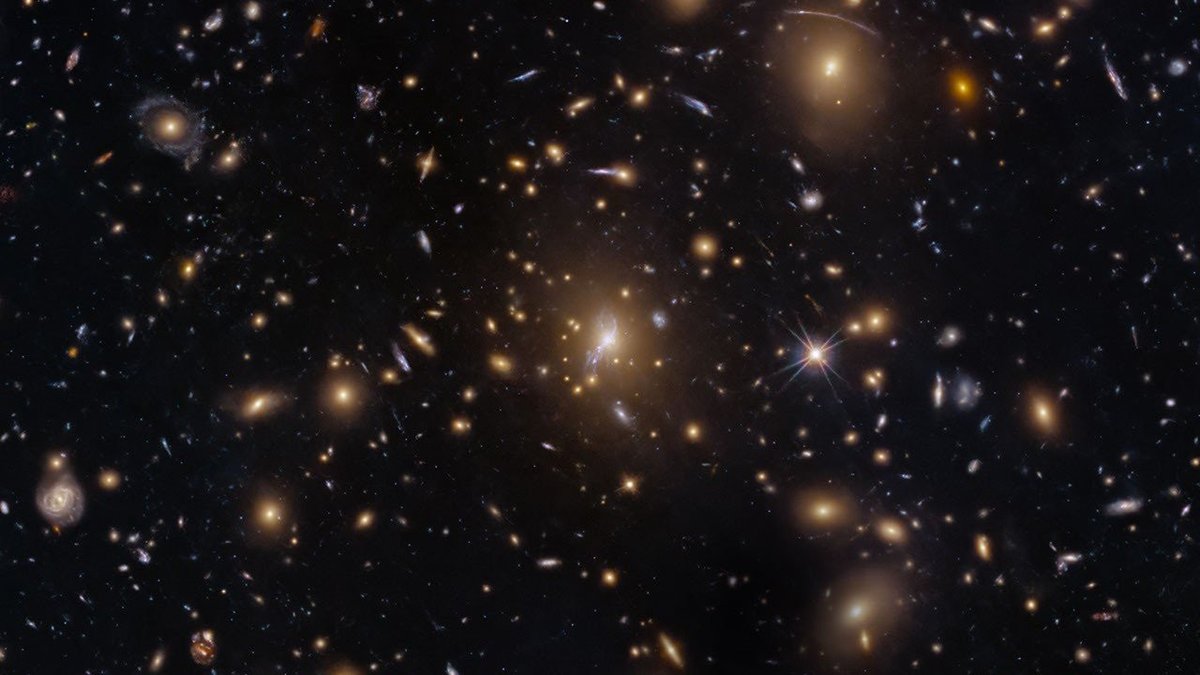
NASA’s Hubble image of the galaxy cluster MACS0329-0211 reveals a crowded cosmic scene where hundreds of galaxies gather in one field of view and the cluster’s gravity bends light from far more distant objects. The result looks like a swarm of galaxies suspended in deep space, with faint arcs that trace the warped paths of ancient light.
The scene centers on MACS0329-0211, a massive galaxy cluster observed by the NASA Hubble Space Telescope. NASA describes the object as a cluster that looks “somewhat like a swarm of bees returning to their hive,” a fitting image for a field packed with bright oval galaxies, thin edge-on disks and delicate spirals seen face-on.
Galaxy clusters matter because they mark places where gravity has gathered enormous amounts of matter over cosmic time. They also act as natural magnifying glasses. In this image, the cluster’s gravity stretches and brightens the light of galaxies lying far behind it, giving astronomers a sharper route into the distant universe.
A Cluster Packed With Galaxies
The first thing the Hubble view delivers is abundance. Galaxies fill the scene with different shapes, angles and colors. Some appear as large, smooth ovals. Others are long, narrow streaks, suggesting disk galaxies tilted edge-on from our point of view.
Those smooth ovals are elliptical galaxies, systems often dominated by older stars and rounded forms. The thinner objects include spiral galaxies and lenticular galaxies seen from the side. In a few places, Hubble catches spiral galaxies face-on, showing curving arms that wrap around bright centers.
This variety helps turn the image into a compact atlas of galaxy forms. A single Hubble frame can show galaxies with very different structures because the cluster brings many of them into the same region of sky. Some belong to the cluster itself. Others sit in the foreground or background along the same line of sight.
Galaxy clusters are among the largest organized structures in the universe. Their members move under the influence of a shared gravitational field, along with gas and unseen matter that contribute to the cluster’s overall mass. In visible light, Hubble shows the galaxies. Through the effects of gravity, the cluster also reveals the presence of mass that shapes the path of passing light.
For general readers, the image offers a simple way to see a deep astronomical idea. The universe has structure on many scales, from stars to galaxies to clusters. MACS0329-0211 sits on one of the grander rungs of that ladder, where many galaxies collect into a single gravitational neighborhood.
Gravity Turns the Cluster Into a Cosmic Lens
The most scientifically powerful feature in the image is gravitational lensing. This happens when a massive object bends the path of light from a more distant source. The effect follows from gravity’s ability to shape space around massive objects, so light travels along curved paths near a cluster like MACS0329-0211.
In everyday terms, the cluster works like a giant lens made of gravity. A background galaxy sends light across the universe. When that light passes near the cluster, the cluster’s mass can redirect it, magnify it and stretch its image into arcs or repeated shapes.
NASA’s description points to this lensing directly. “The image’s upper-right quadrant holds faint arcs of distant galaxies gravitationally lensed by the cluster’s massive gravity,” the agency-provided source notes. Those arcs are among the key clues that distant galaxies lie behind the cluster and have had their light distorted during the journey to Earth.
The word lens can make the process sound tidy, although nature produces a more complicated pattern. A glass lens has a carefully shaped surface. A galaxy cluster has mass distributed through galaxies, hot gas and other matter. Because that mass arrangement is uneven, the lensed images can appear stretched, curved, split, or brightened in surprising ways.
That complexity gives scientists useful information. The shapes and positions of lensed arcs can help researchers study the mass inside a cluster. They can also make remote galaxies easier to see. In this way, the cluster becomes both the subject of study and a tool for studying the background universe.
Faint Arcs Reveal Distant Galaxies
Near the upper-right part of the image, Hubble records faint curved streaks. These are the visual fingerprints of lensed galaxies. The largest arc appears above the bright oval outline of a giant elliptical galaxy, according to NASA’s description of the scene.
These arcs are important because they can represent light from galaxies in the early universe. Without lensing, some of those galaxies would be too faint, too small, or too distant to appear as clearly. The cluster’s gravity gives their light a boost and changes their apparent shape.
Closer to the center of the image, NASA notes several bright white intersecting curves that resemble a distorted figure eight. The agency says this may be another distant galaxy whose light has been magnified and distorted by the cluster’s gravity. That careful wording matters because lensing identifications can require further analysis.
For astronomers, a lensed arc is more than a pretty curve. It can carry information about the galaxy behind the cluster, including its position and the way its light has been altered by the lens. With enough data, scientists can model the cluster’s gravitational field and infer how the background source may have looked before lensing stretched it.
The Hubble image also gives the public a rare visual connection to deep time. Light from distant galaxies has traveled for immense stretches of cosmic history before reaching the telescope. When a cluster magnifies that light, it opens a window onto galaxies from much earlier stages of the universe’s development.
Hubble Used Two Cameras To Capture the Scene
Hubble observed MACS0329-0211 as part of a program focused on X-ray bright galaxy clusters. Such clusters are attractive targets because they often contain large amounts of hot gas and mass. Hubble adds a detailed visible and infrared view of the galaxies and lensed features.
NASA says researchers used Hubble’s two main cameras for the observation. The Advanced Camera for Surveys and the Wide Field Camera 3 gathered data from the cluster in visible and infrared light. Together, those instruments help reveal both familiar starlight and longer-wavelength light from more distant or reddened sources.
Visible and infrared light give astronomers complementary views. Visible light shows many of the structures that human eyes could recognize if they were sensitive enough and close enough. Infrared light helps Hubble detect objects whose light has been shifted toward longer wavelengths by the expansion of the universe or affected by intervening material.
Using both cameras also strengthens the image scientifically. The Advanced Camera for Surveys has long been central to Hubble’s deep imaging work. Wide Field Camera 3 expanded Hubble’s capabilities across ultraviolet, visible and infrared wavelengths. In this observation, the paired camera approach helps capture a rich mix of cluster galaxies and lensed background features.
The image credit reflects that combined effort. NASA and ESA are credited, along with M. Postman of the Space Telescope Science Institute. Image processing is credited to G. Kober of NASA and the Catholic University of America. That processing turns raw telescope data into a view that preserves scientific information while making the cosmic scene readable to human eyes.
Why MACS0329-0211 Matters
MACS0329-0211 matters because clusters like it connect two major stories in astronomy. One story concerns how matter gathered into large structures. The other concerns how gravity can let astronomers look beyond a cluster to galaxies even farther away.
NASA’s source puts the first point plainly. “Galaxy clusters like MACS0329-0211 are important signposts in the story of how the structure of the universe evolved.” A cluster this large represents the long-term work of gravity, which pulls galaxies into vast assemblies across billions of years.
The second story comes from lensing. By magnifying background galaxies, a cluster can help reveal objects from the earliest stages of cosmic history. That makes galaxy cluster observations useful for studying both the cluster itself and the distant galaxies whose light passes through its gravitational field.
Hubble’s broad light-gathering capability is especially valuable here. The telescope can observe across a wide range of wavelengths, which helps researchers compare galaxy shapes, colors and lensed features. With MACS0329-0211, that range helps turn a crowded image into a layered map of foreground, cluster and background objects.
The picture also shows why Hubble remains a powerful observatory for galaxy science. Its sharp imaging can separate fine details in crowded fields. It can reveal arcs and curves that point to hidden alignments across space. In MACS0329-0211, Hubble captures a galaxy swarm that also functions as a natural telescope, bending ancient light into view.