Fifty-six older adults with several chronic conditions finished this water-exercise trial and the clearest psychological gains appeared in the group that trained more often. In the study’s final analysis, people who did aquatic HIIT twice a week reported better sleep quality, less daytime sleepiness, lower anxiety and markedly lower depression scores, while the once-a-week group did not record statistically significant change on those same measures.
The result comes from a 2025 Clinics trial on older adults with multimorbidity, a term that means living with more than one ongoing disease. The participants all had combinations of diabetes, hypertension and depression and they all performed the same interval-style water aerobics routine. Frequency was the main difference the researchers set out to test.
The finding is useful because it joins four outcomes that often travel together in later life: sleep quality, daytime alertness, anxiety and depression. For older adults already managing several conditions, a program that improves mood and sleep at the same time may make daily life easier. The paper still needs careful reading, because the trial was modest in size and the once-versus-twice comparison is more cautious than a simple win-loss headline suggests.
What the researchers tested
The team recruited older adults in Criciuma, Brazil, from university clinics that served people with multimorbidity. According to the paper, 129 people were assessed, 63 were allocated to one of the two intervention groups and 56 were included in the final per-protocol analysis after dropouts and attendance exclusions. Most were women and the analyzed sample ranged from 62 to 77 years old.
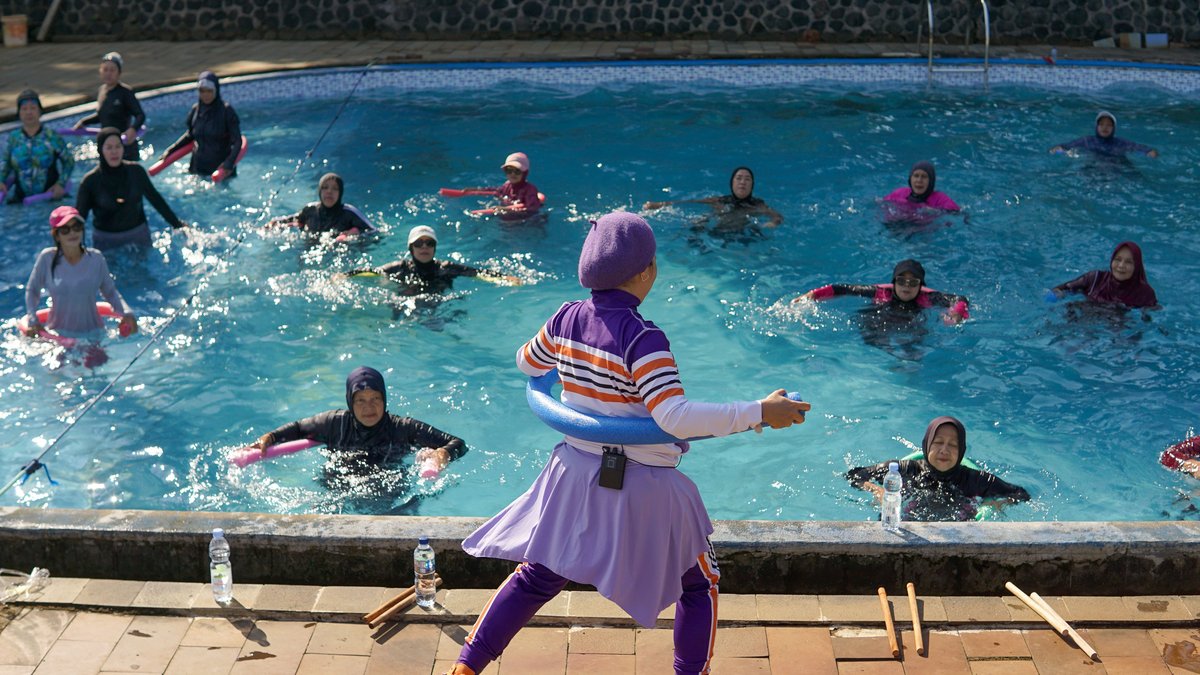
Both groups performed the same nine-exercise program in water. Each session lasted 40 minutes, with four 30-second active intervals followed by 30 seconds of rest and the target intensity was 80 to 90 percent of maximum heart rate, roughly an 8 to 9 effort rating on the Borg Scale. One group completed that session once a week, while the other completed it twice a week.
The mental-health measures were concrete rather than impressionistic. Sleep quality was tracked with the Pittsburgh Sleep Quality Index, daytime sleepiness with the Epworth Sleepiness Scale, anxiety with the Beck Anxiety Inventory and depression with the Beck Depression Inventory. Those questionnaires were applied 48 hours after the final training session, which gave the paper a defined post-program snapshot instead of a same-day mood check. The trial registry at ReBEC also shows that the broader project originally set out to examine mental health, functional autonomy and muscular efficiency in comorbid older adults.
Where the sleep and mood gains appeared
The strongest changes showed up in the twice-weekly group, labeled G2 in the paper. Sleep quality improved by 49 percent, daytime sleepiness fell by 50 percent, anxiety scores dropped by 45 percent and depression scores dropped by 62 percent. Each of those changes reached statistical significance within that group.
The once-weekly group, G1, moved in the same general direction on paper, but those shifts did not reach significance. Sleep quality scores improved from 10.8 to 8.3, daytime sleepiness from 7.9 to 6.2, anxiety from 13.1 to 11.6 and depression from 15.1 to 13.4. Those numbers suggest some possible benefit, yet the study was not able to distinguish those changes from noise with the same confidence.
Depression and anxiety deserve special attention because they shape whether people stay active, keep medical appointments and maintain social contact. The National Institute of Mental Health notes that chronic illness and depression often reinforce each other. In that context, a water-based exercise routine that coincides with lower anxiety and depression scores may matter beyond the pool itself.
Why sleep stayed central to the result
Sleep quality was not a side note in this paper. The study put sleep quality first in the mental-health table and the pattern matched the mood outcomes: only the twice-weekly group improved significantly. That makes practical sense, because better sleep can change how people feel during the day, how much energy they have for movement and how resilient they are when pain or stress rises.
Older adults need about the same amount of sleep as younger adults, yet age, illness and medication can make restful sleep harder to hold onto. The National Institute on Aging says in its guide to sleep and older adults that sleep patterns often change with age even when the need for sleep does not. The present trial does not prove why sleep improved, but it does show that the better-frequency group also had less daytime drowsiness, which strengthens the overall pattern.
One plausible mechanism is that exercise in water asks for sustained effort without the same joint loading many land routines impose on older adults with obesity, hypertension or diabetes. The paper also points to the properties of water itself, including buoyancy and hydrostatic pressure, as reasons aquatic exercise may feel more manageable. A program people can tolerate well has a better chance of improving mood and sleep through repeated participation.
Why the frequency comparison needs caution
The cleanest verified statement is narrow: in this trial, statistically significant mental-health gains appeared only in the twice-weekly group. That is different from proving that once-weekly aquatic HIIT never helps and it is also different from proving that twice-weekly exercise would outperform every other type of activity in a larger study.
Several design details explain the caution. The final analysis was per protocol, which means participants with poor attendance or dropout were removed rather than counted in an intention-to-treat analysis. That left 21 people in the once-weekly group and 35 in the twice-weekly group. Uneven final group sizes can make comparisons harder to read, especially when the outcomes depend on self-report questionnaires.
The intervention itself was also impossible to blind. Participants knew whether they came once or twice each week and instructors knew it too, even though outcome assessment was blinded. In addition, this was a specific population of mostly female older adults with multimorbidity in one Brazilian setting. The National Institute of Mental Health page on older adults and mental health makes clear that mental-health needs in later life vary widely, so generalization should stay modest.
What older adults and clinicians can take from it
The study supports a practical message more than a universal rule. For older adults with diabetes, hypertension and depression who can safely take part in supervised aquatic training, two weekly sessions of this specific HIIT-style water aerobics program were associated with better mental-health outcomes than the researchers could verify with one weekly session. The paper also reports that the intervention was safe and well tolerated.
That matters because many older adults face a tradeoff between what is ideal on paper and what is realistic in the body. Joint pain, obesity, deconditioning and fear of falling can all reduce exercise options. Water exercise can lower impact while still letting heart rate rise into a demanding range. If the program also improves sleep and reduces daytime fatigue, it may help people stay engaged with the rest of their care and preserve daily functioning.
Clinicians still should not oversell the result. This was a randomized clinical trial, but it was also a relatively small one with a narrow population and no nonexercise control group. The authors also noted that they did not stratify participants by specific multimorbidity patterns, so different mixes of diabetes, hypertension and depression may have influenced the response. The fairest conclusion is the one the paper itself supports: twice-weekly HIIT aqua aerobics looked promising for sleep, anxiety and depression in multimorbid older adults, while the once-weekly schedule did not produce the same statistically clear signal in this dataset.