Researchers at the Istituto Italiano di Tecnologia and the Child Mind Institute have identified at least two biological subtypes of autism by combining brain scans from people with autism with data from mouse models of autism-related brain changes. The findings, described in an announcement about a Nature Neuroscience study, suggest that different patterns of brain connectivity can point to different underlying biology.
The study tackles one of the hardest problems in autism research. Autism can involve very different communication styles, sensory experiences, behaviors, strengths and support needs. Researchers have long suspected that this variation may reflect more than one biological pathway in the brain.
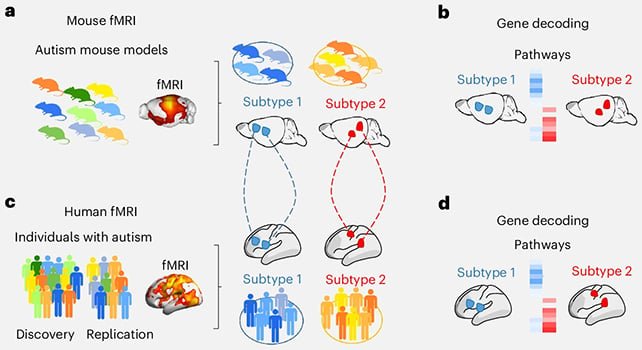
By comparing people and mice, the international team found two recognizable patterns. One group showed reduced brain connectivity, while another showed increased brain connectivity. These patterns were linked to different gene pathways, including genes involved in synapses and immune function.
“For decades, we’ve observed tremendous variability in how autism manifests, but we lacked direct evidence that these differences reflected distinct underlying biology,” said Alessandro Gozzi, a neuroscientist at the Istituto Italiano di Tecnologia.
Two Patterns Emerged in the Brain
The researchers analyzed functional brain connectivity, which reflects how different brain regions coordinate their activity. In this study, that coordination was measured using functional MRI, often called fMRI.
The team examined brain scans from 940 children and young adults with autism and 1,036 neurotypical individuals. They also studied mice carrying 20 different models of autism-like brain characteristics. That cross-species design gave the researchers a way to compare human scan patterns with biological pathways that can be studied more directly in animals.
Two major subtypes stood out. The first was a hypoconnectivity subtype, where autism was associated with reduced coordination across parts of the brain. The second was a hyperconnectivity subtype, where autism was associated with increased coordination across the brain.
These labels describe brain-wide connection patterns seen in the data. They don’t describe a person’s full identity, experience, abilities, or prognosis. Autism remains highly varied and the study focused on patterns that could be measured across large datasets.
The hyperconnectivity group showed modestly higher scores on standardized autism severity measures. The researchers treated that difference cautiously. A scan pattern alone cannot capture the full range of daily life, communication, sensory experience and support needs.
Mouse Models Helped Decode Human Brain Scans
The study’s key move was its use of cross-species analysis. Human brain scans can reveal patterns, but they usually cannot reveal the molecular causes behind those patterns on their own. Mouse models can help researchers connect brain-wide activity to genes, cells and biological pathways.
“The mouse models gave us a biological ‘Rosetta Stone’,” said Adriana Di Martino, a neuroscientist at the Child Mind Institute.
In practice, that meant the researchers first examined connectivity patterns in mice with different autism-related biological changes. They then looked for comparable patterns in human fMRI datasets. This approach allowed the team to connect a scan pattern in people with biological mechanisms seen in mice.
“We could see which biological pathways drive which connectivity signatures, then search for those same patterns in humans,” Di Martino said.
The researchers reported that the approach helped them isolate genetic and immune signatures that corresponded to different brain connectivity patterns. Gozzi described the work as a way to translate biological signals from animal models into human brain imaging results.
One Subtype Was Linked to Synapse Genes
The hypoconnectivity subtype was linked to genes involved in synapses. Synapses are the tiny junctions where brain cells pass signals to one another. They are essential for learning, sensation, memory and communication between neural circuits.
In this group, the brain scans showed reduced connectivity. The linked gene pathways pointed toward the machinery that helps neurons communicate. That connection gives researchers a biological clue about why some autistic people in the dataset showed this scan pattern.
Synapse-related biology has been a major focus in autism research for years. Many autism-linked genes affect how neurons form connections, strengthen signals, or adjust communication over time. The new study adds a brain-wide imaging layer to that story.
The finding also shows why broad averages can hide important details. When researchers compare all autistic participants with all neurotypical participants, some meaningful patterns may blur together. Separating subtypes may reveal biological signals that would otherwise be harder to detect.
Still, the result should be read as a research finding rather than a clinical test. The study points to a relationship between connectivity patterns and gene pathways. It does not establish a diagnostic scan that can be used in routine care today.
The Other Was Linked to Immune Pathways
The hyperconnectivity subtype showed a different biological profile. This group had increased connectivity across the brain and its patterns were linked to genes related to the immune system.
Immune-related biology can influence brain development in many ways. Immune signaling molecules help shape the environment around developing neurons. They can also affect how cells respond to stress, inflammation and developmental timing.
In the Nature Neuroscience study, the hyperconnectivity pattern was associated with immune-related pathways and modestly higher autism severity scores. That does not mean immune biology explains autism in a simple way. It means this subtype carried a measurable link between brain connectivity and immune-related genetic pathways.
That distinction matters because autism has many possible developmental routes. Some may involve synaptic signaling more strongly. Others may involve immune-related biology more strongly. The new findings give scientists a framework for testing those possibilities with larger datasets.
The team’s design also helps avoid relying on a single dataset. The patterns were identified across mice and humans and they were tested across different human datasets. That replication strengthens the case that the two subtypes reflect meaningful biology.
Why the Findings Could Change Autism Research
The study could help move autism research toward more precise biological categories. Many studies search for one average autism brain pattern. This work suggests that several biological patterns may be present inside large autism datasets.
That shift could affect future studies of therapies, supports and developmental pathways. If different subtypes are driven by different mechanisms, a strategy that helps one group may have a different effect in another group. Researchers need those distinctions before they can design more targeted studies.
“Our approach enabled us to isolate specific genetic and immune factors, then translate those signatures to human brain scans,” Gozzi said.
The work may also help explain why autism research can produce mixed findings. A study that averages together people from multiple biological subtypes may miss strong effects within smaller groups. Subtyping gives researchers a way to ask more specific questions.
For families and clinicians, the findings are promising but early. The study does not create a treatment recommendation. It also does not provide a simple scan-based label for individuals. Its immediate value is scientific, giving researchers a clearer map for studying autism’s biological diversity.
More Subtypes May Still Be Hidden
Only about one in four autistic participants in the human datasets fell into the hypoconnectivity or hyperconnectivity groups described in the study. That leaves a large share of participants whose brain scans did not match either of these two patterns.
This result points to a larger landscape. Autism may include additional subtypes that require bigger datasets, improved imaging tools, or different biological measurements to detect. Future work could combine brain scans with genetics, behavior, development, sensory traits and clinical history.
The researchers also made their data and analysis tools available so other scientists can build on the work. Open resources can help independent groups test whether the same patterns appear in new datasets and in different populations.
For now, the study gives autism researchers a sharper starting point. It links two brain connectivity patterns with two different biological signatures, using evidence from both humans and mice. That combination makes the finding especially valuable for a field trying to connect lived variation with measurable brain biology.
The next step will be to test how stable these subtypes are over time. Researchers will also need to learn how they relate to development, daily functioning, sensory differences, communication and support needs. A more detailed map could eventually help scientists design studies that reflect the real biological diversity behind autism.