A study in Physical Review D proposes that ancient black holes could have survived a cosmic bounce before the Big Bang, leaving behind relics that may still shape the Universe today. The research, led by Enrique Gaztañaga of the University of Portsmouth, explores a striking possibility: some black holes may be older than the hot expanding cosmos whose history astronomers usually trace back 13.8 billion years.
The idea belongs to a class of models known as bouncing cosmology. In this picture, the Universe once contracted under gravity, reached an extremely dense state and then rebounded into expansion. If that transition happened, certain compact objects from the earlier contracting phase may have crossed through the bounce and emerged into the Universe we observe.
That possibility matters because cosmology still faces deep puzzles. Astronomers can map galaxies across billions of light-years and measure the faint afterglow of the early Universe with extraordinary precision. Yet the identity of dark matter, the origin of the first supermassive black holes and the physics behind the Universe’s earliest expansion remain open questions.
A Bounce Before the Big Bang
The new model begins with a radical but mathematically motivated scenario. Instead of starting from an infinitely dense point, the Universe contracts from a previous state, reaches a high but finite density and then begins expanding. That turnaround is the bounce.
In standard cosmology, the Big Bang marks the earliest hot, dense phase that current observations can reliably describe. The cosmic microwave background, a faint glow released when the Universe became transparent, gives scientists a detailed snapshot from about 380,000 years after that early state. A bounce model tries to probe what may have happened before that boundary.
Enrique Gaztañaga, affiliated with the University of Portsmouth’s Institute of Cosmology and Gravitation and the Institute of Space Sciences in Barcelona, developed calculations showing how relic structures could pass through such a transition. The study treats the bounce as a physical process that could preserve certain objects across cosmic time.
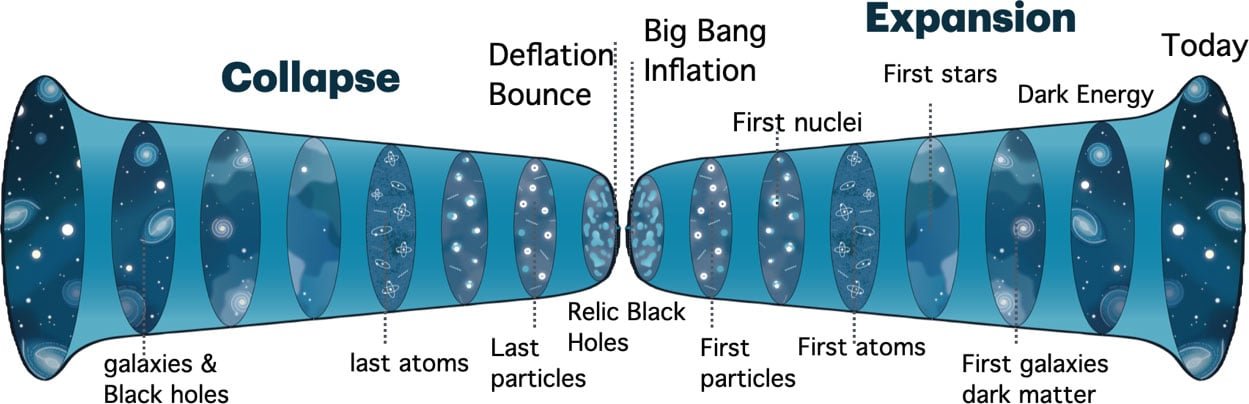
The Black Hole Universe: gravitational collapse of a large matter cloud leads to a bounce and subsequent expansion. A Universe-scale black hole forms, together with smaller relic black holes that could underlie dark energy and dark matter. Credit: University of Portsmouth
The key mechanism is quantum pressure at extreme density. In familiar astrophysics, quantum effects help stabilize compact objects such as white dwarfs and neutron stars against total collapse. In this cosmological model, similar physics acts on the scale of the entire Universe and helps trigger a rebound.
Black Holes That Survive the Cosmic Turnaround
Some structures in the model form before the bounce, during the contracting phase. Dense regions can collapse under their own gravity and become compact objects, including black holes. If those objects meet the right conditions, they can remain outside the causal horizon during the bounce and later re-enter the expanding Universe.
The paper’s abstract states that “perturbations or compact objects larger than ∼90 m survive the bounce.” That threshold gives the proposal a concrete scale. It suggests that relics larger than roughly the size of a city block could cross the transition intact in the mathematical model.
These surviving objects would act like cosmic fossils. They would carry information from a phase that ordinary light cannot show us. Because black holes are defined by extreme gravity, they could endure violent changes in the surrounding Universe while remaining compact and long-lived.
There is also a second pathway in the study. Dark matter halos that form during contraction could leave the horizon, then collapse into black holes when they re-enter after the bounce. That process creates relic black holes through large-scale structure growth during contraction.
The model remains theoretical. It gives researchers a framework for asking what kinds of objects could survive a pre-Big Bang era and how those relics might appear in astronomical data today.
A New Route to Dark Matter
Dark matter is inferred from gravity. Galaxies rotate too quickly for their visible stars and gas alone. Galaxy clusters bend background light more strongly than ordinary matter can explain. Large-scale maps of the cosmos also show a hidden gravitational scaffold that helped galaxies form.
The bounce scenario suggests that relic black holes could contribute to that hidden mass. If enough of them survived from before the bounce, they might make up a substantial fraction of dark matter. In the most ambitious version of the idea, they could account for all of it.
This proposal connects two long-standing mysteries. Black holes are known astronomical objects and dark matter is known through its gravitational pull. A population of ancient black holes would behave gravitationally like dark matter if they were numerous, widely distributed and difficult to see directly.
Scientists have considered black holes as dark matter candidates before. Primordial black holes, which may have formed shortly after the Big Bang, have been studied for decades. Gaztañaga’s model gives the concept a different origin by placing some black hole formation in a contracting Universe before the bounce.
That distinction affects how such objects might be distributed by mass. The study argues that the process could generate a broad range of relic black holes. Some could be small by astronomical standards. Others could be massive enough to influence the growth of early galaxies.
Why Early Galaxies May Have Grown So Fast
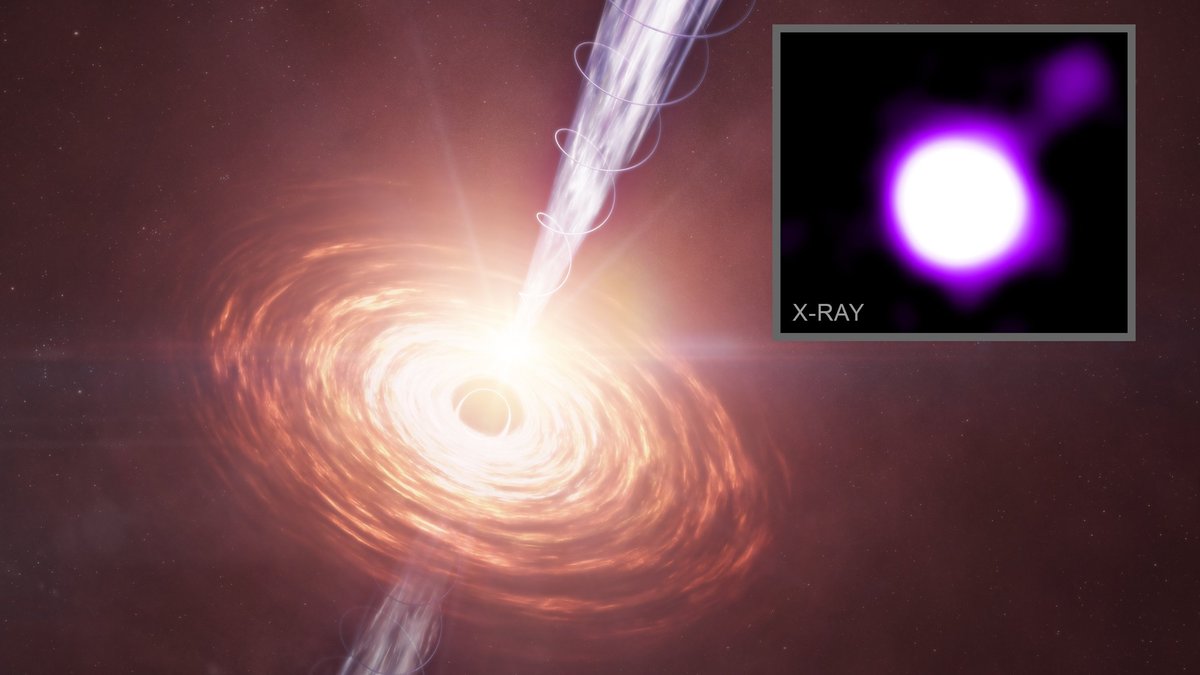
Recent observations have sharpened the mystery of early cosmic growth. The James Webb Space Telescope has found surprisingly bright and massive objects in the young Universe, including compact red sources that many astronomers have linked to rapidly growing black holes.
In conventional timelines, supermassive black holes need seeds. A small black hole can grow by swallowing gas and merging with other black holes, but growth takes time. When massive black holes appear very early, scientists must explain how the first seeds became so large so quickly.
A pre-existing population of relic black holes would change the starting conditions. The earliest galaxies could form around black hole seeds already present just after the bounce. These seeds could help gather gas, trigger rapid accretion and accelerate the assembly of massive systems.
The same idea could also influence the distribution of matter across cosmic scales. If relics survived the bounce, they could seed density patterns that later became galaxies and clusters. That makes the model relevant to both small compact objects and the large cosmic web.
This remains a cautious interpretation. Webb observations are still being analyzed and several explanations may account for unusually bright early sources. The bounce model offers one possible route that future surveys can compare against data.
Signals Hidden in Gravitational Waves
Black holes reveal themselves through gravity and their most dramatic signals come from mergers. When two black holes spiral together, they shake spacetime and release gravitational waves. Detectors such as LIGO, Virgo and KAGRA have already observed many such events.
A population of ancient relic black holes could leave several gravitational-wave signatures. Some relics might merge with each other across cosmic history. Others might produce a background hum from many unresolved events. The masses and merger rates would be central clues.
The study also includes gravitational waves created before the bounce. In the model, some waves from the contracting phase could survive the transition and later re-enter the horizon. If so, the Universe may contain a gravitational memory from an era hidden from ordinary telescopes.
That possibility is especially important because light reaches a limit. The cosmic microwave background is the oldest electromagnetic signal we can observe directly. Gravitational waves can carry information from much earlier epochs because they interact weakly with matter.
Future observatories could expand the search. Ground-based detectors are sensitive to stellar-mass black hole mergers. Space-based missions such as LISA are designed to detect lower-frequency waves from massive black holes and compact binaries. Pulsar timing arrays can probe still lower frequencies across galaxy-sized baselines.
How Astronomers Could Test the Idea
The strongest value of the model lies in its testable consequences. A good cosmological theory needs observational fingerprints. For this proposal, those fingerprints may appear in black hole populations, gravitational-wave backgrounds and subtle patterns in the cosmic microwave background.
One test involves the mass distribution of black holes. Relic black holes from a bounce could span a wide range of masses. If future surveys find an unusual abundance of black holes in mass ranges that are difficult to produce through ordinary stellar evolution, that would give theorists something concrete to investigate.
Another route comes from cosmic microwave background measurements. If the bounce left traces in primordial density fluctuations, those traces might appear as small deviations from the simplest inflationary predictions. Precision maps could help narrow the space of viable models.
Gravitational-wave astronomy may provide an even sharper probe. A relic population could produce merger histories that differ from black holes born from stars. The timing, mass spectrum, spin patterns and possible stochastic background could all help researchers compare models.
The study also shows why caution is essential. A bounce before the Big Bang sits at the frontier of physics, where general relativity, quantum mechanics and cosmology overlap. The calculations offer a possible mechanism for ancient relics, while observations will decide whether the Universe carries those fossils today.