Using NASA’s James Webb Space Telescope and the Hubble Space Telescope, astronomers have confirmed in a NASA announcement that Terzan 5 is a rare survivor from the Milky Way’s earliest building phase. The object sits deep in the galaxy’s crowded central bulge, where dust and packed star fields usually make ancient history hard to read.
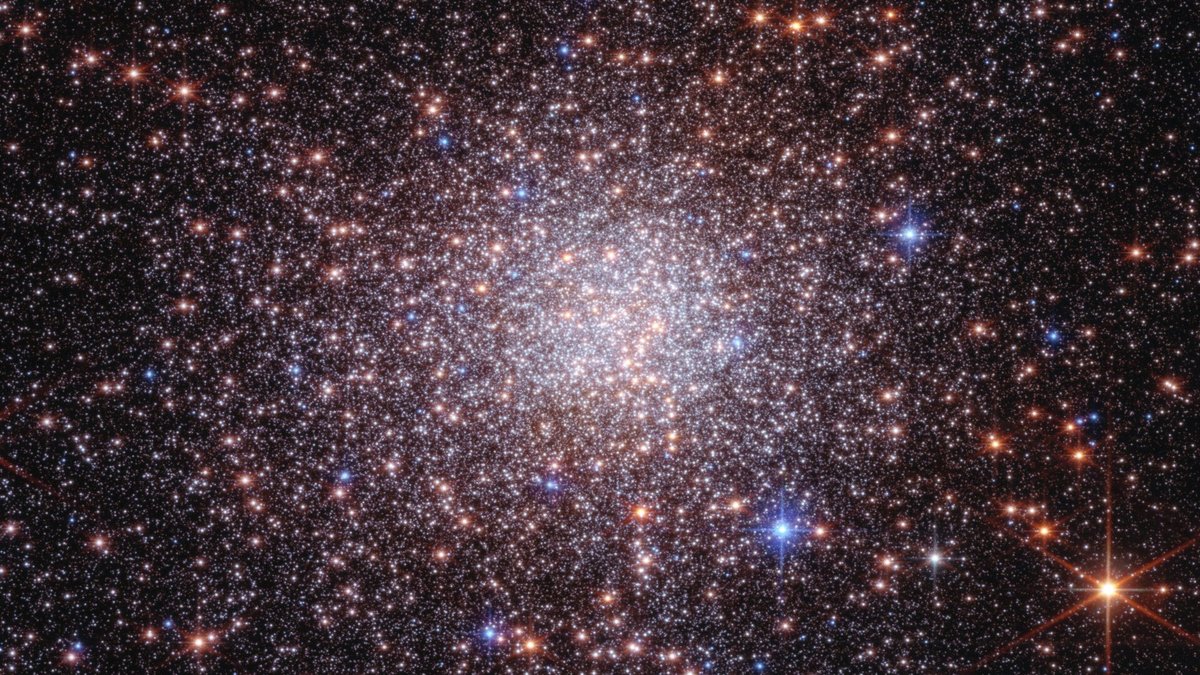
The finding centers on Terzan 5, a dense stellar system once classified as a globular cluster. New Webb observations, combined with 12 years of Hubble data, show that it carries four distinct generations of stars. That pattern marks it as the prototype of a bulge fossil fragment, a remnant of the primordial clumps that helped build the Milky Way’s central region.
The results were presented at the 248th meeting of the American Astronomical Society and published in Astronomy & Astrophysics. They give astronomers a rare nearby example of a process thought to have shaped galaxies across the early Universe.
Terzan 5 Preserves Four Generations of Stars
Terzan 5 has turned out to be a living archive of galactic assembly. The new analysis shows evidence for four generations of stars, with populations that formed roughly 12.5 billion, 4.7 billion, 3.8 billion and 2.5 billion years ago.
That long record is unusual because many compact stellar systems form most of their stars in a single ancient burst. Terzan 5 followed a more complex path. It kept enough gas and chemically enriched material to make new stars again and again over billions of years.
The oldest population formed when the Milky Way itself was still taking shape. Later populations appeared long after the first stars had already lived, exploded and seeded the system with heavier elements. Those later stars carry the chemical fingerprints of earlier generations.
“Along with the ages of these populations, the cluster preserves a fossil record of progressive enrichment of heavy elements by supernovae,” said R. Michael Rich, a research astronomer at the University of California, Los Angeles.
In this picture, supernovae played a central role. These stellar explosions forged heavier elements and scattered them into the surrounding material. Terzan 5 appears to have held onto enough of that material for later rounds of star formation.
Bulge fossil fragment Terzan 5, seen by Webb and Hubble. Credit: NASA, ESA, CSA, STScI, G. Zullo, University of Bologna, F. R. Ferraro, University of Bologna. Image Processing: A. Pagan, STScI. Licence: CC BY 4.0 INT or ESA Standard Licence.
Why This Relic Changed Astronomers’ View
For decades, Terzan 5 looked like a familiar kind of object. It resembles a globular cluster, which is a compact swarm of old stars bound together by gravity. Its location and appearance made that classification seem natural.
Earlier studies began to complicate that picture. In 2009, astronomers found two distinct stellar populations inside Terzan 5. In 2016, Hubble helped estimate their ages, showing one very ancient population and another much younger one.
The new Webb and Hubble analysis adds two more populations. With four generations present, Terzan 5 looks like a self-contained stellar system that enriched itself through time. That gives astronomers a stronger case that it is a preserved fragment from the Milky Way’s formative years.
Francesco R. Ferraro, a professor at the University of Bologna and principal investigator of the Webb observations, described the object in direct terms. “Terzan 5 is what we now call a bulge fossil fragment because it resembles the primordial clumps that contributed to the formation of the bulge.”
This reclassification matters because it changes what Terzan 5 can tell researchers. A standard globular cluster mostly preserves one ancient stellar event. A bulge fossil fragment can preserve a longer story of gas retention, chemical enrichment and repeated star birth.
How Webb Saw Through the Galactic Bulge
The central region of the Milky Way is a difficult place to study. Terzan 5 lies in the galaxy’s bulge, where stars crowd the sky and thick dust blocks much of the visible light from reaching telescopes.
James Webb Space Telescope observations helped solve that problem because Webb is built to study the universe in infrared light. Infrared wavelengths can pass through dust more effectively than visible light, giving astronomers a clearer view of stars hidden in the bulge.
With Webb’s near-infrared measurements, the team could record the colors and brightnesses of many stars in the field. Those details let researchers place stars into groups by age and chemistry. Fainter stars also became easier to include, which sharpened the view of Terzan 5’s population structure.
The Webb data revealed the fingerprints of the younger populations. One population formed about 3.8 billion years ago. Another formed about 2.5 billion years ago. Their presence points to an extended history of star formation inside the same compact system.
Webb’s strength came from seeing through the dust. Yet the telescope also observed many unrelated stars that happen to lie along the same line of sight. To separate Terzan 5 from the crowded background, astronomers needed Hubble’s long time baseline.
How Hubble Identified the True Members
Hubble Space Telescope data gave the team a way to sort Terzan 5’s true stars from the many foreground and background stars in the Milky Way’s bulge. The key was motion across the sky.
Hubble observed the region over a span of 12 years. Across that period, stars shifted by tiny amounts. Astronomers measured those changes as proper motions, which reveal how individual stars move relative to one another.
Stars that belong to Terzan 5 move together in a shared pattern. Unrelated bulge stars follow different paths. By comparing the motions, researchers could build a cleaner sample of Terzan 5 members.
That step was crucial. A crowded field can make separate populations appear blended or misleading. Hubble’s long-term view helped remove the impostors from the dataset, while Webb supplied the infrared depth needed to classify the remaining stars.
“Webb’s new near-infrared observations, cross-referenced with Hubble’s archival observations, have given us a much clearer picture of the history of Terzan 5,” said Giorgia Zullo, who led the research as a PhD student at the University of Bologna.
A Surviving Fragment of the Early Milky Way
The survival of Terzan 5 is part of what makes it scientifically valuable. Billions of years ago, the early Milky Way likely contained many massive clumps of gas and stars. Many of those clumps merged and mixed into the growing central bulge.
Terzan 5 appears to have kept its separate identity. It remained intact while lighter systems were dispersed into the galaxy’s central stellar population. That makes it a rare piece of the original construction material of the Milky Way’s bulge.
The system’s mass likely helped it survive. A less massive stellar system would have struggled to hold onto gas and supernova debris. Terzan 5 had enough gravitational pull to retain raw material for later star formation.
Its chemical history supports that interpretation. Observations from the W. M. Keck Observatory and the European Southern Observatory’s Very Large Telescope show distinct stellar compositions among its populations. Together with the Webb and Hubble ages, those data point to progressive enrichment over time.
Another object, Liller 1, has also been reclassified as a bulge fossil fragment. Ferraro’s team plans to examine 40 to 50 additional globular clusters that orbit within the bulge. Some may turn out to be similar survivors with hidden multi-age populations.
What Terzan 5 Could Reveal About Galaxy Formation
Terzan 5 gives astronomers a nearby laboratory for studying a process that may have been common in the early Universe. Simulations and observations suggest that young galaxies often contained large gas disks that broke into massive star-forming clumps.
Over time, many of those clumps migrated toward galactic centers. As they merged, they helped build bulges, the dense central regions seen in many galaxies. Terzan 5 may preserve one of those early clump-like systems inside our own galaxy.
That connection reaches beyond the Milky Way. Webb has observed distant clumpy galaxies from the early Universe, including objects active only a few hundred million years after the Big Bang. Terzan 5 offers a much closer example that astronomers can examine star by star.
“Terzan 5 may provide direct evidence that can help explain how bulges formed in galaxies throughout the Universe,” said Barbara Lanzoni, a co-author and associate professor at the University of Bologna.
The next phase is a search for more relics. If more bulge fossil fragments are found, astronomers could compare their ages, chemistry and locations. That would help reveal whether Terzan 5 is a rare survivor or part of a hidden population still embedded in the heart of the Milky Way.