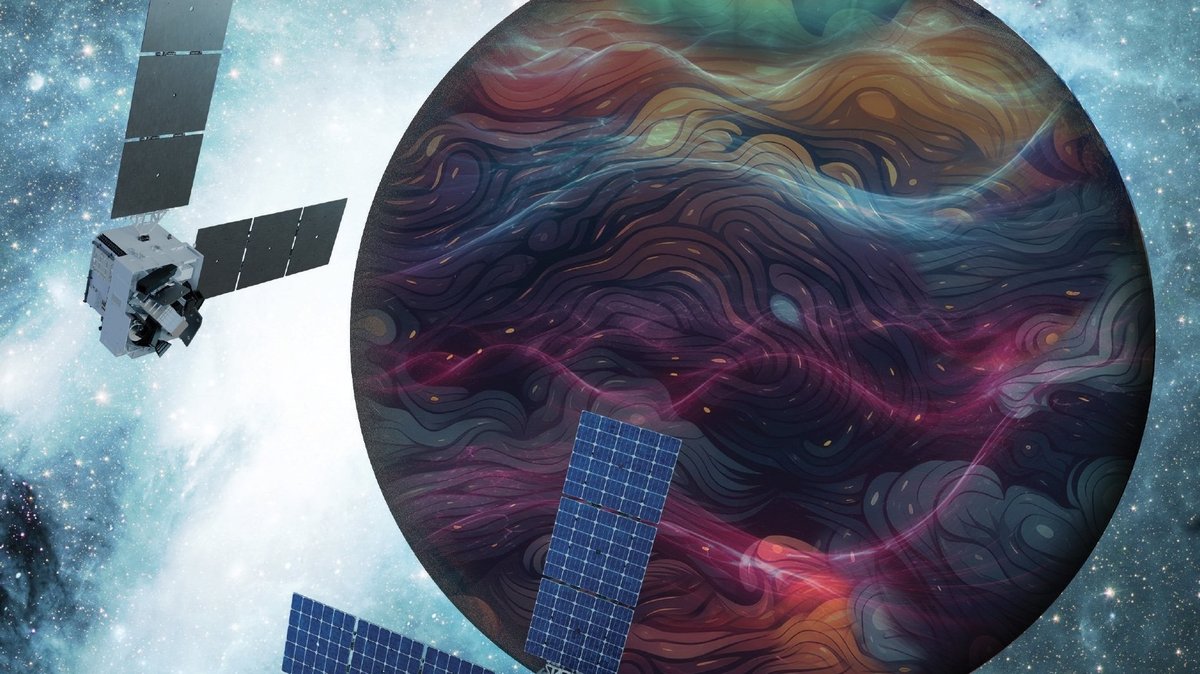
NASA has selected the DAPHNE mission concept to enter Phase B, moving a twin-satellite investigation closer to flight as scientists work to solve a difficult space weather puzzle. The mission will study how activity in Earth’s lower atmosphere can shape the upper atmosphere, where disturbances can affect GPS, satellites in low Earth orbit and astronauts in space.
The mission’s full name is Dynamic Atmosphere-Ionosphere Explorer. Its plan calls for two identical satellites that will make coordinated measurements in the thermosphere. That region sits high above the surface, where the familiar air below gradually gives way to the charged particles of near-Earth space.
NASA says the mission is designed to improve space weather prediction. Better forecasts could help protect technologies that modern life depends on, including satellite navigation, communications and spacecraft operations.
NASA Selects DAPHNE for Mission Design
With the selection, DAPHNE now enters Phase B of development. In NASA mission planning, this phase focuses on detailed design work for the spacecraft, flight systems and mission operations. It’s a key step between an early concept and a confirmed space mission.
DAPHNE was proposed in response to the DYNAMIC mission announcement of opportunity. DYNAMIC stands for Dynamical Neutral Atmosphere-Ionosphere Coupling, a NASA effort aimed at studying how Earth’s weather and atmospheric motion influence space weather above the planet.
The mission is led by Aimee Merkel of the Laboratory for Atmospheric and Space Physics at the University of Colorado Boulder. NASA’s Solar Terrestrial Probes program at Goddard Space Flight Center provides funding and management oversight.
“NASA is advancing the United States’ leadership as a space weather-ready nation,” said Nicky Fox, associate administrator of NASA’s Science Mission Directorate. Her statement highlights the agency’s larger goal, using science missions to prepare for the effects of space weather on Earth and beyond.
Twin Satellites Will Track Earth’s Upper Atmosphere
DAPHNE will use two identical satellites to take coordinated measurements from more than one point at the same time. That twin-spacecraft design matters because the upper atmosphere changes constantly. A single spacecraft can record what happens along one path, while two spacecraft can help researchers separate motion across space from changes through time.
The mission will measure neutral winds, temperature and composition in the thermosphere. Neutral winds are flows of ordinary uncharged particles. They move through the upper atmosphere and can influence how the region responds to energy from below and from space.
NASA describes the concept as low risk and high return. The return comes from observing the upper atmosphere in a way that links physical conditions there with energy rising from the lower atmosphere. Those measurements are expected to feed future models used for space weather prediction.
During an earlier NASA selection of DYNAMIC mission concepts, Peg Luce, then acting director of NASA’s Heliophysics Division, said, “These mission concepts provide an opportunity to study the coupled Earth system.” That idea is central to DAPHNE. The mission treats Earth’s atmosphere and near-Earth space as connected parts of one moving system.
Why Space Weather Matters for GPS and Satellites
Space weather begins with energy and particles from the Sun, but its effects near Earth depend on the planet’s own atmosphere and magnetic environment. When the upper atmosphere swells, shifts, or becomes electrically disturbed, satellites can feel the consequences.
For GPS, the ionosphere is especially important. Navigation signals must pass through this charged region on their way from satellites to receivers on the ground. Changes in the ionosphere can alter those signals and reduce accuracy. For aviation, shipping, emergency response, agriculture and everyday phone navigation, even small errors can matter.
Satellites in low Earth orbit also fly through the outer edges of Earth’s atmosphere. When the upper atmosphere heats and expands, drag can increase. More drag can change orbits and make satellite tracking more difficult. Spacecraft operators need better forecasts to plan maneuvers and reduce risk.
Astronauts also face space weather hazards. NASA’s announcement points to future exploration beyond Earth’s magnetic protection, including missions to the Moon and Mars. Better knowledge of near-Earth space weather can help mission planners anticipate dangerous conditions and protect crews during travel and surface operations.
Luce summarized the broader challenge during NASA’s DYNAMIC concept-stage announcement: “The proposed missions will help us better understand how Earth’s atmosphere interacts with the space environment.” DAPHNE carries that goal forward with a targeted focus on the upper atmosphere.
The Thin Shell Where Air Meets Space
The thermosphere and ionosphere form a thin shell around Earth where the planet’s neutral atmosphere transitions into the ionized plasma of space. In simple terms, this is the boundary region where ordinary air and electrically charged particles share the same environment.
The ionosphere contains atoms and molecules that have been split into charged particles by solar radiation. The thermosphere is a very high layer of Earth’s atmosphere where temperatures can rise sharply because particles absorb high-energy sunlight. Together, these regions help determine how space weather appears near Earth.
This region is in constant motion. Solar activity can heat it from above. Waves, winds and energy from the lower atmosphere can disturb it from below. Magnetic and electric processes in near-Earth space can also shape what happens there.
That combination makes prediction hard. A disturbance in the ionosphere may come from a solar event, from changes in the lower atmosphere, or from interactions among several processes at once. DAPHNE’s job is to help untangle those drivers with direct measurements.
The mission’s focus on composition is also important. The mix of particles in the thermosphere affects how the region stores energy, moves and interacts with the ionosphere. By measuring winds, temperatures and composition together, DAPHNE can give researchers a fuller view of upper-atmosphere behavior.
Lower-Atmosphere Energy Could Improve Forecasts
Weather near the ground can influence the edge of space in surprising ways. Large-scale atmospheric waves, tides and energy patterns can travel upward. By the time they reach the thermosphere and ionosphere, they can alter winds, temperatures and charged-particle behavior.
DAPHNE is designed to incorporate lower-atmospheric energy data into the study of the upper atmosphere. That approach could improve space weather models by giving scientists a better picture of what comes from below. Forecasts that include only solar inputs can miss part of the story.
For general readers, the idea is similar to weather forecasting on Earth. Better forecasts require better observations of the moving system. Meteorologists improved surface weather prediction by measuring temperature, pressure, humidity and winds across large areas. Space weather forecasting needs its own version of that observational leap.
The twin satellites will give scientists coordinated, multi-point measurements. Those observations can reveal whether a feature is traveling, spreading, intensifying, or fading. That distinction is crucial for models that try to predict conditions before they affect satellites and communications.
DAPHNE also fits into NASA’s broader heliophysics fleet. Heliophysics studies the Sun and its influence across the solar system, including the space environment around Earth. By adding upper-atmosphere measurements, DAPHNE will help connect solar activity, atmospheric dynamics and practical space weather forecasting.
Launch Timeline and Mission Cost
NASA says DAPHNE will undergo a confirmation review in 2027. That review will examine the mission’s progress and the availability of funds. If the mission is confirmed, it will move toward later development and eventual launch readiness.
The current launch date is no earlier than 2029. That schedule gives the mission team time to refine the spacecraft design, prepare instruments, plan operations and address the risks that come with flying two coordinated satellites.
If confirmed, DAPHNE’s total estimated cost will stay below $250 million in fiscal year 2023 dollars, excluding launch. That cost cap reflects the mission’s place within a focused NASA science program, where targeted spacecraft can answer specific questions without the scale of a flagship mission.
The mission’s next steps will decide how its concept becomes a working observatory in orbit. Engineers must design reliable spacecraft. Scientists must refine measurement plans. Mission operators must prepare for coordinated flying and data collection.
For NASA, the payoff is a clearer view of the atmospheric machinery that links Earth to space. For everyone who relies on satellites, navigation, communications and human spaceflight, that clearer view could become a practical tool for preparing for the next space weather disturbance.