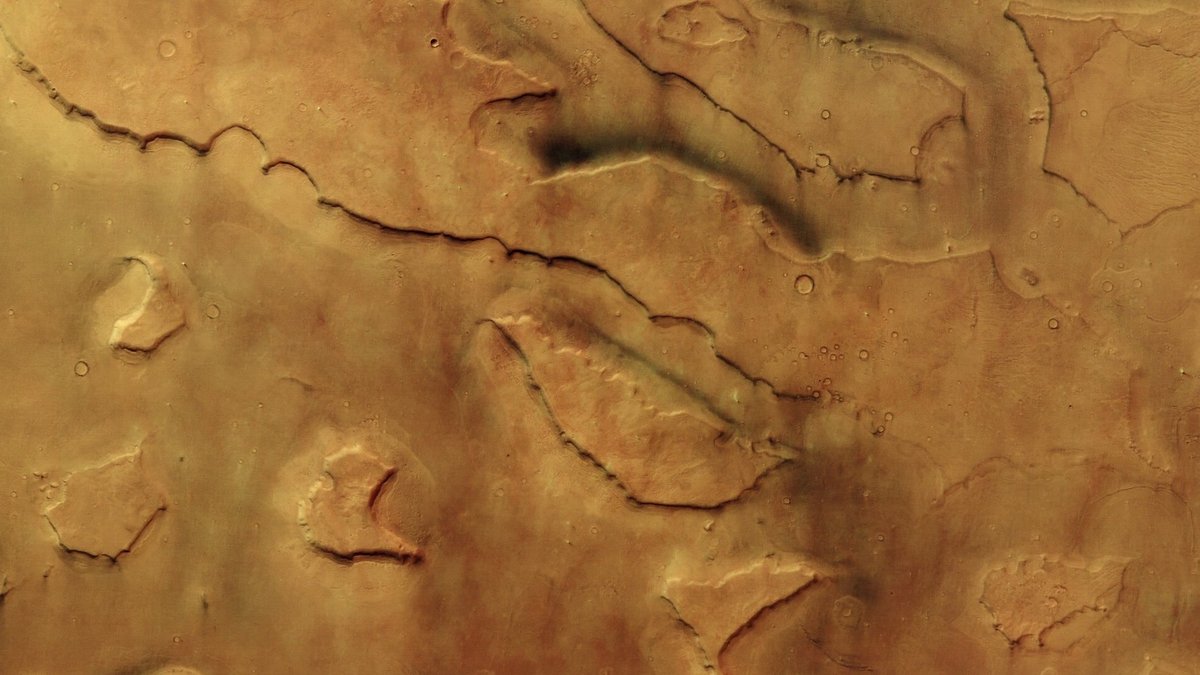
At the German Aerospace Center, DLR, researchers have released new images from ESA’s Mars Express mission showing dozens of active dust devils scattered across Mamers Valles, a sprawling valley system on Mars. The scene captures fleeting winds at work on a landscape whose deeper scars were carved by ancient water, ice and geologic change.
The new views come from Mars Express, a European Space Agency orbiter that has been studying the Red Planet since 2003. Its camera system caught more than 30 small, bright dust features in one scene. Each marks a moving column of dust rising from the surface, shaped by sunlight, thin air and shifting winds.
These dust devils are brief events, yet they matter far beyond their size in an image. On Mars, dust can influence weather, surface temperatures, solar power and the long-term behavior of the atmosphere. A single whirl may fade quickly. Thousands of them, across many seasons and regions, help reveal how Mars moves material around the planet.
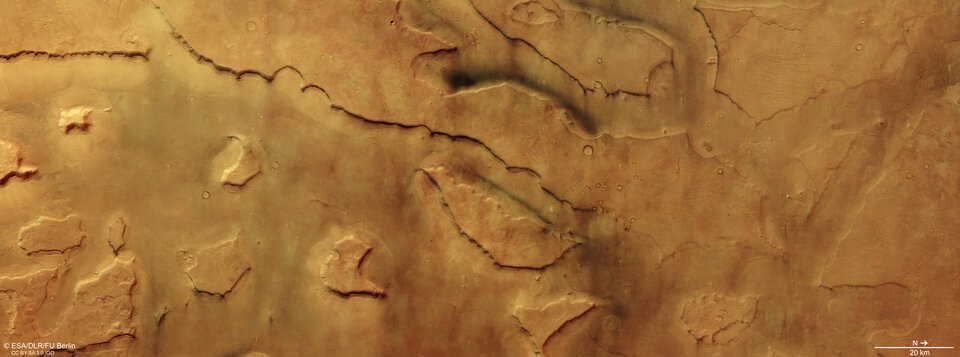
Dozens of Dust Devils in One View
The most striking part of the new Mamers Valles image is its crowd of tiny moving storms. More than 30 active dust devils appear as small yellow dots with pinkish trailing shadows. The colors come from the way Mars Express combines separate camera views into a single image product.
Dust devils form when the Sun heats the Martian surface. Warm air near the ground begins to rise. If local winds and surface conditions line up, that rising air starts to rotate. Dust is pulled into the spinning column, making the invisible motion of the air visible from orbit.
On Earth, similar whirls appear in dry deserts and dusty open landscapes. Mars gives them room to grow into larger forms. According to ESA and DLR mission materials, Martian dust devils can tower up to eight kilometers high, travel for kilometers at a time and reach speeds of up to 45 meters per second.
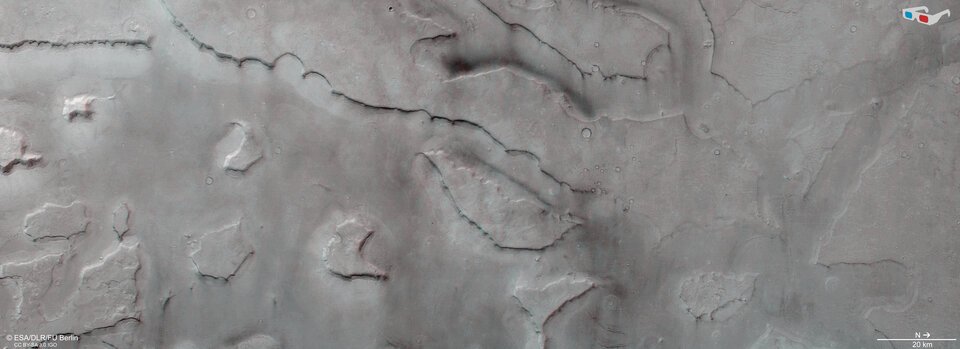
In the Mamers Valles scene, the dust devils are small marks inside a much larger terrain. That contrast is part of what makes the image valuable. A valley shaped over billions of years is hosting atmospheric events that may last only minutes. The same frame records deep time and passing weather together.
How Mars Express Caught Moving Whirlwinds
To catch these whirlwinds, Mars Express relies on the High Resolution Stereo Camera, known as HRSC. The instrument was developed and is operated by DLR. It views the Martian surface through multiple camera channels, which can observe in different colors and from different angles.
A single finished HRSC image is built from sequential views. When the surface stays unchanged during the imaging sequence, the channels line up cleanly. A moving feature creates a mismatch. That mismatch lets dust devils stand out against the surrounding ground.
This imaging approach gives scientists more than a pretty view. By comparing the alignment of camera channels, researchers can infer the direction and speed of moving dust devils. Similar techniques have been used with data from Mars Express and ESA’s ExoMars Trace Gas Orbiter.
Those broader studies have tracked more than 1,000 tornado-like storms on Mars. The result is a moving map of near-surface winds, traced by dust as it rises from the ground. For a planet with few weather stations on the surface, every moving dust column becomes a useful marker.
That makes Mamers Valles especially interesting. The new scene shows many active vortices in a single landscape, which gives scientists a rare glimpse of local wind behavior across rough terrain. Valleys, cliffs, mesas and slopes can steer air in complicated ways. Dust devils make some of that motion visible.
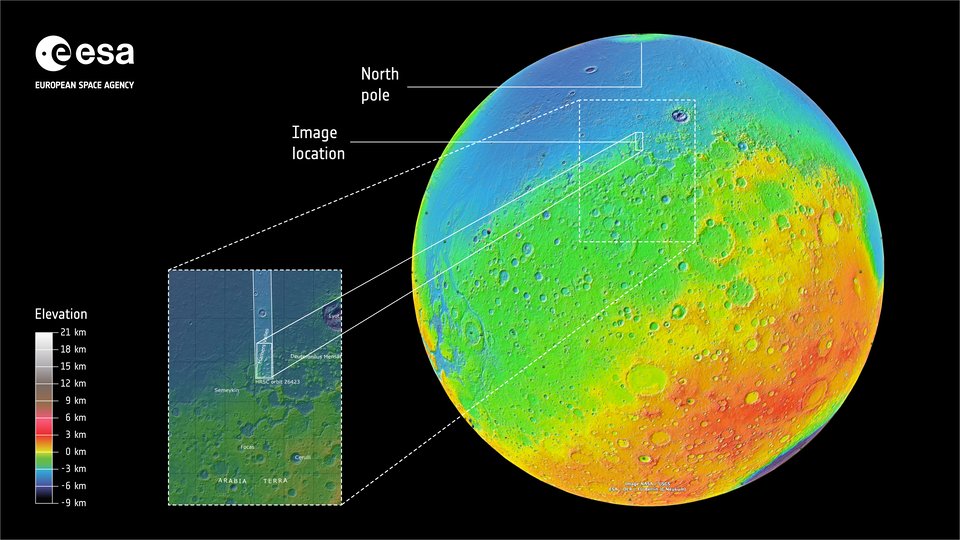
A 1,000-Kilometer Valley Shaped by Ice and Water
Mamers Valles is a vast system of canyons and valleys etched into Mars’s surface. It stretches for around 1,000 kilometers, crossing from the ancient southern highlands toward the northern lowlands. In places, the channels reach up to 25 kilometers wide and about 1.2 kilometers deep.
The name Mamers Valles was adopted in 1976. “Mamers” comes from an ancient Oscan word meaning Mars, while “Valles” means valley. The name fits a region that looks like a broken network of channels, cliffs and flat-topped hills.
Scientists describe this kind of landscape as fretted terrain. It is marked by fragmented highland material, steep scarps, valleys and isolated mesas. The result looks like land that has been carved apart and partly rearranged by erosion and flow.
The new images show more than wind activity. They also display the bones of an older Martian environment. Long ridges and textured valley floors point to past movement by ice-rich material. Other features suggest water or lava once helped shape parts of the region.
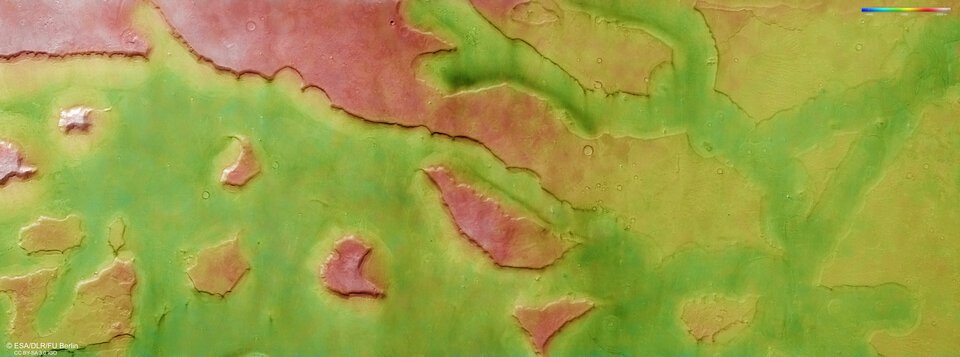
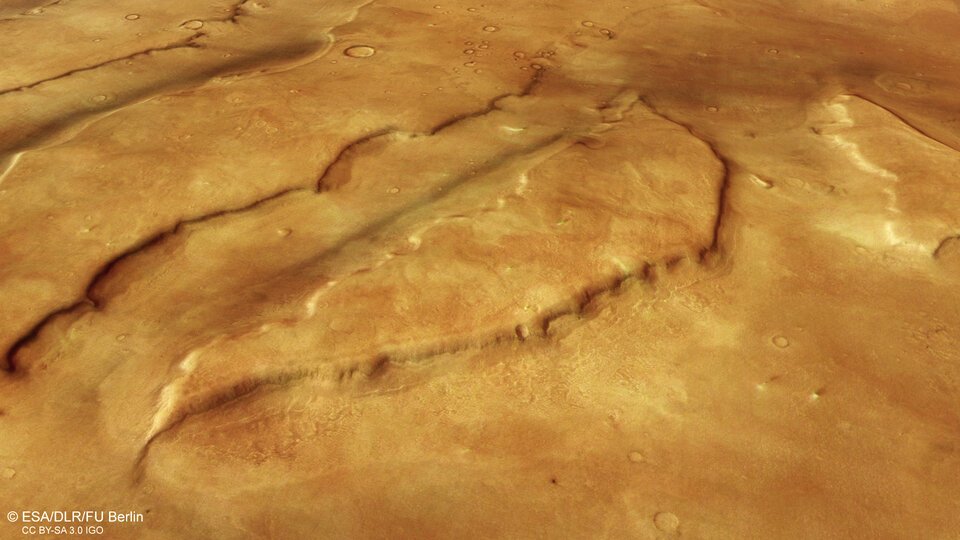
The topographic view helps explain the scale. Mamers Valles crosses a major transition zone between highlands and lowlands. Material moving through that boundary had enough energy to cut deep channels. Over time, erosion left behind mesas and cliffs that now frame the valley system.
Buried Glaciers Beneath Rock and Dust
Some of the most important features in the region sit below a protective cover. Around the steep slopes and valley floors, Mars Express sees signs of debris-covered glaciers. These are deposits where water ice remains hidden beneath rock and dust.
Water ice is vulnerable at the Martian surface today. The planet’s thin atmosphere allows exposed ice to escape into the air over time. A layer of rocky debris can slow that loss. In Mamers Valles, that covering appears to have helped preserve ice-related landforms.
The valley floors show long ridges and flowing textures. These patterns likely formed as debris-covered glaciers moved down both sides of the valley and met near the middle. Similar icy signatures appear along steep cliffs and hillsides.
These buried ice deposits are valuable records of Martian climate. Ice can survive where temperature, latitude, shade and surface cover work together. Its presence tells scientists that Mars’s mid-latitude regions have stored water in ways that are still visible from orbit.
Wind adds another layer to the story. Dust devils sweep across the same terrain that preserves icy traces from the past. They can lift surface dust, expose darker material and move fine grains from one part of the landscape to another. The ancient valley is still being modified, grain by grain.
A Landscape From Mars’s Wetter Past
Mamers Valles dates back roughly 3.8 billion years, to a period of Martian history known as the late Noachian period. This was a major turning point for the planet. Mars was shifting away from a warmer, wetter and more geologically active past toward the cold, dry world seen today.
The region carries marks of that transition. Channels suggest flowing material once crossed the surface. Glacial textures point to ice moving through valleys and along slopes. Dark patches may be volcanic sands that formed nearby or were swept into place by winds.
That mixture of features makes the valley a natural archive. Water, lava, ice and dust each left a different kind of signature. Mars Express can read some of those signatures because HRSC records the surface in color and in three dimensions.
The dust devils add a modern atmospheric layer to this ancient record. They show that Mars remains active at the surface, even under present-day cold and dry conditions. The planet’s atmosphere is thin, yet it still drives winds strong enough to lift dust high into the air.
This matters for Mars science and future exploration. Dust affects visibility, spacecraft operations, solar panels and thermal conditions. It also shapes how scientists interpret surface colors and textures from orbit. A dusty coating can hide, reveal, or rearrange clues about the rocks below.
Two Decades of Mars Express Discoveries
Mars Express launched in 2003 and has spent more than two decades mapping the Red Planet. The spacecraft carries eight instruments, including HRSC. Together, they have helped scientists study the Martian surface, atmosphere, subsurface and mineral record.
HRSC has been central to that work. The camera maps Mars at high resolution, in color and in three dimensions. Its stereo imaging helps researchers measure slopes, depths and terrain shapes. In places like Mamers Valles, that 3D view is essential for connecting surface textures to past movement by ice or water.
The image products are the result of a long collaboration. The HRSC camera is operated by DLR. Systematic processing of the camera data took place at the DLR Institute of Space Research in Berlin-Adlershof. The Planetary Science and Remote Sensing group at Freie Universität Berlin used the data to create the finished image products.
Mars Express has visited this broader region before. Earlier images showed parts of Mamers Valles and neighboring Deuteronilus Mensae. The new release builds on that long record by capturing a moment when dozens of dust devils were active across the scene.
For researchers, the value lies in the overlap between geology and weather. The same orbiter can reveal buried glaciers, ancient channels, valley walls and moving dust. Each view adds detail to the story of how Mars became the planet we see today.
The new Mamers Valles images also show why long missions remain powerful. A spacecraft that keeps watching can catch rare alignments of landscape, lighting, season and weather. In this case, Martian dust cycle activity appeared across a valley that already preserves billions of years of planetary history.
From orbit, the dust devils look like tiny marks. In scientific terms, they are tracers of wind, dust transport and surface change. Mars Express has turned those short-lived whirlwinds into clues about a world that is still moving under a pale Sun.