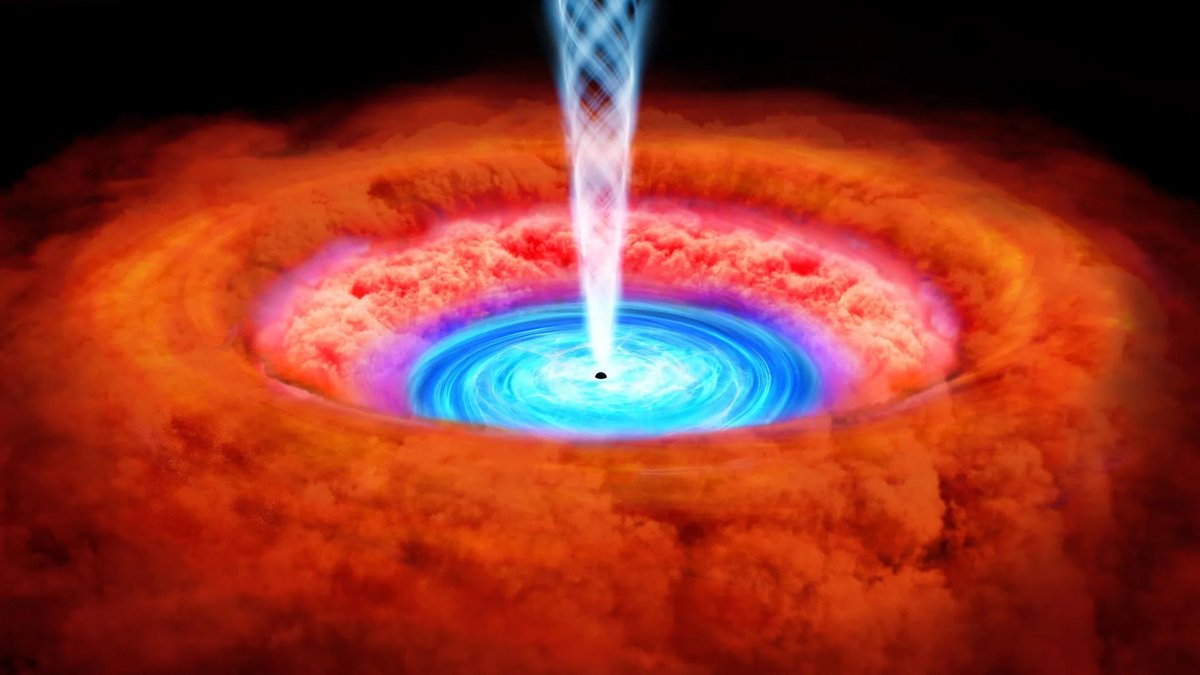
A study in XRISM spectroscopy found that winds from the active center of the galaxy NGC 4151 may be powerful enough to affect the gas supply that galaxies need to form new stars. Led by Xin “Cindy” Xiang and Jon M. Miller at the University of Michigan, the research uses unusually sharp X-ray observations to probe how a feeding supermassive black hole can launch layered streams of hot material into space.
The finding reaches into one of astronomy’s long-running puzzles. The universe’s largest galaxies should have made more stars than astronomers actually see. Something appears to slow their growth. The new XRISM results strengthen a leading explanation, where energy from central black holes can heat or expel the gas that would otherwise become future generations of stars.
At the center of the work is NGC 4151, a nearby active galaxy a little more than 50 million light-years from Earth. Its core is bright in X-rays because gas and dust are falling toward a central supermassive black hole. That makes it an unusually useful target for watching black hole winds in action.
The paper’s abstract puts the stakes plainly: “The hottest, most ionized and fastest winds driven by accretion onto massive black holes have the potential to reshape their host galaxies.” For giant galaxies, that reshaping can influence how much star-making fuel remains available over cosmic time.
XRISM Sees Black Hole Outflows in New Detail
XRISM, short for the X-Ray Imaging and Spectroscopy Mission, is giving astronomers a more detailed view of the gas near active black holes. The mission is led by the Japanese Aerospace Exploration Agency, with NASA and the European Space Agency as partners. Its key strength is its ability to separate X-ray energies with much finer precision than earlier instruments.
That matters because black hole winds leave fingerprints in X-ray light. When hot gas lies between the black hole’s bright inner region and the telescope, atoms in the wind absorb certain X-ray energies. Those missing slices of light reveal the wind’s speed, ionization and structure.
Earlier observations could identify broad signs of outflowing gas. XRISM can resolve finer features. In NGC 4151, that sharp view allowed the team to separate multiple wind components that would otherwise blend together. The result is a more physical picture of the region around the accretion disk, where material spirals toward the black hole before some of it is flung back out.
The study reports slow “warm absorber” winds, faster outflows and ultrafast outflows appearing in the same system. These layers point to a multiphase wind. In everyday terms, the black hole environment seems to drive several streams of gas at once, each with different speeds and physical conditions.
For astronomers, this is a major step because feedback from black holes depends on numbers. A faint or slow wind might stir gas locally. A fast and massive wind can carry enough energy to change the galaxy around it. XRISM gives researchers the spectral detail needed to estimate those quantities more reliably.
A Nearby Galaxy Becomes a Cosmic Test Lab
NGC 4151 is especially valuable because it is bright in the X-ray band observed by XRISM. It belongs to a class of galaxies with an active galactic nucleus, or AGN. In these systems, the central supermassive black hole is surrounded by a luminous disk of infalling material.
That disk is an extreme engine. Gravity pulls gas inward. Friction and compression heat the material until it becomes a hot plasma. As the gas moves through this violent region, magnetic fields and radiation can help drive some of it away from the black hole.
The University of Michigan team and collaborators focused on five XRISM observations of NGC 4151 obtained in 2023 and 2024. Those observations allowed them to inspect the Fe K band, a part of the X-ray spectrum where highly ionized iron can reveal fast-moving gas close to the black hole.
The galaxy’s distance also helps. At a little more than 50 million light-years away, NGC 4151 is close enough by cosmic standards for detailed study. Its bright nucleus gives XRISM a strong signal. Together, those features make it a natural laboratory for studying black hole winds that may operate in more distant and massive galaxies.
Fast Winds That Can Clear Out Star Fuel
Stars form from cold gas. When a galaxy keeps a large supply of that gas, it can keep making stars. When gas is heated, scattered, or pushed out, star formation can slow. This is why black hole winds are so important for models of galaxy evolution.
In the XRISM study, some of the fastest components in NGC 4151 carry impressive energy. The paper reports ultrafast outflow speeds in the range of about 0.033 to 0.33 times the speed of light. That places the strongest winds in a regime where they can have galaxy-scale consequences.
The researchers found that all wind components have mass flow rates comparable to or greater than the mass accretion rate. That means the outflowing gas can rival the amount of material feeding the black hole. In some zones, the wind may carry away more mass than the black hole is taking in.
The most important pieces are the fastest outflows. The study reports that two ultrafast components have kinetic luminosities above a commonly used theoretical threshold for stripping gas from a galaxy’s central bulge. In plain language, those winds appear energetic enough to remove or disturb the raw material that could otherwise form stars.
This helps explain why supermassive black holes are central players in the lives of galaxies. They occupy tiny regions compared with their host galaxies. Their outflows can still inject enormous energy into surrounding gas. Over long spans of time, that energy can help determine whether a galaxy keeps building new stars or settles into a quieter phase.
A New Timing Clue From X-Ray Flares
Xiang’s more recent analysis adds a timing clue to the picture. By examining hundreds of days of XRISM observations of NGC 4151, she looked at how fast winds appear in relation to X-ray flares from the active nucleus.
The focus was both brightness and spectral character. Astronomers describe X-rays as hard or soft depending on their energy. Harder X-rays carry more energy. Softer X-rays carry less. Tracking those changes can reveal how the inner accretion disk and wind respond to shifts in the black hole’s feeding environment.
The surprising pattern was specific. In NGC 4151, the strongest fast winds appeared when X-rays were hard but relatively faint. The fastest outflows tended to show up about 10,000 seconds after bright X-ray flares. That is just under three hours.
This timing connection matters because AGN winds can change dramatically. A single observation may catch a wind in one state and miss another. A delay between flare activity and wind appearance gives researchers a way to connect events near the black hole with the material that later streams outward.
The result points toward a more dynamic view of accretion disks. The disk can brighten, shift its X-ray color and then launch or reveal a fast wind after a measurable delay. That sequence gives astronomers a new handle on the physics that links black hole feeding to galaxy feedback.
What “Cindicity” Could Reveal
To organize those changes, Xiang combined the X-ray brightness and hardness measurements into a new metric called the color intensity index. Miller suggested the shorter name “cindicity,” a nod to Xiang’s first name, Cindy.
The idea is practical. If a source has a certain combination of X-ray color and brightness, astronomers may be able to estimate how likely it is to show a fast outflow at that moment. That could help researchers plan future observations and interpret large sets of AGN data.
According to Xiang, the goal is to make the metric predictive. “Partly because my name is Cindy,” she said. “But the idea is that, in the future, you could tell me the cindicity of your source at this moment and I can tell you the probability that you’re seeing a fast outflow.”
That kind of timing tool could be valuable because telescope time is limited. Fast winds can be fleeting. If researchers know when an AGN is most likely to produce a detectable outflow, they can aim high-resolution observations at the most revealing moments.
The work is still developing. The paper notes that the wind system is complex and variable. NGC 4151 shows multiple layers, shifting emission and signs of changing geometry. Those details make the galaxy rich scientifically, while also making the interpretation challenging.
Why Giant Galaxies Have Fewer Stars Than Expected
The broader puzzle is simple to state. The largest galaxies contain less stellar mass than many models predict. Over cosmic time, they had access to large reservoirs of gas and deep gravitational wells. Yet their star formation seems to have been curtailed.
Accretion-driven winds offer one solution. When a black hole feeds, its accretion disk can release enormous energy. Some of that energy emerges as radiation. Some can be carried by jets or winds. If the energy couples to surrounding gas, it can heat the gas or push it outward.
XRISM’s view of NGC 4151 gives astronomers a detailed local example of that process. The galaxy is far smaller and closer than the most massive galaxies whose missing stars motivate the mystery. Still, the physics near its active black hole can reveal mechanisms that may scale across cosmic history.
The study also points to magnetic forces as a possible driver. The bulk properties of the observed winds are consistent with magnetocentrifugal driving. In that scenario, magnetic fields anchored in the rotating disk can help fling material outward, somewhat like a bead sliding along a spinning wire.
Other mechanisms may contribute as well. Radiation pressure can push on gas. Disk structure can change with time. The researchers describe a complicated system where slow winds, very fast outflows and ultrafast components coexist. That layered structure is exactly the kind of detail astronomers need to build better galaxy models.
The next step is to apply similar timing and spectral analysis to more active galaxies. If the same patterns appear elsewhere, black hole winds will become easier to track across many environments. That could help explain how small central engines influence the growth of the largest galaxies in the universe.