The European Space Agency has approved a broad new push for European space science, extending 13 missions and adopting Arrakihs as its next fast-class mission, according to an official announcement following a Science Programme Committee meeting in Tenerife on June 10 and 11, 2026.
The decisions reach across the Solar System and beyond. They keep veteran observatories working, give Solar Orbiter more time to view the Sun from new angles and move a small galaxy-mapping mission toward launch by the end of 2030. ESA also moved closer to choosing Plasma Observatory, a proposed seven-spacecraft mission that would study how energy moves through space around Earth.
For Europe’s science community, the meeting was a planning milestone. ESA’s Science Programme turns ideas from researchers into missions that can operate for decades. The program is overseen by the Science Programme Committee, where representatives from ESA’s 23 Member States vote on major steps in mission development.
Europe Locks In Its Next Wave of Space Science
ESA’s Science Programme Committee endorsed extensions for 13 missions whose current science phases were due to end before the close of 2026. The committee also approved the adoption of Arrakihs, ESA’s second fast-class mission. Adoption means ESA and its Member States have committed to building and launching it.
That combination matters because space science works on long timelines. A telescope or probe can take years to design, years to build and years more to reach its best scientific targets. By extending active missions and adopting a new one, ESA is keeping current discoveries flowing while preparing the next generation of observations.
The ESA Science Programme is community-driven. Scientists help define the questions, ESA studies technical feasibility and Member States shape the final program. Professor Carole Mundell, ESA’s Director of Science, said the approach helps the agency match missions to scientific need. “Being motivated by the scientific community means that we can build world-leading space missions,” she said.
The committee’s decisions also show how ESA balances several kinds of science at once. Some missions observe planets, some watch the Sun, some study galaxies and others measure energetic environments around Earth. Together, they give researchers a connected view of the physical processes that shape space.
13 Missions Win More Time in Space
The 13 extended missions include spacecraft and observatories that study Mercury, Mars, the Sun, exoplanets, X-rays, galaxy formation and the distant Universe. ESA leads or co-leads ten active space science missions and participates in six more led by international partners. The extension decision keeps many of those collaborations moving.
An initial science operations phase typically lasts up to five years. After that, a mission’s future depends on whether it can keep producing valuable new science. The committee endorsed all 13 missions that came up for review, reflecting confidence that their instruments, teams and observing plans can still serve researchers.
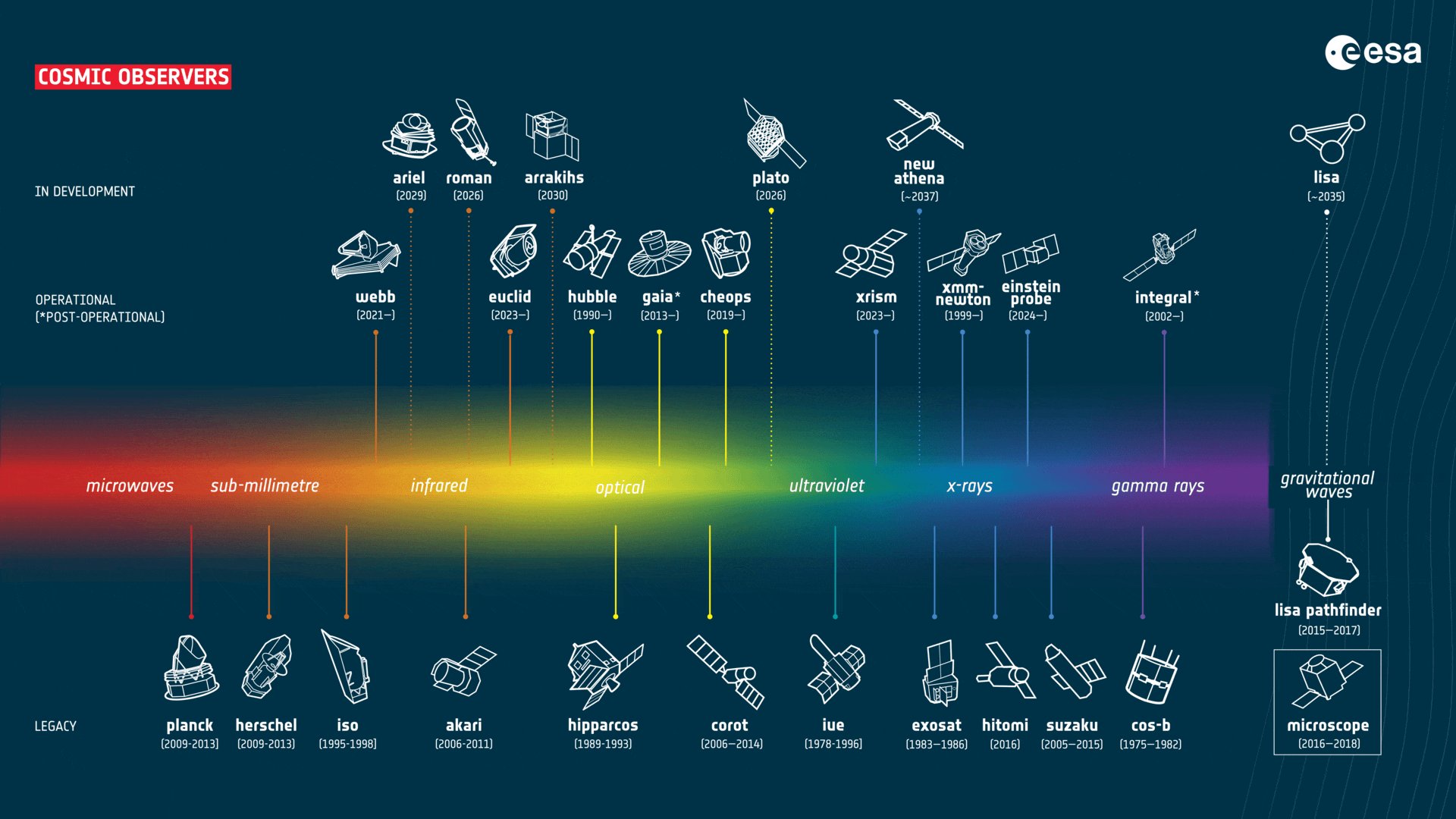
The extended missions are BepiColombo, Cheops, Einstein Probe, Hinode, Hubble, IRIS, Mars Express, Proba-3, SOHO, Solar Orbiter, Webb, XMM-Newton and XRISM. The group spans generations of space hardware. It includes long-running observatories such as Hubble and SOHO, newer missions such as Proba-3 and major international observatories such as Webb.
BepiColombo is on its way to Mercury, while Mars Express continues to study the Red Planet after more than two decades in space. Cheops investigates planets around other stars. XMM-Newton observes the Universe in X-rays, revealing hot gas, black holes, neutron stars and other extreme environments.
Several partner-led missions are also part of the extension group. Hubble and Webb are central observatories for astronomy. Hinode and IRIS study the Sun. XRISM studies X-ray light from energetic cosmic sources. By keeping these missions active, ESA preserves access to data streams that many researchers depend on.
Solar Orbiter Gets a Longer Look at the Sun’s Poles
The extension is especially important for Solar Orbiter, ESA’s Sun-studying mission launched in 2020. The spacecraft is now delivering humanity’s first views of the Sun’s poles, regions that are difficult to see from Earth and most space observatories.
Those polar views could help scientists understand the Sun’s magnetic behavior. The Sun’s magnetic field drives solar storms, shapes the solar wind and influences space weather throughout the Solar System. Much of that activity connects to processes that begin deep inside the Sun and emerge through its atmosphere.
Solar Orbiter is designed to fly close to the Sun and gradually tilt its orbit. As the mission reaches higher latitudes, it can see the solar poles from better angles. The extension gives the spacecraft more time to climb into those viewing geometries and gather observations that were planned as a core part of its scientific payoff.
The poles are scientifically valuable because they hold clues about the solar cycle. Every 11 years or so, the Sun’s magnetic activity rises and falls. During that cycle, the magnetic poles reverse. Better polar measurements could help researchers connect that large-scale flip to eruptions, flares and the flow of charged particles into space.
Solar Orbiter also works with other missions that watch the Sun from different positions. SOHO, Hinode, IRIS and Proba-3 each study solar activity in distinct ways. Combining those observations can help scientists track the Sun from its surface to its outer atmosphere and into the surrounding solar wind.
Arrakihs Becomes ESA’s Next Galactic Archaeologist
Arrakihs received formal adoption on June 10, making it ESA’s second fast-class mission. These missions use existing technology in compact, focused ways. The goal is to move from selection to launch on a shorter schedule than larger missions while still addressing a major scientific question.
Arrakihs will study the faint light from galaxy haloes, the diffuse regions of stars and gas that surround galaxies. These haloes can preserve traces of past mergers and encounters. By reading those faint structures, researchers can study how galaxies grew over cosmic time.
ESA describes Arrakihs as a kind of galactic archaeologist. The mission will look for low surface brightness features around galaxies, including streams, shells and extended stellar haloes. These delicate structures are difficult to observe because their light is spread thinly across the sky.
The mission is expected to launch by the end of 2030. Spain has a leading role in its development and Member States are central to the fast-class model. Arrakihs follows the idea that a tightly focused mission can open a fresh window on a major astrophysical problem.
Its science also complements wider efforts to understand dark matter and galaxy assembly. The shapes and distributions of stellar haloes can carry information about how smaller galaxies were absorbed into larger ones. Arrakihs will give researchers a targeted way to examine those fossil records in nearby galaxies.
A Seven-Spacecraft Plasma Observatory Moves Closer
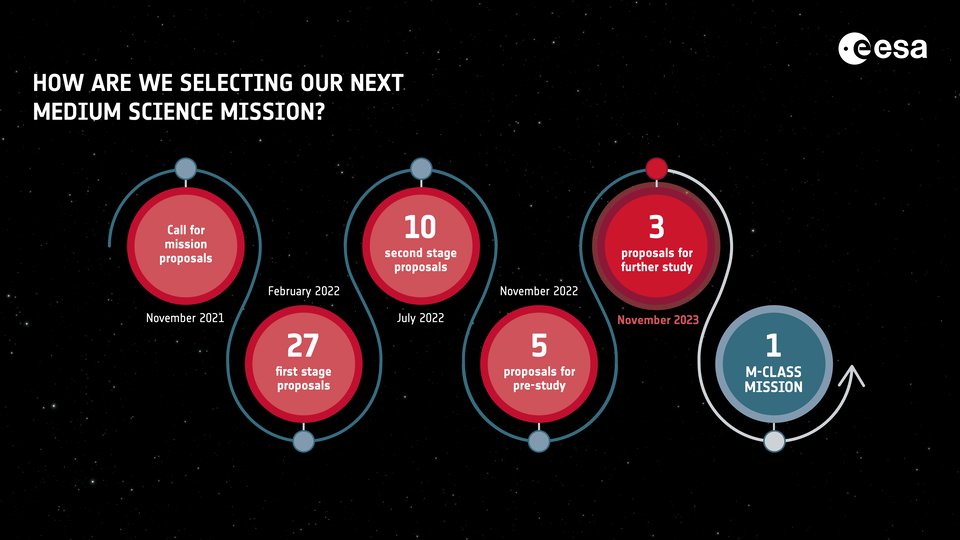
ESA also proposed Plasma Observatory as the next medium-class mission in its Science Programme. The committee took note of that recommendation and is expected to make a formal decision at its next meeting in November 2026.
Plasma Observatory would study how plasma from the Sun interacts with Earth’s magnetosphere, the magnetic bubble that helps shape our planet’s space environment. Plasma is a gas of charged particles. In space, it carries energy, responds to magnetic fields and drives many of the most dynamic events around stars and planets.
The proposed mission would use seven spacecraft to observe the same environment at several scales at once. That point is central to the mission concept. Previous missions, including ESA’s Cluster mission, showed that plasma interactions occur across distances from a few kilometers to tens of thousands of kilometers. They also unfold across timescales from milliseconds to minutes.
Cluster used four spacecraft and revealed the power of multi-point measurements. Plasma Observatory would expand that strategy. By measuring linked processes at multiple scales simultaneously, the mission could help scientists see how small bursts of energy connect to larger flows through the magnetosphere.
The stakes reach beyond Earth. ESA notes that plasma makes up 99% of the visible Universe. The energy transfer seen around Earth can serve as a nearby laboratory for processes that also occur around the Sun, in supernova remnants and in distant galaxies. Earth’s magnetic environment gives scientists a place where spacecraft can sample those processes directly.
Why These Decisions Reach Into the 2030s
Medium-class missions form the backbone of ESA’s Science Programme. Solar Orbiter and Euclid are current examples. Plasma Observatory would become the first medium-class mission in Voyage 2050, ESA’s long-range plan for space science from the 2030s toward mid-century.
The meeting in Tenerife also showed how mission planning happens in stages. In 2023, the science community narrowed the next medium-class mission shortlist to three finalists. Since then, scientists and engineers have assessed the concepts for science return, technical feasibility and fit with other missions. ESA has now recommended Plasma Observatory, while the committee’s formal decision is scheduled for November 2026.
That staged process helps ESA protect long-term scientific value. Space missions require stable budgets, careful engineering and international coordination. ESA’s Science Programme is part of the agency’s mandatory activities, which means all Member States contribute and participate. That structure supports planning cycles that stretch across decades.
The program has already passed through several planning eras. Horizon 2000 guided missions from 1985 to 2005. Horizon 2000+ followed, then Cosmic Vision. Voyage 2050 now sets the frame for the next long span of European space science, with new missions expected to ask questions about planets, stars, galaxies and the fundamental behavior of matter in space.
Professor Mundell framed the goal in practical terms. “Our aim is to provide the best missions possible to encourage technological innovation and scientific discoveries across our Member States,” she said. With 13 extended missions, Arrakihs adopted and Plasma Observatory moving toward a decision, ESA has laid out a science path that runs well into the 2030s.