A 2026 SETI paper by astrophysicist Brian C. Lacki proposes a striking place to look for traces of ancient extraterrestrial technology, the dust and soil of our own Moon. The preprint argues that long-dead alien megastructures could, in principle, grind themselves into microscopic debris that drifts between stars. Some of that material may have crossed the Solar System and become trapped in quiet places such as lunar regolith.
The idea is speculative and it comes from a preprint rather than a peer-reviewed journal article. Even so, it points to a serious challenge in the search for extraterrestrial intelligence. Civilizations may be separated by vast stretches of time as well as space. A radio signal can fade. A transmitter can shut down. A fragment of engineered dust may last far longer.
Lacki frames the search around passive technosignatures, signs of technology that keep existing after their builders are gone. That shifts attention from active messages to relics. In the paper’s own words, “Technological societies are separated in time, not just space.”
A New Search for Ancient Technosignatures
SETI has often focused on signals that a technological civilization might send or leak into space. Radio waves remain the classic example. Optical flashes, lasers and other intentional beacons also fit that model. These searches ask whether another civilization is currently producing something our instruments can notice.
Lacki’s paper takes a longer view. A civilization may build artifacts that keep interacting with starlight or planetary material after active control ends. Those relics could span many scales. Some might be shiny objects in a planetary system. Others might be vast swarms around stars. At the smallest end, the remnants could be dust.
This is where the Drake equation becomes more than a famous formula. One of its hardest questions is how long a technological civilization produces detectable signs. If that window is short, two societies can miss each other in time. A relic that survives for millions or billions of years widens the chance of overlap.
The paper’s central move is simple and unsettling. A durable artifact can outlive a civilization’s active phase. If advanced structures fail, collide and fragment, their debris could remain detectable long after the original builders disappear from view.
Why the Moon Could Preserve Alien Debris
The Moon is an unusually quiet archive. Its surface lacks flowing rivers, thick weather and the kind of active plate tectonics that constantly recycles Earth’s crust. That makes lunar dust a potential record of material that has fallen onto the surface across immense spans of time.
From a SETI perspective, the value of the Moon comes from its patience. Interstellar grains that pass through the Solar System can be swept up by planets, moons and small bodies. On Earth, many signals would be altered by geology, biology, water and atmosphere. On the Moon, some exotic particles could remain closer to their original form.
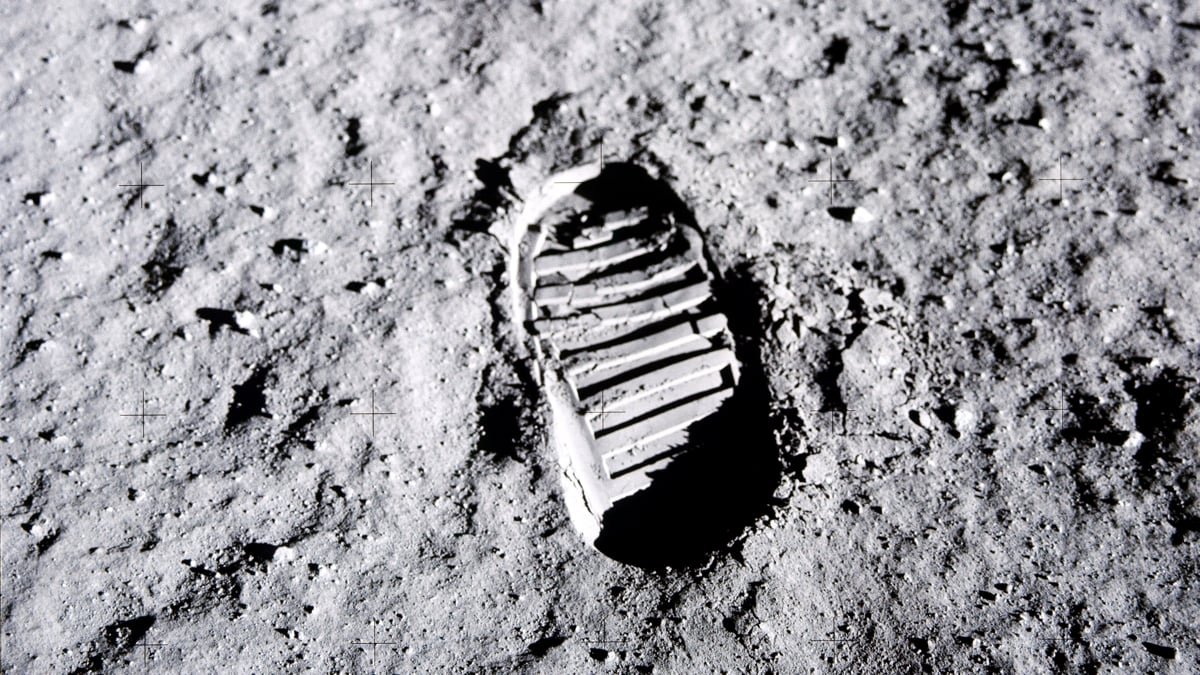
The lunar surface is covered in regolith, a powdery mixture created by impacts and space weathering. Astronaut bootprints show its texture at human scale. At microscopic scale, that same material may contain grains from many sources, including meteorites, solar wind products and interstellar dust.
Lacki’s proposal adds one more possibility to that inventory. Some grains could be artificial fragments from ancient extraterrestrial engineering. Detecting them would require a careful search for chemistry, structure, or physical properties that stand apart from known natural materials.
How Megastructures Could Become Dust
One route to alien debris begins with a familiar SETI idea, a Dyson swarm. In theory, such a swarm would consist of many structures orbiting a star to collect, reflect, or manage energy. A large enough system could become visible across interstellar distances through its effect on starlight.
A swarm that lasts for a very long time would need stability. Its elements would orbit, perturb one another and interact with dust, radiation and gravity. If control systems eventually failed, collisions could begin. Each collision would produce fragments. Those fragments could strike more elements and make even smaller pieces.
This process resembles a collisional cascade. In Earth orbit, a similar concern appears in discussions of Kessler syndrome, where debris creates more debris through repeated impacts. Around another star, a failed megastructure could be ground down in the same broad way. Over time, engineered parts could become tiny grains.
Lacki calls the possible fragments technograins. Once they become small enough, stellar radiation and stellar wind can help push them outward. Some grains might escape their home system and enter interstellar space. From there, they would drift through the galaxy as faint evidence of technology that once existed elsewhere.
Occulters, Glinters and Diffusers
The paper groups passive technosignatures into several broad kinds. Each interacts with light in a different way. The categories help show why alien technology may leave clues without sending a message.
Occulters are objects that block starlight. A natural planet can dim a star as it passes in front of it. An artificial structure could also dim a star, though its pattern might look unusual. Shape, timing, depth and repetition would matter in such a search.
Glinters work through reflection. A large mirror or reflective surface could redirect light across enormous distances. To a distant observer, this might appear as a strange flare or brightening near a star. Reflection is powerful because it can use existing starlight instead of requiring a powered transmitter.
Diffusers scatter light more broadly. Their signatures might be fainter. They could show unusual color, brightness, or polarization. These clues would be difficult to interpret, since nature also produces many odd-looking light patterns.
Together, these categories give astronomers a menu of passive targets. Some might be seen around other stars. Others could leave physical remnants that drift into the Solar System. The lunar dust idea belongs to the second path.
Why Passive Signals Could Last Longer
Radio searches remain valuable because radio waves can travel far and can carry clear artificial-looking features. The challenge is duration. A civilization has to produce a detectable signal at the right time, in the right direction and at a frequency observers are watching.
Human technology shows how quickly that window can change. Powerful broadcast leakage from Earth has shifted as communications systems have evolved. More efficient networks often send energy in narrower beams or through cables and satellites. A distant observer would see Earth’s radio behavior change over just a few generations.
A passive artifact follows a different timeline. A mirror can keep reflecting sunlight. A large object can keep blocking starlight. Dust can keep drifting. These signatures may grow faint, fragmented, or confusing, but they can persist without fresh energy from a living society.
That endurance is the key attraction of ancient technosignatures. If life and technology are rare, the odds of catching an active civilization may be small. Durable relics give SETI another temporal strategy. They let scientists ask where evidence could remain after the active phase ends.
The Moon fits that strategy because it can preserve samples. Instead of waiting for a signal from a distant star, researchers can examine material already collected or collected by future missions. The method would bring part of SETI into the laboratory.
What Scientists Could Look for in Lunar Regolith
A practical search would begin with the reality of lunar dust. Regolith contains many natural particles with complicated histories. Micrometeorites, volcanic glass, impact melt, solar wind implantation and cosmic rays all leave marks. Any claim about technology would need to clear a very high bar.
Scientists could look for unusual combinations of traits. One grain might show isotopic ratios that point beyond the Solar System. Another might have a structure, composition, or surface pattern that differs from known natural processes. A convincing candidate would likely need several independent clues.
Modern instruments can study grains at extraordinary resolution. Electron microscopes, mass spectrometers and microanalysis tools can reveal shapes, chemistry, crystal structure and isotopic fingerprints. These methods already help scientists interpret meteorites, returned asteroid samples and lunar material.
The challenge is sorting an enormous haystack. Lunar regolith is messy. Interstellar dust is rare. Artificial interstellar dust, if it exists, would be rarer still. A search would require careful screening, strong contamination controls and comparisons with natural grains from many environments.
Future lunar exploration could help. New samples from different regions and depths would expand the archive. Older, shielded deposits may preserve different records than material exposed at the surface. Sample context would matter as much as the grains themselves.
A Long Shot With a Real Test
Lacki’s proposal belongs to the speculative edge of astrobiology, but it has a useful scientific shape. It turns an enormous question into a set of things researchers can look for. That matters because SETI advances when ideas become testable.
The paper does make clear that passive relics could take many forms. Some may be astronomical targets seen through telescopes. Some may be microscopic debris. In the final case, the search becomes a question of materials science, planetary science and patient sample analysis.
The strongest version of the idea also stays cautious. A strange grain in Moon dust would need many checks before anyone could call it technological. Natural explanations would come first. Laboratory contamination would have to be excluded. Independent teams would need to reproduce the finding.
Still, the possibility is powerful. The Solar System moves through the galaxy. The Moon records incoming material. If ancient civilizations ever built huge passive structures, their broken remnants may be scattered far beyond their birth stars.
For now, alien technology in moon dust remains a hypothesis. It gives researchers a new reason to study lunar regolith with fresh eyes. Somewhere in that gray powder, the universe may have stored a record from another place and another time.