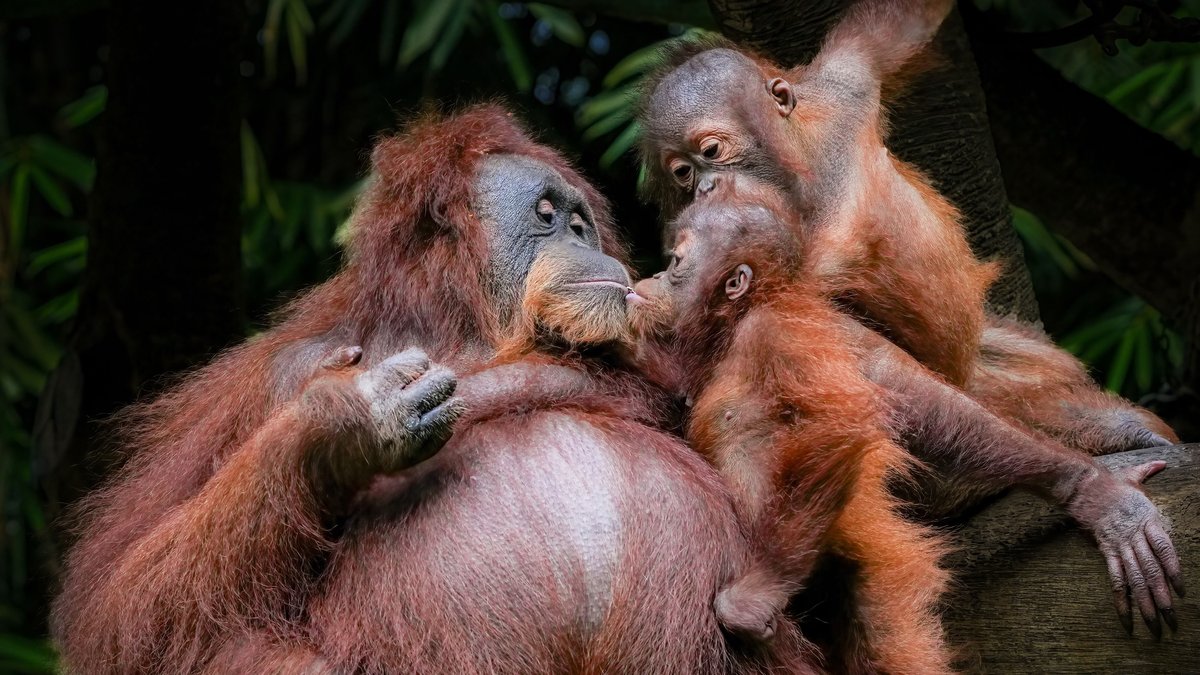
Using motion-activated cameras over five years, a study in American Journal of Biological Anthropology has captured rare details of how wild Bornean orangutans move when they leave the trees. The study, led by researchers affiliated with the University of Michigan and Universitas Nasional, analyzed 100 instances of wild orangutans on the ground in Gunung Palung National Park in West Kalimantan, Indonesia.
The footage offers an unusual look at Pongo pygmaeus, a great ape best known for life in the forest canopy. Wild orangutans spend so much time in trees that their ground movement has been difficult to study. Much of what scientists have known about terrestrial posture and walking came from captive settings, where floors, enclosures and daily routines differ from tropical forest terrain.
That makes the new camera-trap record valuable. It shows orangutans moving across real forest substrates, with roots, slopes, leaf litter and uneven ground shaping every step. The researchers describe the work as “the first assessment of wild orangutan terrestrial locomotor and postural behavior on natural substrates.”
The central finding is striking. When these orangutans walked on the ground, they most often used quadrupedal fist-walking with a heel-strike. Their wrist positions and step patterns varied from one moment to the next. Their upright postures also revealed a body that can carry tree-based movement habits onto the forest floor.
Camera Traps Capture Rare Ground Movement
Orangutans can be hard to follow even when researchers know where to look. They move high in dense forest, often out of clear view. When they descend to the ground, the event may be brief. A person walking behind them can also change the very behavior being studied.
Camera traps solve part of that problem. The devices wait quietly until movement triggers recording. In this study, cameras placed in Gunung Palung National Park recorded orangutans over a five-year period. The research team then examined 100 instances of orangutan terrestriality, meaning moments when the animals were on the ground.
The footage allowed the researchers to document positional behavior, a term that includes both movement and posture. For locomotion, they looked at how the animals walked. For posture, they examined how the animals held their bodies while standing or supporting themselves. They also recorded hand positions, foot positions and overstride patterns.
That level of detail matters because orangutan ground movement has long been difficult to interpret. A captive orangutan may walk on smooth surfaces. A wild orangutan may walk across forest floor that bends, shifts and blocks a clean path. Camera traps give scientists a chance to see what happens under the animal’s own conditions.
The study focused on wild Bornean orangutans and the results belong to that context. The sample was also limited to captured events from cameras. Even so, the clips opened a rare window into behavior that usually happens away from human eyes.
Fist-Walking With a Heel Strike
The clearest locomotion pattern in the footage was walking on all fours. The study reports that Pongo pygmaeus “primarily engaged in quadrupedal fist-walking with heel-strike.” In simple terms, the orangutans often supported their front limbs on closed fists while placing the heel down during foot contact.
This hand posture is different from the familiar knuckle-walking image often associated with African apes. Orangutans have their own anatomy and movement history. Their hands are highly adapted for gripping branches, reaching across gaps and suspending body weight in trees. On the ground, those same hands still need to manage weight support.
The cameras showed that the wrists did not follow one single pattern. Wrist position during quadrupedal walking varied both within individuals and between individuals. That variability suggests that orangutans adjust their limb placement moment by moment as they cross natural ground.
The study also examined overstride patterns. Overstride refers to how the hind foot lands relative to where the front hand had been placed. In the footage, these patterns were variable. That finding fits a picture of flexible walking, shaped by terrain and immediate body position.
For a large animal built for arboreal movement, flexibility may be essential. A branch path rarely offers the regular rhythm of a flat walkway. The forest floor also has uneven surfaces. The observed variation suggests that orangutans can reorganize their gait as conditions change.
Upright Postures on Natural Ground
The posture results were just as notable as the walking patterns. When the orangutans were captured in postural moments, they were seen standing upright more often than in pronograde postures. Pronograde means the body is held more horizontally, as in a typical four-limbed stance.
The upright postures included both one-legged and two-legged support. The animals were often captured with full extension of the hip and knee. That detail matters because joint position can reveal how an animal supports body weight and balance.
The researchers found that upright postures on the ground often showed strong hindlimb extension. In trees, orangutans can use extended-limb postures while moving across compliant branches. The new footage indicates that a similar form of bipedal support can appear on natural ground as well.
Here, the forest floor becomes an important test. Branches bend under weight. Solid ground behaves differently. Seeing full hip and knee extension without branch compliance suggests that the pattern belongs to the orangutan’s movement repertoire. It appears across substrates.
This finding also helps refine how scientists think about ape posture. Upright standing in orangutans can be part of everyday behavioral flexibility. It can happen during vigilance, travel, feeding, or other brief moments on the ground. The cameras captured fragments of that broader movement world.
A Five-Year Look in Borneo
Over five years, the cameras recorded enough rare moments to build a behavioral sample. The resulting 100 terrestrial instances were analyzed for locomotion and posture. The researchers also looked qualitatively at hindlimb joint movements during upright behaviors.
The setting gives the work added weight. Gunung Palung National Park protects forest in West Kalimantan, Indonesia. Studying orangutans there means observing them in a natural landscape where trees, ground and daily movement choices are connected.
The researchers reported 77 bouts of locomotion in the footage. Most of those were quadrupedal walking. Bipedal walking appeared rarely, but it did occur across different submodes. The study also noted behaviors such as travel, vigilance, feeding, resting and play in the camera-trap records.
Because the cameras were motion-activated, the sample is expected to favor movement. An animal standing still for long periods may be less likely to trigger the same kind of footage. The study’s strength lies in direct video evidence of natural ground behavior. Its limits come from the same reality, since camera traps capture only what passes in front of them.
Still, repeated records across years provide a valuable data set. Orangutans do descend to the ground and when they do, their movement can now be described with more precision. That turns scattered sightings into analyzable behavior.
What This Reveals About Ape Movement
Wild orangutan movement is often described through an arboreal lens. That makes sense, given their lives in the canopy. The new footage adds ground-based evidence to the same story of adaptable bodies and flexible limb use.
The high proportion of asymmetrical movement and posture stood out in the study. Asymmetry means the limbs may be doing different things on opposite sides of the body. One hand or wrist may be positioned differently from the other. One side may carry or adjust weight in a distinct way.
Apes are already known for independence between their forelimbs and hindlimbs. Orangutans, in particular, often move through complicated three-dimensional spaces. The study suggests an additional lateral flexibility, where left and right limbs can also decouple during movement and posture.
That idea may help explain why orangutans can handle such varied supports. In trees, a hand may grip one branch while a foot braces against another. On the ground, the same general flexibility may help the animal manage roots, slopes and irregular surfaces.
The paper’s broader implication is that orangutan movement is deeply adaptable. Its abstract concludes that “orangutan positional adaptability is intrinsic regardless of substrate.” For scientists studying ape evolution, that matters. It shows how a highly arboreal great ape can still bring a flexible movement system to the ground, one step at a time.