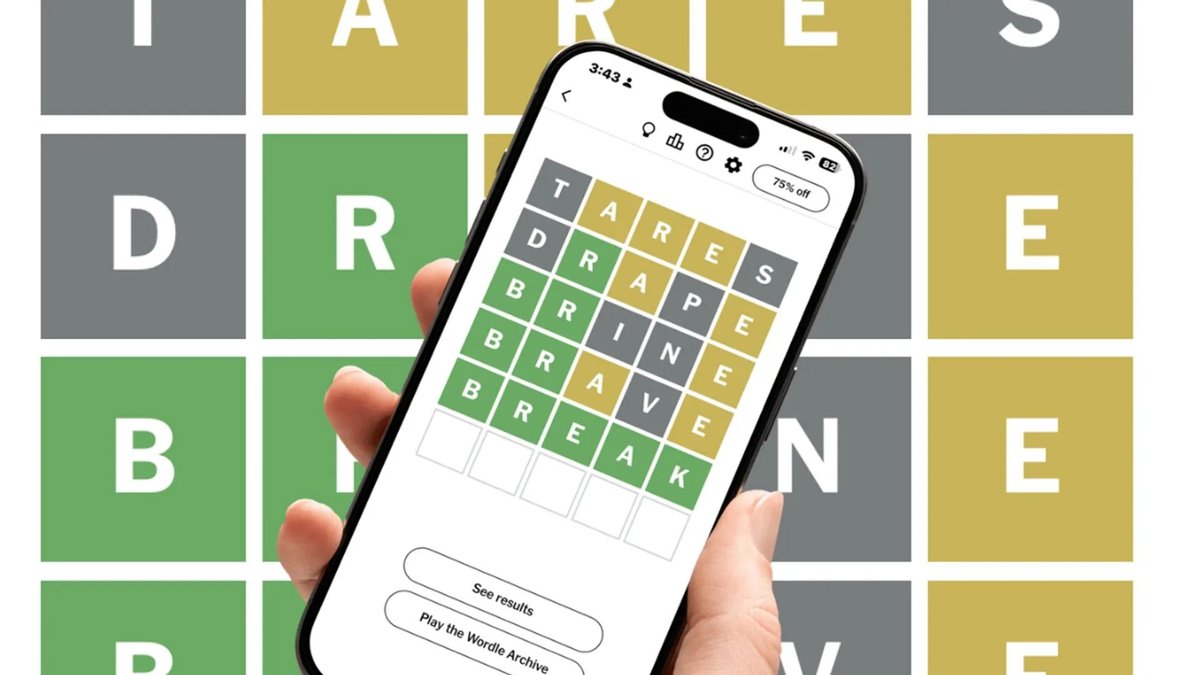
Using a mathematical rule for choosing guesses, researchers at Binghamton University, State University of New York, developed a method that solves Wordle with a reported 99% success rate. The work was published in the Northeast Journal of Complex Systems and it turns a daily word puzzle into a clean demonstration of how information can guide decisions.
The team applied Shannon entropy, a mathematical way to measure uncertainty. In simple terms, the method asks which guess is likely to teach the player the most. That can make the strategy feel surprising because it values clues as much as immediate answers.
Every Wordle player already performs a small experiment. A five-letter guess comes back with green, yellow and gray squares. The Binghamton approach gives that familiar feedback a more formal job. Each pattern reduces the set of possible answers and the next guess is chosen to shrink that set as efficiently as possible.
A 99% Wordle Strategy
The study focuses on the familiar challenge at the center of Wordle. A player has six guesses to identify a hidden five-letter word. Each guess produces color-coded feedback that tells the player whether each letter is absent, present in a different spot, or already in the correct position.
That feedback creates a decision tree. After the first guess, some words become impossible. After the second guess, the remaining list gets smaller. The research team built a strategy around making each branch of that tree as useful as possible.
The method does this by ranking possible guesses according to expected information. A guess that splits the remaining answers into many informative groups can be valuable. The goal is to reduce uncertainty quickly, so later guesses become more targeted.
That logic helped the strategy solve 99% of puzzles in simulations. The number is striking because Wordle gives players only a handful of moves. A single weak guess can leave too many possibilities for the final attempts.
The result also shows why games can be useful teaching tools. Wordle is simple enough to explain in a few sentences. At the same time, it creates a real optimization problem with uncertainty, feedback and limited chances.
Why the Best Guess Can Look Random
To a human player, the information-based strategy may look odd. A recommended word may feel disconnected from the most likely answer. The method is looking for a useful response from the puzzle, so it may choose a word that tests several letters or positions at once.
Donald Stephens, a doctoral student at Binghamton University, described the key idea plainly. “A guess doesn’t have to be the most likely answer; it simply has to be informative.”
That idea is central to the strategy. A player may want to lock in a possible answer as soon as a few letters appear. The algorithm can favor a broader probing word when that word is expected to separate many possible answers.
For example, a guess can reveal whether several common letters remain in play. It can also test where known letters belong. Even when the guess has a low chance of being the hidden word, the pattern it produces may carry a large amount of information.
This is why the method can seem less intuitive than ordinary play. Human solvers often rely on memory, favorite starters and the feel of English words. The Binghamton strategy follows a calculation after each response from the puzzle.
How Shannon Entropy Narrows the Puzzle
Shannon entropy comes from information theory. It measures uncertainty in a system where several outcomes are possible. In Wordle, the unknown outcome is the secret word and each clue pattern changes the remaining uncertainty.
Before any guess, many five-letter answers could fit. After a guess, the green, yellow and gray squares rule out words that conflict with the feedback. A gray letter can remove many candidates. A green square can lock a letter into a specific position.
The strategy evaluates how much uncertainty each possible guess is expected to remove. A good guess creates feedback patterns that divide the remaining candidates efficiently. When those patterns are informative, the next move begins from a smaller and clearer list.
This process repeats after every turn. The player enters the latest feedback into a separate script or program. The program then recommends the next guess based on the current set of possible answers and the expected information gain from each candidate word.
Assistant Professor Congyu “Peter” Wu led the research team. According to the university, Wu framed the problem as a trajectory through guesses. Previous guesses remove options and some future guesses can make information arrive faster.
What the Simulations Showed
The researchers tested the information theory strategy against a more traditional approach. That comparison used a strategy based on choosing common letters, including letters such as A, E and R. Many casual players use a version of that idea when selecting early guesses.
In simulations, the entropy-based method solved 99% of Wordle puzzles. The traditional letter strategy solved about 90%. That gap matters because the final few unsolved cases are often the hardest ones. They can involve words that share many letters and differ by only one position.
The result should be read as a simulation finding. The study tested the approach in a computer setting. It shows how the method performed under those conditions, with the chosen word lists and rules used by the researchers.
The method also requires extra help during live play. A person using it would run a script on the side. After entering a Wordle guess, the player would feed the color response into the program and the program would return the next recommended word.
That setup makes the project especially useful as a teaching example. It connects a popular puzzle to a broader idea in computation. When choices are limited and feedback arrives step by step, math can help decide which action should come next.
From Class Project to Published Study
The Wordle strategy began as a classroom assignment. Wu asked students to show how information theory could solve a practical problem. The puzzle gave them a familiar setting where uncertainty could be measured after every move.
That class exercise grew into a scientific paper. The study, titled “Solving Wordle Using Information Theory,” was published in the Northeast Journal of Complex Systems. The author list includes Talal Aladaileh, Donald Stephens, Mallak Alqaisi and Congyu Wu.
Co-author Talal Aladaileh connected the project to the training students receive at Binghamton. “The courses here don’t just teach concepts,” he said.
The phrase captures why the project fits engineering education. The students took an abstract idea and turned it into a working decision system. Wordle supplied the rules, while information theory supplied the strategy.
The study also shows how a game can make a technical concept visible. Entropy can sound distant from daily life. In this case, it appears as a practical question that every Wordle player recognizes, which word should come next?