Researchers at the University of Oxford have demonstrated a new family of Schrödinger’s cat-like quantum states, opening a stranger corner of quantum physics where superpositions are built from components that are already deeply quantum. The work, published in Physical Review X, shows how the motion of a single trapped ion can be shaped into exotic forms that were previously difficult to access in the lab.
The result gives physicists a new way to create and control quantum superpositions, the famous feature of quantum mechanics in which a system can occupy more than one possible state at once. In the popular Schrödinger’s cat thought experiment, that idea is expressed through a cat that is treated as both alive and dead until observed. In the Oxford experiment, the cat is represented by the motion of one charged atom.
That may sound abstract, yet the achievement is practical in a very specific sense. Quantum computers, sensors and clocks all depend on the ability to prepare delicate quantum states, steer them and measure them before surrounding noise destroys the information they carry. A method that can sculpt more complex quantum states could expand the toolkit available to quantum engineers.
The Oxford team used a trapped ion because it combines two useful behaviors in one system. The ion’s internal state behaves like a qubit, while its motion behaves like a quantum harmonic oscillator. That oscillator can occupy many motional states, giving researchers a richer stage than a simple 0-or-1 system.
A New Family of Cat States
Schrödinger’s cat remains one of the most famous images in physics because it captures a real mathematical idea with a vivid story. A quantum object can exist in a blend of possible states before measurement. When scientists create cat states in the laboratory, they build controlled superpositions that reveal this quantum behavior in a measurable system.
Traditional cat states in an oscillator are often made from coherent states. These are wave packets that behave as the closest quantum version of ordinary classical motion. A familiar version places an oscillator in a superposition of two such packets, with the packets separated in phase space and moving in distinct ways.
The Oxford work takes a more elaborate route. The researchers created superpositions from nonclassical quantum components, such as states where quantum uncertainty has been redistributed. These building blocks already carry features that ordinary classical motion cannot capture. Combining them produces a more intricate kind of cat state.
For general readers, the key idea is that the team changed the ingredients. Instead of using relatively classical-looking wave packets as the components, the researchers used components with stronger quantum character. That makes the final state richer and gives physicists more control over its shape.
Why Trapped Ions Made It Possible
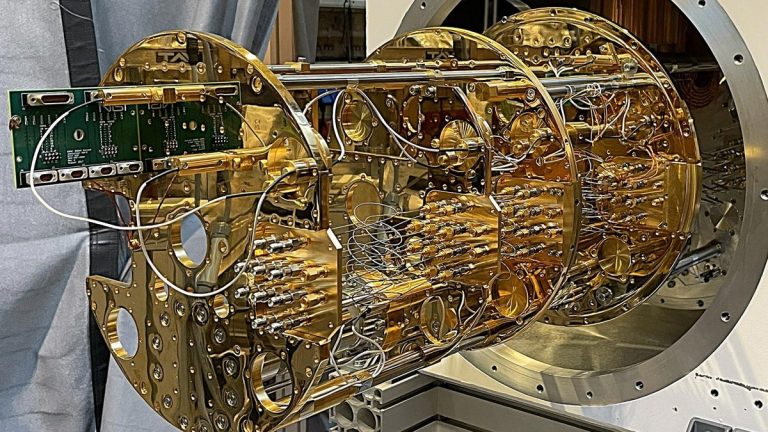
A single trapped ion is a charged atom held nearly still by electromagnetic fields. In quantum experiments, this platform is prized because researchers can control it with high precision. They can manipulate the ion’s internal energy levels and also influence how it moves within the trap.
This dual nature matters. The ion’s internal state acts like a qubit, the basic unit used in many quantum computing schemes. Its motion acts like a quantum harmonic oscillator, a system that can occupy a ladder of possible energy levels. Together, they form a hybrid system with both two-state and many-state behavior.
That hybrid structure gave the Oxford physicists a way to link the ion’s internal state with its motion. By engineering interactions between the two, they could use the qubit-like part as a control handle. The motion then became the place where the more elaborate superposition was formed.
This matters because many powerful quantum ideas rely on oscillators. Light, vibrations and trapped-particle motion can all be described with oscillator-like physics. A method that works in a trapped ion can therefore help researchers test concepts relevant to several branches of quantum technology.
How the Team Sculpted the Superposition
The experiment began by entangling the ion’s internal state with different possible states of motion. Entanglement means that the two parts of the system become linked so closely that describing one part depends on the other. In this case, the internal state helped determine which motional possibilities were being combined.
Next came a mid-circuit quantum measurement. This measurement was performed on the ion’s internal state while the quantum process was still underway. The outcome caused the ion’s motion to collapse into a chosen superposition of nonclassical components.
“This approach gave us a tool to sculpt the quantum superposition into almost any shape,” said Dr Sebastian Saner, lead author from the Department of Physics at the University of Oxford.
The word “sculpt” is apt because the team could tune the shape of the state by changing experimental settings. They adjusted the relative size, orientation and separation of the components in the superposition. With the same trapped-ion system, they could produce a wide range of unusual motional quantum states.
That programmability is central to the advance. Quantum technologies need repeatable ways to prepare special states on demand. A flexible method for producing many different oscillator states gives researchers a larger menu of options for computation, sensing and fundamental tests.
Signs of Deep Quantum Behavior
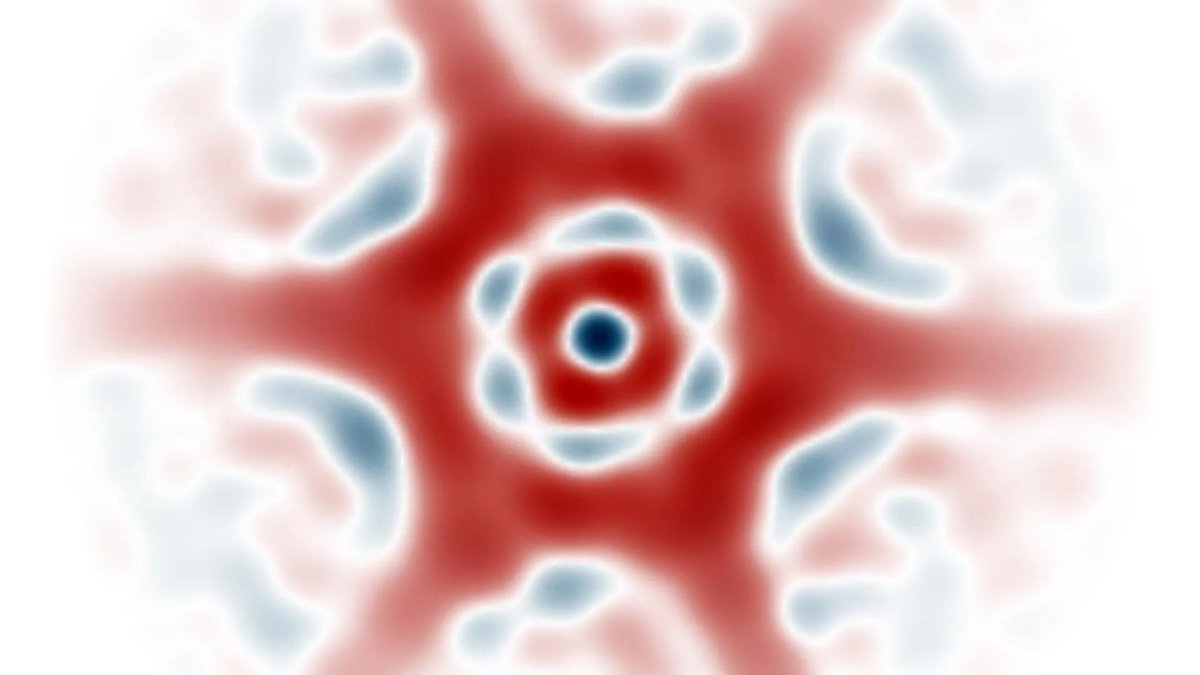
Creating an exotic state is only part of the challenge. Researchers also need to prove that the state has the intended quantum properties. The Oxford team reconstructed the motional states directly, then looked for signatures that distinguish genuine superpositions from ordinary mixtures.
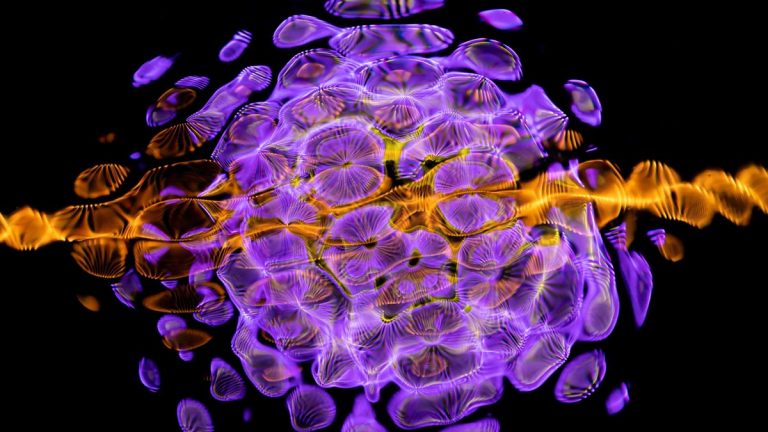
One important sign was the presence of interference patterns. Interference is a hallmark of wave-like quantum behavior. When different parts of a superposition overlap, they can reinforce or cancel each other in patterns that reveal the coherence of the state.
The team also observed regions of Wigner negativity. The Wigner function is a way of representing a quantum state in a space related to position and momentum. Negative regions in that representation are strong evidence that the state cannot be described through everyday classical probability.
These measurements confirmed that the experiment had produced real superpositions of nonclassical motional states. The result gives researchers a clearer view of quantum behavior in a controlled oscillator, where the structure of the state can be prepared and then examined.
For physicists, such signatures are more than visual proof. They help quantify how far a state departs from classical expectations. That makes them useful for both applications and foundational research.
Why It Could Matter for Quantum Computers
Quantum computing often begins with qubits, where information is stored in two-level systems. Oscillators offer another path because they can occupy many levels and support more complex encodings. These encodings may help protect quantum information against certain errors.
The Oxford result points toward oscillator-based quantum computing, where information could be stored in specially engineered states of motion. Cat-like states and related oscillator states have attracted interest because they can support error-correction strategies. Some designs aim to make the most common errors easier to detect or repair.
The new family of states may expand what those designs can do. Because the components are already nonclassical, they may offer different ways to encode information or detect disturbances. The the Oxford report presents this as a promising direction, rather than a finished quantum computer component.
That caution is important. The experiment demonstrates preparation and control of unusual states in a single trapped-ion system. Turning such states into scalable technology would require many additional steps, including reliable integration with operations, measurements and error correction across larger systems.
Even so, the physics is valuable now. Quantum technologies often advance when researchers learn how to create new resource states. These states can become ingredients for future devices, even when their first demonstration happens in a carefully controlled laboratory setting.
The Next Questions for Quantum Physics
The Oxford team is now working with theorists to understand how “quantum” these newly created states are. That question sounds playful, yet it points to a serious problem. Physicists need ways to compare different quantum states and measure the resources they provide.
Dr Raghavendra Srinivas, who supervised the work at the Department of Physics, said the team was encouraged by the response from colleagues. “We believe we’re still scratching the surface of what’s possible.”
One next step is to map which state shapes are most useful. Some may prove valuable for computation. Others may be better suited to precision sensing, where fragile quantum behavior can amplify small signals. Still others may help physicists test the boundary between the quantum world and the classical world we experience.
That boundary remains one of physics’ enduring puzzles. Quantum mechanics governs atoms, light and microscopic motion with extraordinary accuracy. Everyday objects appear to follow classical rules because interactions with the environment rapidly wash out delicate quantum features. Carefully engineered cat states allow researchers to study that transition under controlled conditions.
The new Oxford states add a sharper tool to that effort. By building superpositions from highly nonclassical components, physicists can probe more complex versions of quantum behavior. The work also shows that a single trapped ion can serve as a remarkably versatile platform for exploring states that stretch the usual intuition behind Schrödinger’s cat.