A study in Physical Review Letters reports three linked discoveries from a rare nuclear decay that may sharpen scientists’ picture of how the universe forges heavy elements such as gold and platinum. Working at CERN, a team led by physicists from the University of Tennessee, Knoxville observed a difficult two-neutron decay process for the first time in an r-process nucleus.
The research focuses on indium-134, a fleeting isotope that decays so quickly that scientists need specialized facilities to make and study it. The team examined its decay at CERN’s ISOLDE Decay Station, where unstable nuclei can be produced and separated for close measurement.
At the center of the work is beta-delayed two-neutron emission. In this process, a neutron-rich nucleus undergoes beta decay and then releases two neutrons from an excited daughter nucleus. The details matter because similar decays are expected to influence the rapid neutron capture process, or r-process, which builds many of the heaviest elements in the cosmos.
A First Look at Two-Neutron Decay
The newly reported measurement gives physicists their first direct view of two-neutron emission from indium-134. That makes the result a rare experimental anchor for models that describe nuclei far from stability. These nuclei are central to cosmic element formation, yet many exist for fractions of a second.
During beta decay, a neutron inside the nucleus changes into a proton and emits other particles. In very neutron-rich nuclei, that decay can leave the daughter nucleus with enough energy to shed one or more neutrons. The University of Tennessee-led team measured the energies of the emitted neutrons, which allowed them to reconstruct part of the decay path.
This kind of measurement is especially valuable because the r-process moves through unstable nuclei that are hard to create on Earth. Astrophysical models often need nuclear data from regions that experiments have barely reached. Each direct measurement helps reduce the guesswork.
The study’s abstract states that the work reports the “direct observation of a β-delayed two-neutron emission.” That compact phrase describes a technically demanding result. The team detected a decay route that had been expected to matter, then used it to probe the structure of the nuclei produced along the way.
Why Indium-134 Matters
Indium-134 sits in a part of the nuclear chart that matters for the r-process. It is rich in neutrons and lies near nuclei that can shape the flow of heavy-element production during explosive cosmic events. The isotope exists briefly before transforming into tin isotopes.
In the experiment, indium-134 decayed into excited forms of tin-132, tin-133 and tin-134. Those daughter nuclei carry clues about how energy and structure move through a nucleus after beta decay. By watching the neutrons released from these excited systems, the researchers could test how well current theories describe the decay sequence.
The r-process begins when nuclei capture neutrons rapidly in extreme environments. Those nuclei become heavier and more unstable. Eventually, they decay toward more stable forms, creating a broad range of heavy elements. Scientists connect this chain to neutron star mergers and certain stellar explosions.
Gold and platinum are famous products of this cosmic assembly line. The full recipe depends on many short-lived nuclei, including ones that have yet to be measured in detail. Indium-134 offers a window into one hard-to-reach part of that recipe.
The CERN Experiment Behind the Discovery
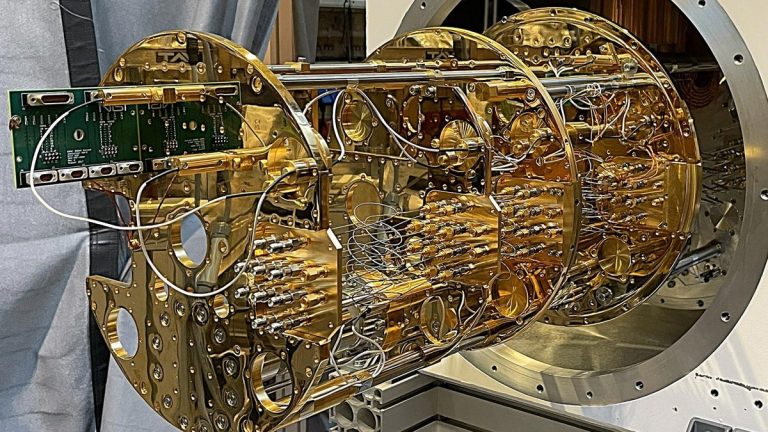
At CERN’s ISOLDE Decay Station, scientists can make beams of exotic nuclei and study their decays with sensitive detector systems. For this experiment, the team needed enough indium-134 atoms to observe a rare decay channel. That required both production power and careful detection.
Robert Grzywacz, a University of Tennessee physicist involved in the project, highlighted the challenge. “These nuclei are hard to make and require a lot of new technology to synthesize in sufficient quantities”, he said in the provided source material.
The team used a specialized neutron detector developed with support from the National Science Foundation. The detector was designed to identify neutrons and track their interactions. That capability mattered because the researchers needed to distinguish two-neutron emission from other decay paths.
The method is known as neutron spectroscopy. Instead of merely counting that neutrons came out, the researchers measured their energies. Those energy measurements helped reveal the sequence of events after beta decay.
Careful neutron measurements are difficult because neutrons carry no electric charge. They do not leave tracks in the same straightforward way as charged particles. Detectors must infer their presence from collisions and timing, which makes experiments like this especially demanding.
A Long-Sought Tin State Appears
The experiment also revealed a nuclear state that physicists had searched for over many years. During the decay chain, the team observed a predicted excited state in tin-133. The state is associated with the neutron single-particle i13/2 orbital.
That observation gives scientists a more complete map of tin-133. The nucleus is close to tin-132, which is often described as doubly magic because its proton and neutron numbers form especially stable shell closures. Nearby nuclei provide important tests of nuclear shell structure.
Grzywacz described the moment plainly. “People were searching for it for 20 years and we found it.” The quote captures the experimental payoff of a measurement that depended on both rare isotope production and precise neutron detection.
The team used the two emitted neutrons to identify how the decay populated this long-sought state. That link between decay products and nuclear structure is one reason the result goes beyond a simple discovery of a new decay path. It connects a reaction process to a specific arrangement inside the daughter nucleus.
Nuclear Memory in an Unstable Atom
Another striking part of the study involves what researchers describe as a kind of nuclear memory. After the decay, the daughter nucleus appeared to retain signs of the structure that existed before the transformation. That behavior gives physicists a fresh way to think about how unstable nuclei carry information through decay.
In simple terms, a nucleus can behave as though its earlier arrangement still matters after it changes identity. The starting nucleus and the daughter nucleus have different compositions. Even so, the observed population of states suggests that the decay process preserved some structural preferences.
That idea matters because many nuclear models treat highly excited states with statistical assumptions. If the nucleus keeps a memory of its initial structure, those assumptions may miss important details. This becomes especially relevant for nuclei far from stability, where direct measurements are sparse.
The finding also helps explain why rare-isotope experiments are so informative. A single decay measurement can reveal both the emitted particles and the internal architecture of the nuclei involved. In this case, the two neutrons acted like messengers from a state that had been difficult to access by other means.
Why the Results Challenge Current Models
The newly observed tin-133 state behaved in a way that current calculations did not fully predict. The researchers found that the state’s population was much smaller than expected from a statistical model. That mismatch gives theorists a concrete target for improving their descriptions of exotic nuclei.
The result is important because statistical models are widely used when direct measurements are unavailable. In r-process calculations, many nuclear properties must be estimated. A discrepancy in one well-measured case can expose where those estimates need refinement.
The experiment was carried out under controlled laboratory conditions. That strengthens the value of the comparison because the unexpected pattern came from a direct measurement. For physicists, this kind of disagreement can be productive. It marks a place where the nucleus is revealing more structure than the model includes.
The study also points toward future experiments on multineutron emitters. By measuring energy and angular correlations in greater detail, researchers can test whether similar patterns appear in other neutron-rich nuclei. Those data could help link nuclear structure more tightly to astrophysical models.
What This Means for Cosmic Gold
The connection to gold begins with the r-process. In neutron-rich cosmic environments, atomic nuclei can capture neutrons faster than they decay. This rapid buildup creates very heavy, unstable nuclei. Their later decay fills in the periodic table with elements including gold and platinum.
Many r-process calculations depend on beta decay rates and neutron emission probabilities. When a nucleus releases neutrons after beta decay, it can change the path of element formation. It can also affect the final abundance of heavy elements that survive after the cosmic event cools.
The indium-134 result gives modelers a measured case in a relevant region of the nuclear chart. That does not turn one laboratory decay into a full explanation for cosmic gold. It supplies a precise piece of nuclear data for a chain of reactions that unfolds under extreme astrophysical conditions.
The study’s abstract says that “Understanding β-delayed two-neutron emission probabilities is essential.” In this context, essential means that theorists need these probabilities to validate the calculations used in r-process nucleosynthesis models.
Future measurements will determine how broadly these findings apply. For now, the CERN experiment shows that rare decays can reveal hidden structure in nuclei that help shape the universe’s heavy elements. The gold in planets, jewelry and ancient rocks traces back to cosmic violence. Studies like this help explain the nuclear steps that made it possible.