Using the NASA/ESA/CSA James Webb Space Telescope, researchers have mapped gas orbiting a black hole in the tiny galaxy Abell2744-QSO1, finding evidence that the black hole was already enormous before its host galaxy had fully formed.
The object sits more than 13 billion light-years away and appears as it was about 700 million years after the Big Bang. At its center is a black hole weighing roughly 50 million solar masses, an astonishing mass for such a small early galaxy. The result comes from studies published in Nature and the Monthly Notices of the Royal Astronomical Society.
For astronomers, the finding reaches into one of the deepest questions in cosmic history. Supermassive black holes are seen surprisingly early in the universe, yet ordinary stellar collapse leaves behind small seeds that need time to grow. Abell2744-QSO1 suggests that some black holes may have started life already huge.
“This is a remarkable finding,” said Roberto Maiolino of Cambridge University, a co-author of the studies. He called it “a paradigm shift,” because the result forces astronomers to revisit long-standing ideas about how black holes and galaxies grow together.
A Little Red Dot From the Young Universe
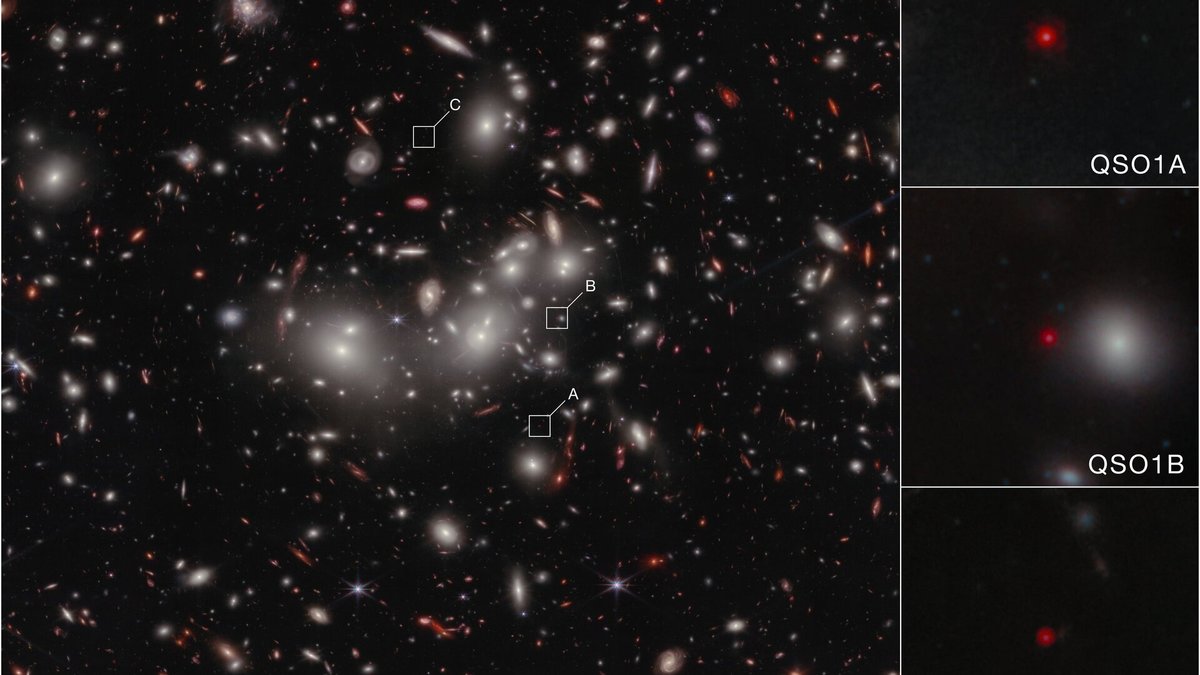
Abell2744-QSO1, often shortened to QSO1, belongs to a strange class of objects known as Little Red Dots. Webb has found many of these compact reddish sources in the early universe. Their small size and bright light have made them difficult to interpret.
QSO1 is only about 1,300 light-years across. That is tiny compared with large modern galaxies, including the Milky Way. Its light has been traveling for more than 13 billion years, so Webb is seeing it from a time when the universe was still young.
The object is easier to study because of gravitational lensing. A massive galaxy cluster called Abell 2744, also known as Pandora’s Cluster, lies between Earth and QSO1. The cluster’s gravity bends and magnifies the light from the distant object. It also creates three separate images of QSO1 in the sky.
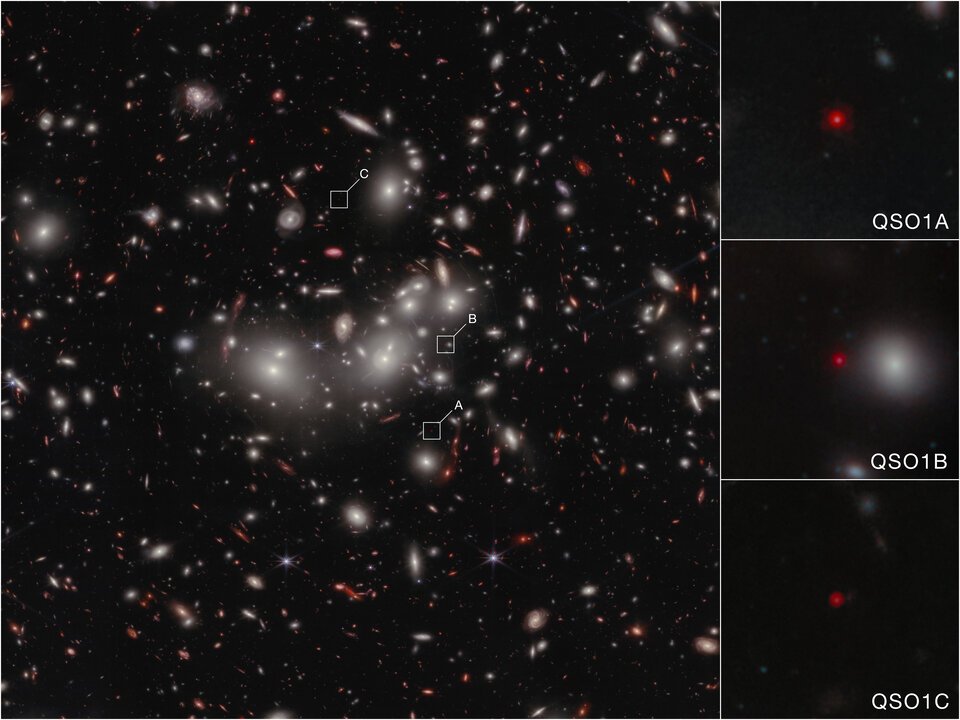
This cosmic magnifying glass gave astronomers a rare advantage. A remote object that would normally be too faint and small became bright enough for Webb to inspect in detail. That extra clarity mattered because the central question was precise: how much mass is packed into QSO1’s center?
Earlier work had already suggested that QSO1 might be dominated by a black hole. The object appeared to be made mostly of glowing hydrogen and helium gas circling a compact central source. Still, astronomers needed a more direct way to test whether the black hole was truly as massive as it seemed.
Webb Weighed the Black Hole Directly
The new measurement relied on Webb’s NIRSpec, the Near Infrared Spectrograph. This instrument can split faint infrared light into its component colors. Those colors reveal which elements are present and how fast gas is moving.
The team used NIRSpec’s integral field unit, or IFU, to study QSO1 across a tiny patch of sky. Instead of taking one blended measurement, the IFU allowed researchers to map the object piece by piece. That gave them a way to trace the motion of gas near the black hole.
This direct mapping is important because many early-universe black hole masses have been estimated indirectly. Those estimates often depend on assumptions drawn from nearby galaxies and black holes. Francesco D’Eugenio of Cambridge University, a co-author of the study, explained the concern clearly: “We didn’t know if those assumptions really apply to the distant Universe.”
With QSO1, Webb measured the gas motion itself. The team could then use gravity to calculate how much mass must be sitting at the center. The result was about 50 million times the mass of the Sun.
That number is striking on its own. The ratio is even more surprising. The black hole appears to make up about two-thirds of QSO1’s total mass. In nearby galaxies, central supermassive black holes usually account for only a tiny fraction of their host galaxy’s mass.
Gas Moving Like Planets Around a Star
Ignas Juodžbalis, a Cambridge graduate student and Cosimo Marconcini of the University of Florence helped lead the work that mapped the hydrogen gas around the black hole. They found that the gas followed Keplerian motion.
That phrase comes from the same basic physics used to describe planets orbiting the Sun. In a Keplerian system, orbital speed changes with distance in a predictable way. Gas close to the center moves faster. Gas farther out moves more slowly.
For QSO1, this pattern showed that most of the mass sits in a compact central point. A broad collection of stars spread through the object would create a different motion pattern. The clean rotation gave the team a gravitational scale for weighing the black hole.
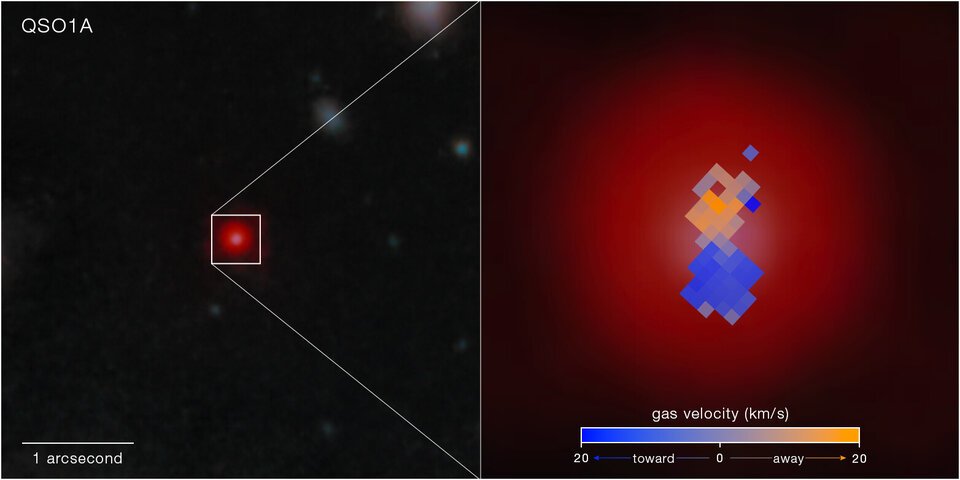
“This is a phenomenal result,” said Marconcini. The team describes it as the first direct measurement of a black hole mass within the first billion years after the Big Bang.
The finding also gives astronomers confidence that earlier indirect measurements may have been broadly reliable. If QSO1’s direct mass matches the earlier estimate, then some assumptions used for other early black holes may still work. That matters because thousands of early black hole candidates are now part of the Webb-era cosmic census.
A Galaxy With Almost No Stellar Debris
Webb measured more than motion. The NIRSpec IFU also mapped the chemical makeup of the gas in QSO1. That composition turned out to be almost as important as the mass measurement.
The gas is dominated by hydrogen and helium. It contains very little of the heavier elements that astronomers call metals. In astronomy, metals include elements such as oxygen, carbon and iron. These elements are forged inside stars and scattered into space when stars shed material or explode.
QSO1’s metallicity is less than 0.5% of the Sun. That makes it one of the most pristine galactic environments ever measured. Such a low metal content suggests that the object had seen very little star formation before Webb observed it.
This chemistry strengthens the case that the black hole did much of the early growing before a substantial galaxy of stars surrounded it. A star-rich galaxy would have left more chemical fingerprints. QSO1 instead looks like a compact gas system wrapped around a massive central black hole.
The result paints a vivid picture. A huge black hole sits in a small early object made mostly of primordial gas. The surrounding galaxy appears underbuilt compared with the black hole at its heart.
Why This Changes Black Hole Origins
Supermassive black holes are common in the centers of large galaxies today. The Milky Way has one called Sagittarius A*. Many galaxies contain even larger central black holes, with masses reaching millions or billions of Suns.
The puzzle comes from timing. Webb and other observatories have found massive black holes in the early universe. If they began as the remnants of ordinary massive stars, they would need to feed and merge extremely quickly to reach such sizes in a few hundred million years.
QSO1 points toward a different early path. The black hole seems to have been born large, either as a primordial black hole associated with conditions near the beginning of the universe or as a direct collapse black hole formed from a giant cloud of gas.
Both ideas have been discussed for years. Primordial black holes would come from dense regions in the very early universe. Direct collapse black holes would form later, when an enormous gas cloud collapses into a black hole seed far larger than a stellar remnant.
The Webb data do not settle which path produced QSO1. They do show that the black hole’s mass is difficult to explain through slow growth from small seeds. That is why the discovery carries so much weight for theories of cosmic structure.
The Search for More Early Black Hole Seeds
The team suspects that objects like QSO1 were present in meaningful numbers during the early universe. Little Red Dots may represent a broader phase in which massive black holes were gathering gas before their host galaxies fully developed.
Researchers are now analyzing similar objects to see whether QSO1 is part of a wider pattern. If more Little Red Dots show the same mix of huge central masses, pristine gas and compact sizes, astronomers will have stronger evidence that black holes sometimes lead galaxy growth.
Webb is especially well suited for this work. Its infrared vision can reach light stretched by cosmic expansion. Its spectroscopy can reveal both motion and chemistry in objects that formed when the universe was only a small fraction of its present age.
The next step is comparison. Astronomers need to measure more early black holes in the same careful way. Direct gas-motion measurements can show whether the extreme mass ratio in QSO1 is rare or part of a larger population.
For now, Abell2744-QSO1 stands as one of Webb’s clearest glimpses of a black hole seed in the making. It may be showing astronomers an early chapter in which a black hole formed first, then began building a galaxy around itself.