A study in Nature led by researchers at the Institute of Vertebrate Paleontology and Paleoanthropology, Chinese Academy of Sciences, describes a tiny fossil fish from South China that preserves the oldest articulated bony fish skeleton yet found. The animal, named Eosteus chongqingensis, lived about 436 million years ago and measured only around 3 centimeters long.
The discovery gives scientists a rare look at a stage of vertebrate evolution that has long been represented by scattered fragments. Bony fishes sit near the center of the vertebrate family tree. Their descendants include most living fishes and the land vertebrates known as tetrapods.
The same research group also reported new anatomical evidence from Megamastax amblyodus, a much larger Silurian fish from Yunnan. Together, the two fossils help clarify how jaws, teeth, skulls and body plans were taking shape before the two great branches of bony fishes split apart.
Oldest Bony Fish Fossil Found in South China
The new fossil comes from Early Silurian rocks in Xiushan, Chongqing. These deposits preserve life from a time when vertebrate evolution was entering a critical phase. Jawed fishes were diversifying and the roots of major living vertebrate groups were beginning to form.
Eosteus chongqingensis stands out because its body is preserved in articulation. That means the skeleton remained connected enough for researchers to study the animal as a whole. For paleontologists, this kind of fossil can be far more revealing than isolated scales, teeth, or bone fragments.
At about 436 million years old, Eosteus predates previously described large bony fish fossils. According to the supplied research summary, it even predates the earliest known bony fish microfossils. That makes the tiny specimen an unusually important marker in the early history of vertebrates.
The research team was led by Profs. Min Zhu, Jing Lu and You’an Zhu from the Institute of Vertebrate Paleontology and Paleoanthropology. Their work appeared in two back-to-back cover articles in Nature, reflecting the importance of both the Chongqing fossil and the newly reconstructed Megamastax material.
Why Bony Fish Origins Matter
Bony fishes, also called osteichthyans, are one of the great success stories in animal evolution. The group includes two major living lineages. Ray-finned fishes include most familiar fish species today. Lobe-finned fishes include the lineage that eventually gave rise to land vertebrates.
That connection gives these fossils a reach far beyond ancient fish anatomy. The early history of bony fishes is also part of the story of where amphibians, reptiles, birds, mammals and humans came from. The bones in a tiny Silurian fish can help illuminate the origin of features that later shaped bodies on land.
The Nature paper’s abstract summarizes the scale of the group clearly: “Osteichthyans, comprising sarcopterygians and actinopterygians, dominate modern vertebrate biodiversity.” The terms refer to lobe-finned and ray-finned fishes, the two major bony fish branches that define much of later vertebrate evolution.
For years, the earliest part of that story remained hard to reconstruct. Many Devonian fossils already show specialized traits. Earlier and more primitive forms were scarce, which made it difficult to infer what the common ancestor of ray-finned and lobe-finned fishes looked like.
The South China fossils now add bodies, skulls, jaws, teeth and braincase details to that missing interval. These are the kinds of anatomical clues researchers need when they build evolutionary trees and test how major vertebrate traits appeared.
The 3-Centimeter Fossil Named Eosteus
The most striking feature of Eosteus is its scale. This animal was only about 3 centimeters long, roughly the length of a small paper clip. Even so, it preserves the body from head to tail, giving scientists a compact view of early bony fish anatomy.
Its body was streamlined and it had a single dorsal fin. The fossil also preserves specialized scale structures called caudal fulcra near the tail. These features resemble traits later seen in early ray-finned fishes, which dominate modern fish diversity.
Other parts of Eosteus look more primitive. The fossil lacks lepidotrichia, the bony fin rays usually associated with bony fishes. It also has an anal fin spine, a feature previously known from cartilaginous fishes and placoderms in this context.
This mixture is what makes the fossil so useful. It captures an early condition in which different vertebrate features had yet to settle into the familiar combinations seen in later groups. Eosteus shows that key pieces of the bony fish body plan were already present during the Early Silurian.
The discovery also pushes the timeline for articulated bony fish fossils deeper into the past. A complete or near-complete skeleton lets researchers compare many traits in one individual, rather than piecing together a picture from separated remains.
Ancient Jaws, Teeth and a Primitive Body Plan
The two Nature papers focus on fossils that preserve several of the most important features in early jawed vertebrates. Jaws and teeth changed how animals fed. Braincases and skull bones help reveal how the head was organized. Fins and body scales show how these animals moved through ancient water.
In Eosteus, the anatomy points to a stem position near the base of the bony fish lineage. A stem group includes extinct relatives that fall outside the living branches, while still belonging near the origin of the broader group. These fossils help scientists infer what came before ray-finned and lobe-finned fishes became distinct.
The phylogenetic analysis placed both Eosteus and Megamastax within the stem group of bony fishes. That position matters because it means these animals preserve traits from before the major split between the two lineages. Their anatomy can therefore help reconstruct the ancestral bony fish condition.
High-resolution computed tomography played an important role in this work. HRCT allows researchers to see inside fossils without cutting them apart. The method can reveal hidden skull structures, internal cavities and tooth arrangements that remain locked inside rock or bone.
From these details, the team found evidence that several bony fish features arose earlier than scientists had been able to confirm. The fossils preserve a period when jawed vertebrates were experimenting with body forms that would later become central to vertebrate evolution.
Megamastax and the Silurian Tooth Puzzle
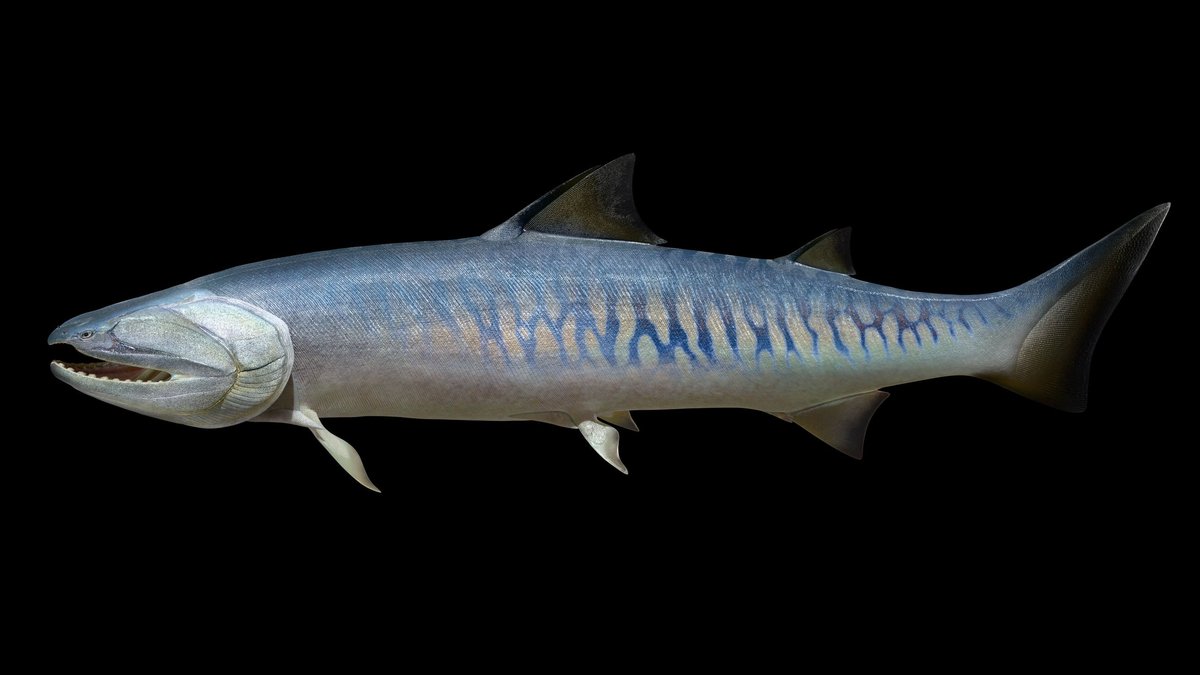
Megamastax amblyodus tells a different part of the same story. This fish lived around 423 million years ago in what is now Qujing, Yunnan. It could grow to more than 1 meter long, making it the largest known vertebrate from the Silurian period.
Earlier evidence from Megamastax had already made the animal significant. The newly studied material adds a fuller picture of the skull, jaws and internal anatomy. After years of work, the researchers used advanced imaging and 3D reconstruction to examine structures that had remained difficult to interpret.
The teeth of Megamastax are arranged in inner and outer rows, known as dental arcades. The inner row contains tooth cushions on blunt bases. According to the research summary, this arrangement represents a primitive form of bony fish dentition.
That finding helps solve a debate that had lasted more than half a century. Isolated tooth cushions from Silurian rocks in the Baltic region had puzzled researchers because their relationships were uncertain. The new Megamastax anatomy provides a framework for classifying those fossils.
Megamastax also shows that large body size had already appeared among early bony fish relatives by the Late Silurian. Paired with the much smaller Eosteus, it reveals a surprisingly broad range of early forms in South China’s ancient waters.
South China’s Role in Early Vertebrate Evolution
The fossils strengthen the view that South China was a major center for early vertebrate evolution. Xiushan in Chongqing and Qujing in Yunnan have yielded fossils that capture different stages of Silurian life. Together, they offer a rare regional record of early jawed vertebrates.
South China has been important in earlier discoveries as well. Fossils from the region have helped researchers study ancient jaws, skull bones and the early assembly of vertebrate body plans. The new Eosteus and Megamastax work adds more direct evidence for the origin of bony fishes.
The discoveries also show the value of long field campaigns. The research summary notes that the team spent more than ten years on fieldwork and laboratory analysis. Fossils this informative often emerge only after repeated collecting, careful preparation and patient imaging work.
In paleontology, location can shape what scientists are able to see. Some rocks preserve only fragments. Others preserve whole animals in enough detail to reveal relationships. The Chongqing Lagerstätte appears to have captured a rare window into the early Silurian.
South China’s fossil record now gives researchers a stronger basis for comparing early bony fishes with cartilaginous fishes, placoderms and later vertebrate groups. That broader comparison is essential for understanding how jaws and skeletons evolved.
What the Fossils Reveal About Our Deep Ancestry
The findings reach back to a time long before forests, dinosaurs, mammals, or humans. In the Silurian seas, small and large fishes were already carrying anatomical experiments that would shape later life. Some of those traits became part of the bony fish body plan. Others illuminate pathways that evolution later left behind.
Eosteus is especially valuable because it preserves an early body plan in miniature. Its combination of streamlined form, tail structures, missing fin rays and fin spine anatomy gives scientists a clearer view of what early bony fishes could look like before the major lineages separated.
Megamastax adds the larger, tooth-bearing side of the story. Its jaws and dental arcades help explain how early bony fish teeth were arranged. Its skull anatomy also gives researchers new characters for testing evolutionary relationships among Silurian jawed vertebrates.
The fossils do more than extend a timeline. They add anatomical evidence from a poorly known interval. That evidence helps bridge the gap between scattered early remains and the more familiar Devonian fishes that appear later in the fossil record.
For human ancestry, the connection is deep and indirect, yet meaningful. The lobe-finned branch of bony fishes eventually produced tetrapods. Every new fossil near the base of the bony fish tree helps refine the early stages of the lineage that led to vertebrate life on land.
The oldest bony fish skeleton now gives scientists a sharper starting point for that story. From a 3-centimeter fossil in South China, researchers can trace clues about jaws, teeth, fins and skulls across hundreds of millions of years.